


Chinese Nationalist Party (KMT) chairman-elect Wu Den-yih (吳敦義) yesterday questioned how plans to build light rail lines as part of the Cabinet’s Forward-looking Infrastructure Development Program would benefit the nation, while urging President Tsai Ing-wen’s (蔡英文) administration to convince the public of its policies rather than forcing them through the legislature.
Wu made the remarks on the sidelines of a meeting with KMT lawmakers in Taipei to discuss strategies to streamline efforts between the caucus and KMT think tank the National Policy Foundation in the hope of bolstering the caucus’ operations.
The Tsai administration should not skip the explanations for its policies just because of the disparity between the number of legislative seats held by the Democratic Progressive Party (DPP) and the KMT, Wu said.
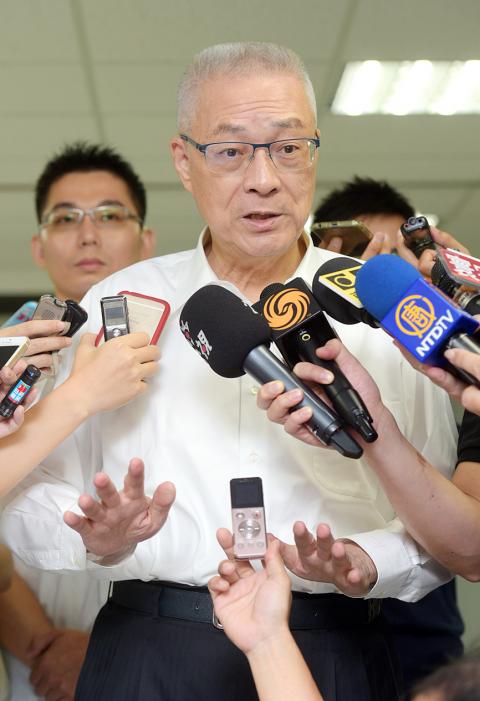
Photo: Chang Chia-ming, Taipei Times
The DPP has 68 legislative seats, while the KMT has 34.
“The policies pushed by the Tsai administration have drawn mounting public criticism, yet the DPP still forces them through,” Wu said. “If [the KMT] can make good sense [of why it opposes Tsai’s policies], the public would have a perfect understanding of our reasoning. We might be defeated in votes [at the legislature], but we would win public support.”
Wu also criticized the government’s plans to build light rail lines, questioning how much they would bolster the nation’s development.
Former national policy adviser Rex How (郝明義), former vice president Annette Lu (呂秀蓮), former Council for Economic Planning and Development chairman Chen Po-chih (陳博志) and former DPP legilsator Lin Cho-shui (林濁水) have all voiced objections to the plans, he added.
On plans to streamline efforts within the KMT, Wu said that after assuming office, he would propose a rule change that would make the KMT caucus whip the KMT Policy Committee director.
The KMT’s National Development Institute, which is responsible for cultivating young and female talent, must redouble its efforts, while the National Policy Foundation must not be content with just proposing theories, but must also conduct international research and planning, especially for issues that affect people’s daily lives, thereby formulating strategies to be employed by the caucus, he said.
For example, the foundation should collect information on whether other nations use rules governing private foundations when regulating temples and religious groups, and predict the DPP administration’s next move on managing such outfits, Wu said, in reference to a draft bill approved by the Executive Yuan last week that seeks to have temples and religious groups registered as “religious foundations,” thereby ensuring the transparency of their finances.
Asked whether former legislative speaker Wang Jyn-ping’s (王金平) absence from the meeting signaled that Wang had fallen out with him, Wu said that Wang had other items on his agenda and that KMT caucus whip Lin Te-fu (林德福) would make another appointment for Wu to meet with Wang.
Asked whether the KMT would consider nominating New Taipei City Mayor Eric Chu (朱立倫) to challenge Taipei Mayor Ko Wen-je (柯文哲) in next year’s local elections, Wu said: “I cannot make any comment on this.”
Wang, who was presiding over a Foundation of Fire Fighting Development meeting when Wu met with KMT lawmakers, rejected Wu’s invitation when asked whether he would meet with Wu.
“I have no such plans,” Wang said. “I do not know about the chairman.”

Actor Darren Wang (王大陸) was sentenced to six months in prison, commutable to a fine, by the New Taipei District Court today for contravening the Personal Data Protection Act (個人資料保護法) in a case linked to an alleged draft-dodging scheme. Wang allegedly paid NT$3.6 million (US$114,380) to an illegal group to help him evade mandatory military service through falsified medical documents, prosecutors said. He transferred the funds to Chen Chih-ming (陳志明), the alleged mastermind of a draft-evasion ring, although he lost contact with him as he was already in detention on fraud charges, they said. Chen is accused of helping a

SECURITY: Starlink owner Elon Musk has taken pro-Beijing positions, and allowing pro-China companies to control Taiwan’s critical infrastructure is risky, a legislator said Starlink was reluctant to offer services in Taiwan because of the nation’s extremely high penetration rates in 4G and 5G services, the Ministry of Digital Affairs said yesterday. The ministry made the comments at a meeting of the legislature’s Transportation Committee, which reviewed amendments to Article 36 of the Telecommunications Management Act (電信管理法). Article 36 bans foreigners from holding more than 49 percent of shares in public telecommunications networks, while shares foreigners directly and indirectly hold are also capped at 60 percent of the total, unless specified otherwise by law. The amendments, sponsored by Chinese Nationalist Party (KMT) Legislator Ko
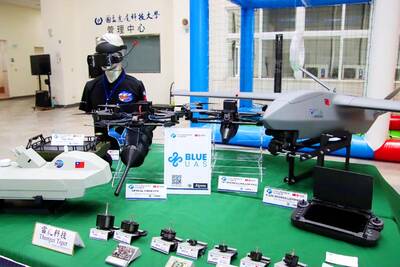
NON-RED SUPPLY: Boosting the nation’s drone industry is becoming increasingly urgent as China’s UAV dominance could become an issue in a crisis, an analyst said Taiwan’s drone exports to Europe grew 41.7-fold from 2024 to last year, with demand from Ukraine’s fight against Russian aggression the most likely driver of growth, a study showed. The Institute for Democracy, Society and Emerging Technology (DSET) in a statement on Wednesday said it found that many of Taiwan’s uncrewed aerial vehicle (UAV) sales were from Poland and the Czech Republic. These countries likely transferred the drones to Ukraine to aid it in its fight against the Russian invasion that started in 2022, it said. Despite the gains, Taiwan is not the dominant drone exporter to these markets, ranking second and fourth

The eastern extension of the Taipei MRT Red Line could begin operations as early as late June, the Taipei Department of Rapid Transit Systems said yesterday. Taipei Rapid Transit Corp said it is considering offering one month of free rides on the new section to mark its opening. Construction progress on the 1.4km extension, which is to run from the current terminal Xiangshan Station to a new eastern terminal, Guangci/Fengtian Temple Station, was 90.6 percent complete by the end of last month, the department said in a report to the Taipei City Council's Transportation Committee. While construction began in October 2016 with an


 RSS
RSS