


The government is mulling the establishment of a new car assessment program, the Ministry of Transportation and Communications (MOTC) said yesterday, adding that the Vehicle Safety Certification Center is assessing ways such a program might be enforced.
The ministry issued the statement after the brakes of a concrete pumping truck on Wednesday apparently failed while it was going down Yangmingshan’s (陽明山) Yangde Boulevard, causing it to crash into oncoming traffic, killing four people and injuring nine.
Following the accident, writer Huang Shao-bo (黃邵博) published an opinion piece in the Chinese-language Business Weekly accusing the ministry of not caring about people’s lives.
Huang said that other nations promulgate new car assessment programs to protect their consumers, but Taiwanese learn about the importance of vehicle safety by repeatedly conducting collision experiments “with their lives.”
The ministry said that Taiwan has had a vehicle safety inspection system since 1998, adding that the EU, Japan, Australia and other countries put into place similar regulations in the same year.
Since 2006, Taiwan has also fine-tuned its vehicle safety regulations so they are now in sync with those stipulated by the UN Economic Commissions for Europe, the ministry said.
In addition, Article 63 of the Highway Act (公路法) requires vehicles to pass safety certification tests before they can be registered, the ministry said, adding that small passenger vehicles must meet the standards set for 59 test items to pass.
The nation’s inspection standards for vehicle collision tests are based on the UN’s regulations on the protection of occupants in frontal or lateral collisions, the ministry said.
According to the ministry, the EU is to enforce regulations preventing fire risks caused by rear-end collisions as well as rules on the vehicle restraint system in frontal and side impacts, adding that the regulations would not be enforced until next year and 2020 respectively.
Taiwan also plans to implement similar regulations soon, the ministry said, adding that the date of enforcement would be announced after the Vehicle Safety Certification Center completes discussions on both types of regulations next month.
The European New Car Assessment Program (Euro-NCAP) and vehicle safety inspection system in the EU are completely different systems, the ministry said.
While the European Commission mandates that all cars in the EU pass safety inspections before they are licensed, the Euro-NCAP is an independent program backed by the EU, it said.
However, the Euro-NCAP is a voluntary vehicle safety rating system as the standards in the program are stricter than vehicle inspection criteria set by the European Commission, it said.
Therefore, the Euro-NCAP program is often used to evaluate some popular car types, the ministry said, adding that results of the evaluation are then converted into “star grades” that can be used by consumers as a reference.
The ministry said that the Euro-NCAP rating is only one of nine similar programs enforced around the world.
Should the nation choose to enforce the Euro-NCAP system, it would need to build a new laboratory to conduct the tests, the ministry said.
“We are working with the Vehicle Safety Certification Center to establish a new car assessment program, including the items to be tested, the agency to enforce the program and the source of funding,” the ministry said.
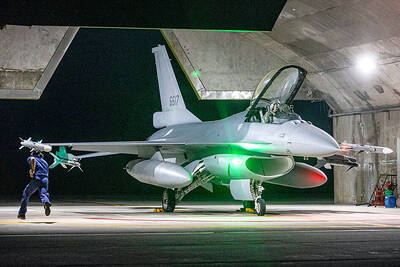
Taiwan has received more than US$70 million in royalties as of the end of last year from developing the F-16V jet as countries worldwide purchase or upgrade to this popular model, government and military officials said on Saturday. Taiwan funded the development of the F-16V jet and ended up the sole investor as other countries withdrew from the program. Now the F-16V is increasingly popular and countries must pay Taiwan a percentage in royalties when they purchase new F-16V aircraft or upgrade older F-16 models. The next five years are expected to be the peak for these royalties, with Taiwan potentially earning
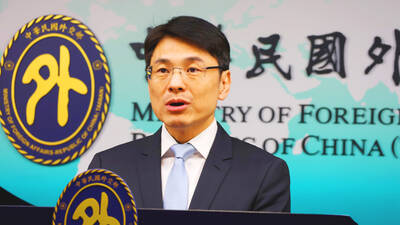
STAY IN YOUR LANE: As the US and Israel attack Iran, the ministry has warned China not to overstep by including Taiwanese citizens in its evacuation orders The Ministry of Foreign Affairs (MOFA) yesterday rebuked a statement by China’s embassy in Israel that it would evacuate Taiwanese holders of Chinese travel documents from Israel amid the latter’s escalating conflict with Iran. Tensions have risen across the Middle East in the wake of US and Israeli airstrikes on Iran beginning Saturday. China subsequently issued an evacuation notice for its citizens. In a news release, the Chinese embassy in Israel said holders of “Taiwan compatriot permits (台胞證)” issued to Taiwanese nationals by Chinese authorities for travel to China — could register for evacuation to Egypt. In Taipei, the ministry yesterday said Taiwan
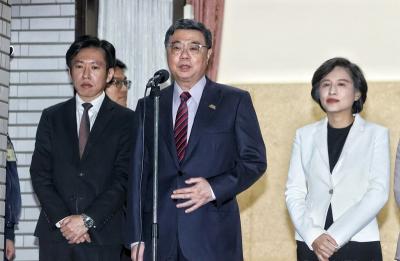
Taiwan is awaiting official notification from the US regarding the status of the Agreement on Reciprocal Trade (ART) after the US Supreme Court ruled US President Donald Trump's global tariffs unconstitutional. Speaking to reporters before a legislative hearing today, Premier Cho Jung-tai (卓榮泰) said that Taiwan's negotiation team remains focused on ensuring that the bilateral trade deal remains intact despite the legal challenge to Trump's tariff policy. "The US has pledged to notify its trade partners once the subsequent administrative and legal processes are finalized, and that certainly includes Taiwan," Cho said when asked about opposition parties’ doubts that the ART was
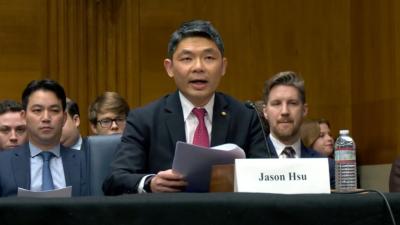
If China chose to invade Taiwan tomorrow, it would only have to sever three undersea fiber-optic cable clusters to cause a data blackout, Jason Hsu (許毓仁), a senior fellow at the Hudson Institute and former Chinese Nationalist Party (KMT) legislator, told a US security panel yesterday. In a Taiwan contingency, cable disruption would be one of the earliest preinvasion actions and the signal that escalation had begun, he said, adding that Taiwan’s current cable repair capabilities are insufficient. The US-China Economic and Security Review Commission (USCC) yesterday held a hearing on US-China Competition Under the Sea, with Hsu speaking on


 RSS
RSS