

A cross-committee budget review of the Cabinet’s proposed Forward-looking Infrastructure Development Program was thrown into disarray at the legislature yesterday as Democratic Progressive Party (DPP) and Chinese Nationalist Party (KMT) lawmakers clashed over who should chair the meeting.
The meeting was presided over by the Cabinet’s Finance Committee, of which KMT Legislator Luo Ming-tsai (羅明才) and DPP Legislator Wang Jung-chang (王榮璋) are conveners.
On Monday, when the review began, the KMT caucus sought to have Luo chair the session, but later said that Wang could take the role.
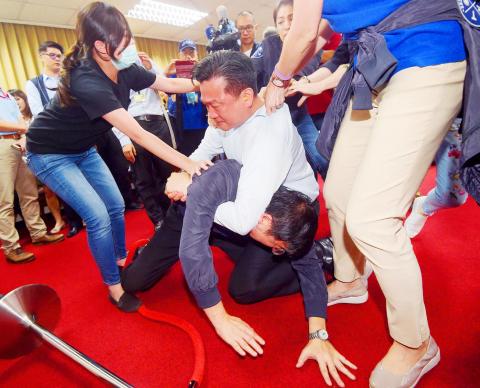
Photo: Huang Yao-cheng, Taipei Times
However, KMT lawmakers yesterday said that Luo must chair the meeting, entering the venue shouting: “Here comes the chairman.”
They occupied the chairperson’s podium, triggering an altercation with DPP lawmakers.
Male lawmakers of both parties shoved and tackled one another, while female legislators tried to edge opposing lawmakers off the podium that was to be used by Executive Yuan officials during a legislative question-and-answer session before the meeting.
DPP lawmakers secured the podium, but the KMT occupied the two podiums for lawmakers and officials.
Each side accused the other of using violence, while the KMT said that the DPP had made an illegal, unilateral decision that Wang should chair the meeting.
When the room settled, Luo showed written agreements from cross-caucus negotiations in March that said he and Wang had the right to schedule and chair committee reviews.
He and Wang should take turns as chairman, Luo said.
Wang announced the start of the session, but Luo sought to take over as chairman, making announcements throughout the meeting using a microphone the KMT caucus had prepared.
The proceedings again descended into conflict when DPP Legislator Karen Yu (余宛如), the first lawmaker to speak, was at the legislators’ podium.
KMT caucus whip Lin Te-fu (林德福) attempted to take over the podium while Yu was speaking, but he was dismissed by DPP Legislator Chao Tien-lin (趙天麟).
KMT Legislator Chen Ming-wen (陳明文) wrestled with DPP Legislator Hsu Yu-jen (許毓仁), who sustained a minor injury.
KMT Legislator Alex Fai (費鴻泰) climbed onto a desk and disabled one of the loudspeakers in an attempt to silence DPP announcements.
New Power Party (NPP) Executive Chairman Huang Kuo-chang (黃國昌) said that he should be given time to question officials, calling Minister of Transportation and Communications Hochen Tan (賀陳旦), Minister of Education Pan Wen-chung (潘文忠) and Minister of Health and Welfare Chen Shih-chung (陳時中) to the podium.
Seeing the podium had been occupied, Wang declined Huang’s demand.
Huang said he must be allowed to press Premier Lin Chuan (林全) to “own up to the mistakes” the Cabinet made preparing the budget for the program and that Lin should explain the Executive Yuan’s debt repayment plan for the program, the first stage of which has its budget capped at NT$420 billion (US$13.83 billion) over four years.
KMT Legislator Lai Shyh-bao (賴士葆) said that despite repeated KMT demands, the Executive Yuan refused to revise the program and its budget proposals, because the “pork barrels” the DPP administration had doled out to local governments were worth NT$882.49 billion — the budget proposed by the DPP when it first unveiled the program — rather than NT$420 billion.
The NPP caucus accused KMT legislators of pursuing a “disguised shielding” of the infrastructure plans using legislative boycotts that have interfered with question-and-answer sessions.
“Even if they are wearing the skin of a boycott, the result is a shielding of the plans, because [the KMT’s tactics] guarantee that government officials and those who have written the plans will not face questions from legislators,” NPP Legislator Freddy Lim (林昶佐) said.
As for today’s cross-committee review, KMT caucus secretary-general Lin Wei-chou (林為洲) said that as the KMT does not acknowledge the legitimacy of Wang as chairman, it would continue with its obstruction tactics.
Additional reporting by Abraham Gerber
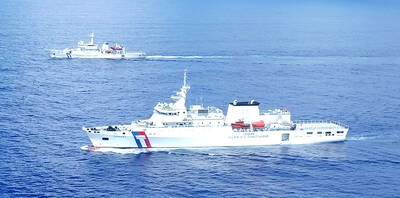
‘FRIENDSHIP FLEET’: A CGA official is scheduled to meet with the president of the Pacific nation, while one of the ships is to host a banquet and National Day event Two Coast Guard Administration (CGA) patrol vessels have docked at Malakal Harbor in Palau as part of an expedition exercise and diplomatic visit, during which a senior official is expected to meet with Palauan President Surangel Whipps Jr, the agency said yesterday. The two vessels, the 4,000-tonne-class Chiayi and the 1,000-tonne-class Penghu, set sail for Palau from Taiwan last week and arrived on Tuesday at Malakal Harbor, the CGA’s Fleet Branch said in a statement. The journey marks the second time the CGA has dispatched a “friendship fleet” to another country, after it sent its first-ever goodwill fleet, comprising the Hualien and
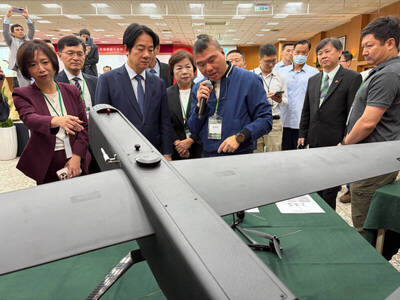
Two executives of drone supplier Jiin Ming Industry Co (錦明實業) have been detained and held incommunicado over the company's alleged use of prohibited China-made chips and camera lenses in drones supplied under recent military contracts, the Taoyuan District Prosecutors' Office said today. In a statement, prosecutors said they raided the offices of Jiin Ming — headquartered in Taoyuan — as well as those of its subsidiaries and its suppliers on Thursday last week. The raids followed a report that the company had breached its procurement contracts by putting the prohibited components into drones delivered to the military. During the raids, prosecutors summoned
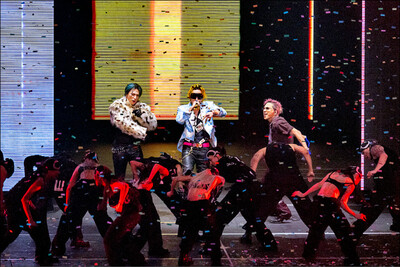
South Korean boy band BigBang drew 120,000 fans to three concerts at Taipei Dome from Friday through yesterday, as the band thanked them for their support over their 20-year career. The Taipei Dome concerts were part of BigBang's "2026-2027 World Tour XX: Cosmos." Friday's concert was BigBang's first performance in Taiwan in 11 years. During the encore, group leader G-Dragon (GD) shouted "I love you" in Chinese and said he was especially happy to perform in Taiwan with bandmates Taeyang and Daesung. "Taipei, I'm very grateful to you all," GD said in Chinese, asking fans to wait for the band's return. Daesung thanked
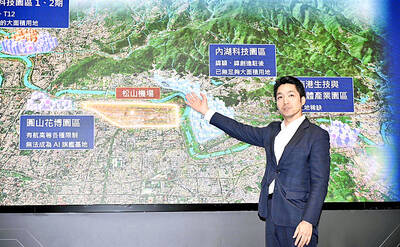
DETAILED PLAN NEEDED: Relocating the airport would affect not just travelers, but also undermine national defense and emergency medical services, a legislator said Taipei Mayor Chiang Wan-an (蔣萬安) yesterday proposed relocating Taipei International Airport (Songshan airport) and turning the site into an artificial intelligence (AI) park, drawing opposition from politicians across party lines. Chiang’s plan would turn the 300 hectares into an AI park featuring tech clusters, residential communities and green space. The industrial cluster would host 200 domestic enterprises, generate NT$12 trillion (US$376.47 billion) in output, and accommodate 65,000 jobs and 35,000 residents, he said. Cabinet spokeswoman Michelle Lee (李慧芝) said the Executive Yuan was surprised by the announcement, as the Taipei City Government did not discuss the proposal with the central government before making


 RSS
RSS