


About 1,500 Falun Gong practitioners yesterday marched in Taipei to commemorate fellow members persecuted by the Chinese Communist Party (CCP) since July 1999.
Falun Gong is a school of Chinese qigong that incorporates tenets of Buddhism founded by Li Hongzhi (李洪志) in China in 1992.
The march marks the 18th anniversary of China’s suppression of Falun Gong practitioners in 1999.

Photo: David Chang, EPA
There are about 700,000 Falun Gong practitioners in Taiwan and about 100 million worldwide, Falun Gong Human Rights attorney group spokesperson Chu Wan-chi (朱婉琪) said.
China’s persecution of the practitioners could be compared with the genocide committed by German Nazis during the World War II, she added.
At about 3:30pm, protesters wearing yellow shirts gathered at Taipei City Hall before marching to Taipei 101 and back to the city hall.
They held banners that read: “CCP is not equal to China,” “Stop forced live organ harvesting in China” and “Prosecute the culprit [former Chinese president] Jiang Zemin (江澤民),” among others.
After marching back to city hall at about 6pm, the protesters sat down in front of the hall and practiced a 10-minute meditation before the ceremony started.
“If China is to embrace democracy, it can never ignore the [persecution] of Falun Gong,” Chu said.
She urged Chinese President Xi Jinping (習近平) to prosecute Jiang who had ordered the brutal suppression of Falun Gong practitioners on July 20, 1999, and to close the nation’s 610 Office that is tasked with suppressing them.
She also called on Xi to reveal data relating to Falun Gong persecution since 1991 and to end the CCP’s authoritarian rule by allowing people to enjoy religious and expressive freedoms.
Falun Gong lawyers in Hong Kong and Taiwan in 2015 initiated a petition calling for prosecution of Jiang, which has garnered more than 2.4 million signatures worldwide, Chu said.
“As seen in the cases of Taiwanese human rights advocate Lee Ming-che (李明哲), late Nobel Peace Prize laureate Liu Xiaobo (劉曉波) and the four ousted Hong Kong councilors, China’s strength might be contingent upon its suppression of human rights,” Taipei City Councilor Lee Ching-feng (李慶鋒) said.
University of South Carolina Aiken associate professor Frank Tian Xie (謝田) said he has practiced Falun Gong for 20 years, and it has helped him cultivate a higher sense of morality through its principles of truthfulness, benevolence and forbearance.
Last year, he started a Falun Gong class at the university with about 30 students, he said, adding that it is expected to continue.
The gathering ended with a candlelight service accompanied by music.

SECURITY: Starlink owner Elon Musk has taken pro-Beijing positions, and allowing pro-China companies to control Taiwan’s critical infrastructure is risky, a legislator said Starlink was reluctant to offer services in Taiwan because of the nation’s extremely high penetration rates in 4G and 5G services, the Ministry of Digital Affairs said yesterday. The ministry made the comments at a meeting of the legislature’s Transportation Committee, which reviewed amendments to Article 36 of the Telecommunications Management Act (電信管理法). Article 36 bans foreigners from holding more than 49 percent of shares in public telecommunications networks, while shares foreigners directly and indirectly hold are also capped at 60 percent of the total, unless specified otherwise by law. The amendments, sponsored by Chinese Nationalist Party (KMT) Legislator Ko

The eastern extension of the Taipei MRT Red Line could begin operations as early as late June, the Taipei Department of Rapid Transit Systems said yesterday. Taipei Rapid Transit Corp said it is considering offering one month of free rides on the new section to mark its opening. Construction progress on the 1.4km extension, which is to run from the current terminal Xiangshan Station to a new eastern terminal, Guangci/Fengtian Temple Station, was 90.6 percent complete by the end of last month, the department said in a report to the Taipei City Council's Transportation Committee. While construction began in October 2016 with an

The military has spotted two Chinese warships operating in waters near Penghu County in the Taiwan Strait and sent its own naval and air forces to monitor the vessels, the Ministry of National Defense (MND) said. Beijing sends warships and warplanes into the waters and skies around Taiwan on an almost daily basis, drawing condemnation from Taipei. While the ministry offers daily updates on the locations of Chinese military aircraft, it only rarely gives details of where Chinese warships are operating, generally only when it detects aircraft carriers, as happened last week. A Chinese destroyer and a frigate entered waters to the southwest
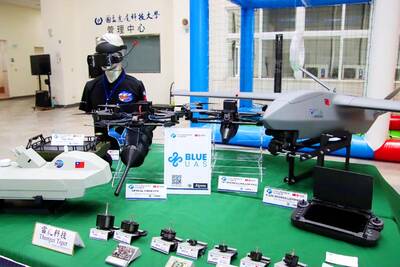
NON-RED SUPPLY: Boosting the nation’s drone industry is becoming increasingly urgent as China’s UAV dominance could become an issue in a crisis, an analyst said Taiwan’s drone exports to Europe grew 41.7-fold from 2024 to last year, with demand from Ukraine’s fight against Russian aggression the most likely driver of growth, a study showed. The Institute for Democracy, Society and Emerging Technology (DSET) in a statement on Wednesday said it found that many of Taiwan’s uncrewed aerial vehicle (UAV) sales were from Poland and the Czech Republic. These countries likely transferred the drones to Ukraine to aid it in its fight against the Russian invasion that started in 2022, it said. Despite the gains, Taiwan is not the dominant drone exporter to these markets, ranking second and fourth


 RSS
RSS