


A planned review of the Forward-looking Infrastructure Development Program budget yesterday drew conflicting reactions from civic groups, with one environmental group calling for additional funding even as others called for the review to be postponed or stopped.
“The current budget is insufficient, because it does not include any funds for a ‘blue road’ coastal ferry service and the first stage does not include the doubling of railway on the eastern coast,” Taiwan Environmental Protection Union chairman Liou Gin-show (劉俊秀) told a news conference, calling infrastructure development plans for eastern counties “far too slow.”
“Plans to develop MRT and light rail systems in western cities such as Hsinchu, Tainan and Kaohsiung can be slowed down a bit, because residents need to get used to using public transportation first,” Liou said. “However, rail development on the east coast is extremely urgent, because there is no way to get to most places other than driving.”
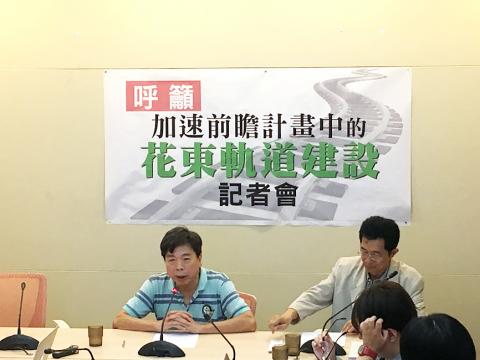
Photo: Cheng Hung-ta, Taipei Times
There has been opposition to a proposal to expand eastern coastal highways following the temporary closure of the Suhua Highway due to a landslide in May, with some calling for an expanded rail line complemented by new bus and ferry services, he said.
“We oppose expanding the Suhua Highway, because that area is not suited to road building, as evidenced by numerous landslides. While the road should still be kept open, government policy should be to reduce usage as much as possible,” Liou said.
Alternate proposals include a new toll system, the addition of a parallel set of rails along the east coast and electrifying the South-Link Line (南迴鐵路), he added.
“Failure to include a parallel set of rails for the east coast in the first stage of government infrastructure plans is a mistake, because the region’s residents are clustered along a long, narrow corridor and the railway has the potential to work like an MRT system,” Liou said, adding that the limitation of a single set of tracks has prevented widespread use of frequent “local train” services available in western areas.
Small or medium buses based at rail stations should be used to expand the availability of public transportation from stations to nearby “zones,” he said, adding that a regular ferry service along the east coast would enable the transportation system to better cope with earthquakes and typhoons, which can lead to extended closures.
However, at a separate news conference, Citizen’s Congress Watch blasted the legislature for prioritizing the special budget for the program over the overdue regular budget for state-owned enterprises.
“This fiscal year’s regular budget for state-owned enterprises has yet to be passed, even though it encompasses more than NT$5 trillion [US$164.6 billion], while the forward-looking program’s budget is only a little more than NT$400 million over four years,” Citizen’s Congress Watch executive director Chang Hung-lin (張宏林) said, adding that failing to address the state-run enterprises budget during an extraordinary legislative session would likely ensure that its passage is delayed until November, a full year past its legal deadline for passage.
State-owned firms operate based on the parameters of the most recently passed fiscal budget if a new budget is not approved by the legal deadline, a common occurrence over the past few years.
“If the Democratic Progressive Party is serious about economic and infrastructure development, it should not ignore new plans in the state-owned enterprises budget,” Chang said. “For example, Taiwan Power Co has plans to promote renewable energy, but the government is setting them aside to pass ‘special’ budgets to promote renewable energy — what sense does that make?”
As committee review of the state-owned enterprises budget has already been completed, review could begin immediately at the extraordinary legislative session, Citizen’s Congress Watch department of policy director Allen Tian (田君陽) said.
He condemned calls for the Legislative Yuan to add funds to the program’s budget, saying that would violate the separation of powers, citing constitutional provisions limiting the legislature’s power to cut funds from budgets proposed by the Executive Yuan.

Taiwanese can file complaints with the Tourism Administration to report travel agencies if their activities caused termination of a person’s citizenship, Mainland Affairs Council Minister Chiu Chui-cheng (邱垂正) said yesterday, after a podcaster highlighted a case in which a person’s citizenship was canceled for receiving a single-use Chinese passport to enter Russia. The council is aware of incidents in which people who signed up through Chinese travel agencies for tours of Russia were told they could obtain Russian visas and fast-track border clearance, Chiu told reporters on the sidelines of an event in Taipei. However, the travel agencies actually applied

Japanese footwear brand Onitsuka Tiger today issued a public apology and said it has suspended an employee amid allegations that the staff member discriminated against a Vietnamese customer at its Taipei 101 store. Posting on the social media platform Threads yesterday, a user said that an employee at the store said that “those shoes are very expensive” when her friend, who is a migrant worker from Vietnam, asked for assistance. The employee then ignored her until she asked again, to which she replied: "We don't have a size 37." The post had amassed nearly 26,000 likes and 916 comments as of this

New measures aimed at making Taiwan more attractive to foreign professionals came into effect this month, the National Development Council said yesterday. Among the changes, international students at Taiwanese universities would be able to work in Taiwan without a work permit in the two years after they graduate, explainer materials provided by the council said. In addition, foreign nationals who graduated from one of the world’s top 200 universities within the past five years can also apply for a two-year open work permit. Previously, those graduates would have needed to apply for a work permit using point-based criteria or have a Taiwanese company
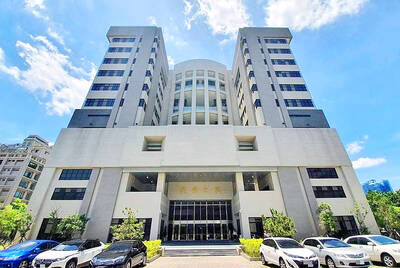
The Shilin District Prosecutors’ Office yesterday indicted two Taiwanese and issued a wanted notice for Pete Liu (劉作虎), founder of Shenzhen-based smartphone manufacturer OnePlus Technology Co (萬普拉斯科技), for allegedly contravening the Act Governing Relations Between the People of the Taiwan Area and the Mainland Area (臺灣地區與大陸地區人民關係條例) by poaching 70 engineers in Taiwan. Liu allegedly traveled to Taiwan at the end of 2014 and met with a Taiwanese man surnamed Lin (林) to discuss establishing a mobile software research and development (R&D) team in Taiwan, prosecutors said. Without approval from the government, Lin, following Liu’s instructions, recruited more than 70 software


 RSS
RSS