


One physician is calling on the government to combat low birth rates, saying the situation is worsening.
Taiwan Association of Obstetrics and Gynecology secretary-general Huang Min-chao (黃閔照) said this year is on track to be the second-worst for births since the economic crisis of nearly 10 years ago, citing a monthly average of 15,000 in the first six months.
Roughly 300,000 babies per year were born in Taiwan in the 1980s and 1990s, but the number fell to 260,354 in 2001 and to 227,070 in 2003 and it has never recovered, leaving the nation with one of the world’s lowest birth rates at fewer than 10 per 1,000 people.
Since 2012 there have usually been more than 200,000 births per year, or roughly 17,000 per month, but the total might be well below 200,000 this year, Huang said.
So far this year, monthly births are 70 percent of what they were last year, Huang said.
The worst year to date for new births was 2010 following the economic crisis two years before, he said, adding that in 2010 there were only about 13,000 births per month, or an annual total of about 160,000.
The low birth rate means the population will gradually decrease, putting major stress on economic development and society, Huang said.
For example, each working-age person would have to support more retirees as the nation ages, he said.
A Ministry of Health and Welfare task force to deal with the issue met on Monday.
It said that the issue should be tackled as part of the government’s Forward-looking Infrastructure Development Program.
National Taiwan University professor James Hsueh (薛承泰) said that in Taiwan the birth rate is closely tied to marriage.
Only 4 percent of couples have children out of wedlock, Hsueh said, adding that the declining birth rate is likely connected with the declining number of marriages registered since last year.
The economy and unstable politics are also contributing factors, he said, adding that addressing the declining birth rate does not necessarily mean the government needs to spend large amounts of money.
However, the issue does need to be prioritized, he said.
Former minister of health and welfare Lin Tzou-yien (林奏延) said that the issue should be addressed quickly so that it does not affect government departments.
The issue is more critical than pension reform and long-term care, Lin said.
The solution would require integration of government resources to improve public childcare facilities, raise the salaries of young adults and provide more social housing so that young people are more willing to get married and have children, he said.
“The government must show that it is resolutely determined to improve the situation and find a solution. If not, the birth rate crisis is going to have a terrible effect on the population structure of the nation,” he said.
Additional reporting by CNA
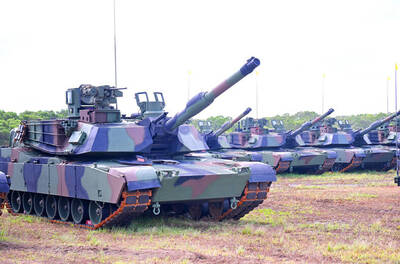
The manufacture of the remaining 28 M1A2T Abrams tanks Taiwan purchased from the US has recently been completed, and they are expected to be delivered within the next one to two months, a source said yesterday. The Ministry of National Defense is arranging cargo ships to transport the tanks to Taiwan as soon as possible, said the source, who is familiar with the matter. The estimated arrival time ranges from late this month to early next month, the source said. The 28 Abrams tanks make up the third and final batch of a total of 108 tanks, valued at about NT$40.5 billion

Two Taiwanese prosecutors were questioned by Chinese security personnel at their hotel during a trip to China’s Henan Province this month, the Mainland Affairs Council (MAC) said yesterday. The officers had personal information on the prosecutors, including “when they were assigned to their posts, their work locations and job titles,” MAC Deputy Minister and spokesman Liang Wen-chieh (梁文傑) said. On top of asking about their agencies and positions, the officers also questioned the prosecutors about the Cross-Strait Joint Crime-Fighting and Judicial Mutual Assistance Agreement, a pact that serves as the framework for Taiwan-China cooperation on combating crime and providing judicial assistance, Liang
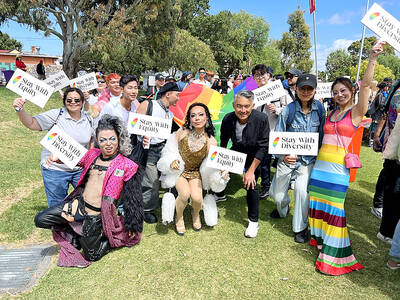
A group from the Taiwanese Designers in Australia association yesterday represented Taiwan at the Midsumma Pride March in Melbourne. The march, held in the St. Kilda suburb, is the city’s largest LGBTQIA+ parade and the flagship event of the annual Midsumma Festival. It attracted more than 45,000 spectators who supported the 400 groups and 10,000 marchers that participated this year, the association said. Taiwanese Designers said they organized a team to march for Taiwan this year, joining politicians, government agencies, professionals and community organizations in showing support for LGBTQIA+ people and diverse communities. As the first country in Asia to legalize same-sex
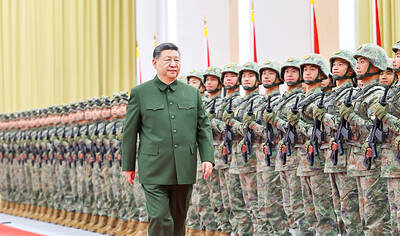
MOTIVES QUESTIONED The PLA considers Xi’s policies toward Taiwan to be driven by personal considerations rather than military assessment, the Epoch Times reports Chinese President Xi Jinping’s (習近平) latest purge of the Chinese People’s Liberation Army (PLA) leadership might have been prompted by the military’s opposition to plans of invading Taiwan, the Epoch Times said. The Chinese military opposes waging war against Taiwan by a large consensus, putting it at odds with Xi’s vision, the Falun Gong-affiliated daily said in a report on Thursday, citing anonymous sources with insight into the PLA’s inner workings. The opposition is not the opinion of a few generals, but a widely shared view among the PLA cadre, the Epoch Times cited them as saying. “Chinese forces know full well that


 RSS
RSS