


The Cabinet yesterday denied reports that taxpayers would have to foot a NT$283 billion (US$9.33 billion) bill to shutter the Fourth Nuclear Power Plant, saying that the government is still evaluating how to deal with the mothballed plant.
Chinese-language media reports said that each household might have to pay NT$5,600 and every industrial user NT$7.58 million to compensate for the costs incurred in the construction and maintenance of the facility in Gongliao District (貢寮), New Taipei City.
According to the reports, Minister of Economic Affairs Lee Chih-kung (李世光) approved a proposal to require households and businesses to foot the bill as the government could not afford the expense given its push for the NT$882.49 billion Forward-looking Infrastructure Development Program.
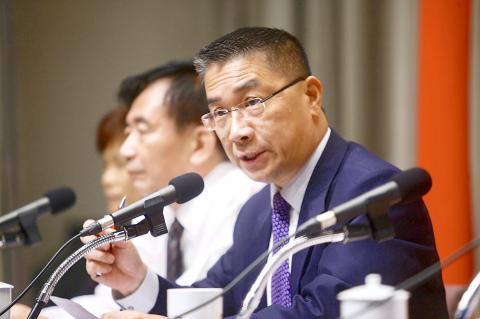
Photo: CNA
Executive Yuan spokesman Hsu Kuo-yung (徐國勇) yesterday rejected the reports, saying that the Cabinet is still evaluating possibilities for the plant, such as selling the generator systems to foreign buyers or refitting the plant for other purposes.
The Cabinet has not reached any conclusion, and the budgets for the infrastructure program and the nuclear plant are different, as one is a special budget and the other a management fund, so there is no causal relation between them, the spokesman said.
“The Basic Environment Act (環境基本法) stipulates that plans should be made to make the nation nuclear-free, so the Fourth Nuclear Power Plant is not going to be activated and the government will not extend the operational lifespan of the three other nuclear power plants,” Hsu said.
The Gongliao plant has been sealed since April 2014.
The Democratic Progressive Party (DPP) has vowed to close it permanently as the party is committed to a nuclear-free Taiwan.
Taiwan Power Co is looking for buyers and evaluating the possibility of transforming the facility into a fossil fuel power station, the Bureau of Energy said.
Although environmental groups have urged the permanent closure of the plant, the government would seek to recycle part of it, DPP Legislator Huang Wei-cher (黃偉哲) said.
It would be unfair if the cost were transferred to the public, Chinese Nationalist Party (KMT) Legislator Lee Yen-hsiu (李彥秀) said.
“It was the DPP’s arbitrary decision to appropriate the special budget for the Forward-looking Infrastructure Development Program,” Lee said.
The DPP has swindled voters with its “nuclear-free home” policy, as rather than sealing or abolishing the plant, it now wants to transform it and is considering having the public pay the cost, Lee said.
“The nation’s energy options require more careful deliberation. The DPP … should give the public a clear explanation if it wants them to pay the bill,” she said.
Additional reporting by Sean Lin
Beijing could eventually see a full amphibious invasion of Taiwan as the only "prudent" way to bring about unification, the US Department of Defense said in a newly released annual report to Congress. The Pentagon's "Annual Report to Congress: Military and Security Developments Involving the People's Republic of China 2025," was in many ways similar to last year’s report but reorganized the analysis of the options China has to take over Taiwan. Generally, according to the report, Chinese leaders view the People's Liberation Army's (PLA) capabilities for a Taiwan campaign as improving, but they remain uncertain about its readiness to successfully seize

Taiwan is getting a day off on Christmas for the first time in 25 years. The change comes after opposition parties passed a law earlier this year to add or restore five public holidays, including Constitution Day, which falls on today, Dec. 25. The day marks the 1947 adoption of the constitution of the Republic of China, as the government in Taipei is formally known. Back then the Chinese Nationalist Party (KMT) governed China from Nanjing. When the KMT, now an opposition party in Taiwan, passed the legislation on holidays, it said that they would help “commemorate the history of national development.” That

Taiwan has overtaken South Korea this year in per capita income for the first time in 23 years, IMF data showed. Per capita income is a nation’s GDP divided by the total population, used to compare average wealth levels across countries. Taiwan also beat Japan this year on per capita income, after surpassing it for the first time last year, US magazine Newsweek reported yesterday. Across Asia, Taiwan ranked fourth for per capita income at US$37,827 this year due to sustained economic growth, the report said. In the top three spots were Singapore, Macau and Hong Kong, it said. South

Snow fell on Yushan (Jade Mountain, 玉山) yesterday morning as a continental cold air mass sent temperatures below freezing on Taiwan’s tallest peak, the Central Weather Administration (CWA) said. Snowflakes were seen on Yushan’s north peak from 6:28am to 6:38am, but they did not fully cover the ground and no accumulation was recorded, the CWA said. As of 7:42am, the lowest temperature recorded across Taiwan was minus-5.5°C at Yushan’s Fengkou observatory and minus-4.7°C at the Yushan observatory, CWA data showed. On Hehuanshan (合歡山) in Nantou County, a low of 1.3°C was recorded at 6:39pm, when ice pellets fell at Songsyue Lodge (松雪樓), a


 RSS
RSS