


Liberty Times (LT): As the first minister-without-portfolio specifically tasked with digital affairs, can you elaborate on what you intended to achieve when you took the job?
Audrey Tang (唐鳳): The position of minister-without-portfolio for digital affairs means that it is not just a one-person job and that everyone can, through digital systems and technology, help resolve governmental affairs.
We have made public on the PDIS.tw Web site our visits with those who are interested in sharing their views and each meeting the government has held. We hope to better integrate the collective wisdom and strengths of the people to help the government.
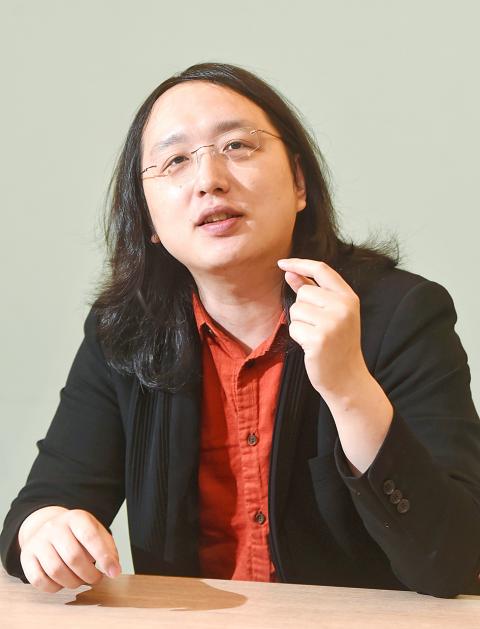
Photo: Fang Pin-chao, Taipei Times
LT: You have always been a supporter of an “open government.” What are your goals for establishing digital information management to that end?
Tang: The goal of digital management is to digitize all executive affairs. If everything is on paper it sits on desks or the computers of the people working on the file, which makes it impossible to render transparent. Therefore, the next step is to share the data on which we base our decisions in a transparent manner.
Next is the matter of accountability. For every opinion that is raised, for everything that happens in each stage, we must have the same response.
Last is inclusiveness, which allows everyone to participate and not just those who are knowledgeable in code or law.
LT: You are an avid user of the Internet, though which you are connected to global trends. How can Taiwan’s policies, or hardware construction, on digital information policies keep up with such trends?
Tang: In terms of “keeping abreast of trends,” I would say that we should not consider competitiveness as a competition with others, but rather as point of comparison with what we want to do and what we are capable of.
In terms of policy, the draft regulations on innovative financial technological experimentation, the draft act on digital communication and media, and the draft act on recruiting and hiring professional foreigners are all policies that have emerged under the joint discussion of those who would benefit from the passage of the laws. We hope that should these laws be implemented, it would help enable innovation in Taiwan.
In terms of infrastructure, the majority have considered issues on informational security, digital equality, transparent content, common service portals and machine collaborations important. Therefore, under the proposed Forward-looking Infrastructure Development Program, we have allocated funding of a four-year program to build infrastructure for those issues.
LT: How would governmental services transition into a digital format? How would such policies reach and influence the public?
Tang: Take the Taiwan High Speed Rail iTaiwan free Wi-Fi connection for example. It has been installed in 177 carriages and just last week was used by more than 10,000 people. More carriages are to be outfitted with such services.
I think that for the public to feel that something is done, they would have to raise the issues that they feel must be changed. Therefore, people should make their ideas known through online participation on public policies forums. Then they could actually see and discuss what is being changed.
LT: The Internet speed in Taiwan has fallen behind that of South Korea and Japan, while the coverage of Wi-Fi services in metropolises cannot compare with China. Were it not for this year’s Universiade, the issue of information “blind corners” on the Taiwan High Speed Rail would not have been addressed. Do you feel this is too slow a process?
Tang: I have always thought that if the value of thing is established on comparison, then we are forever helpless, because there will always be instability.
The crux is what kind of services everyone hopes to have and how such services are provided by different sectors. If broadband reception is something we feel is important, than it should be gradually implemented, regardless of whether it is in urban or rural areas. This, like information security, is very basic in terms of digital infrastructure.
LT: It has been almost a year since you accepted your position. From your observations, what digital advantages does Taiwan have and how long can they continue to be in the lead? Are there any issues that the government knows should be addressed, but cannot afford to?
Tang: Taiwan has had ample experience in the integration and use of the Internet, whether among society or private corporations. Such an advantage can be used in cross-sector integration.
In practice, even if people do not trust the government, the government should trust the people. Under such a premise, we will gradually make transparent the information on which we base our policy decisions and implementation for discussion among the public. Only then can we achieve consensus.
Translated by staff writer Jake Chung

The military has spotted two Chinese warships operating in waters near Penghu County in the Taiwan Strait and sent its own naval and air forces to monitor the vessels, the Ministry of National Defense (MND) said. Beijing sends warships and warplanes into the waters and skies around Taiwan on an almost daily basis, drawing condemnation from Taipei. While the ministry offers daily updates on the locations of Chinese military aircraft, it only rarely gives details of where Chinese warships are operating, generally only when it detects aircraft carriers, as happened last week. A Chinese destroyer and a frigate entered waters to the southwest

A magnitude 6.1 earthquake struck off the coast of Yilan County at 8:39pm tonight, the Central Weather Administration (CWA) said, with no immediate reports of damage or injuries. The epicenter was 38.7km east-northeast of Yilan County Hall at a focal depth of 98.3km, the CWA’s Seismological Center said. The quake’s maximum intensity, which gauges the actual physical effect of a seismic event, was a level 4 on Taiwan’s 7-tier intensity scale, the center said. That intensity level was recorded in Yilan County’s Nanao Township (南澳), Hsinchu County’s Guansi Township (關西), Nantou County’s Hehuanshan (合歡山) and Hualien County’s Yanliao (鹽寮). An intensity of 3 was
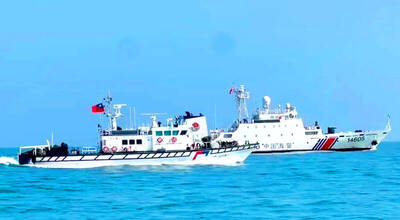
Instead of focusing solely on the threat of a full-scale military invasion, the US and its allies must prepare for a potential Chinese “quarantine” of Taiwan enforced through customs inspections, Stanford University Hoover fellow Eyck Freymann said in a Foreign Affairs article published on Wednesday. China could use various “gray zone” tactics in “reconfiguring the regional and ultimately the global economic order without a war,” said Freymann, who is also a nonresident research fellow at the US Naval War College. China might seize control of Taiwan’s links to the outside world by requiring all flights and ships entering or leaving Taiwan
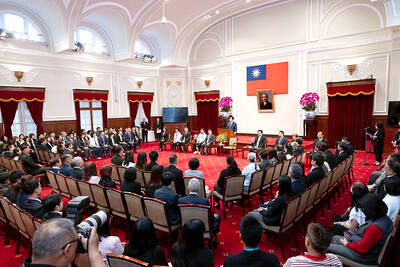
The next minimum wage hike is expected to exceed NT$30,000, President William Lai (賴清德) said yesterday during an award ceremony honoring “model workers,” including migrant workers, at the Presidential Office ahead of Workers’ Day today. Lai said he wished to thank the awardees on behalf of the nation and extend his most sincere respect for their hard work, on which Taiwan’s prosperity has been built. Lai specifically thanked 10 migrant workers selected for the award, saying that although they left their home countries to further their own goals, their efforts have benefited Taiwan as well. The nation’s industrial sector and small businesses lay


 RSS
RSS