


The Presidential Office’s pension reform committee has revised a statement that said retired military personnel protesting pension reform had agreed to leave the streets and return to the negotiating table, after the claim was rejected by retired lieutenant general Wu Sz-huai (吳斯懷), one of the spokespeople for the protesters camped outside the Legislative Yuan in Taipei.
The committee released the initial statement yesterday morning, with the title saying that a group of retired military personnel protesting the government’s pension reform proposal “decided to leave the street and return to the meeting table.”
Five retired generals, including Wu — who had been camped outside the Legislative Yuan alongside a group of protesters — on Thursday visited committee deputy convener and chief executive Lin Wan-yi (林萬億) accompanied by Democratic Progressive Party Legislator and Foreign and National Defense Committee convener Wang Ding-yu (王定宇).
Wu told the media that the statement’s title was misleading and it was “extremely inappropriate” for the committee to have reached the conclusion that the protesters agreed to leave the streets.
The committee’s action would only make communication more difficult, Wu said.
The committee later released a revised statement, removing the sentences that said the protesters would decamp.
The statement said the retired generals were “furious” over how the media, the Internet and political talk shows have been portraying military personnel, civil servants and public teachers since pension reform started.
However, the retired generals “gave credit to the Executive Yuan’s pension reform office in reiterating to the public that pension reform is for reforming the institution rather than targeting particular occupational groups,” the statement said.
It quoted the retired generals as saying that as military personnel who had vowed to protect the nation, it is not possible for them to deliberately cause social unrest, adding that they have also been assuaging a minority of “radical members.”
The retired generals said that China Unification Promotion Party Chairman Chang An-le (張安樂), the former leader of the Bamboo Union gang who is also known as the “White Wolf,” showed up at their rally uninvited, adding that they turned down Chang’s proposal to join the protest, the statement said.
Lin told the retired generals that the committee agrees that the pension system for military personnel has particularities that should not be reformed according to plans to reform the pension systems for civil servants and public teachers.
There are special considerations reserved for military personnel due to their service and special working conditions, and the committee would invite related groups for discussion before handing the draft to the Executive Yuan, the statement quoted Lin as saying, who also asked for the retired generals’ understanding in the face of public pressure on carrying out pension reform, which has high popular support.
The retired generals and Lin agreed that the committee should urge the public not to stigmatize people and promised that the Ministry of National Defense would invite retired military personnel for discussion before presenting the official version of the pension reform proposal, the statement said.

More than half of the bamboo vipers captured in Tainan in the past few years were found in the city’s Sinhua District (新化), while other districts had smaller catches or none at all. Every year, Tainan captures about 6,000 snakes which have made their way into people’s homes. Of the six major venomous snakes in Taiwan, the cobra, the many-banded krait, the brown-spotted pit viper and the bamboo viper are the most frequently captured. The high concentration of bamboo vipers captured in Sinhua District is puzzling. Tainan Agriculture Bureau Forestry and Nature Conservation Division head Chu Chien-ming (朱健明) earlier this week said that the
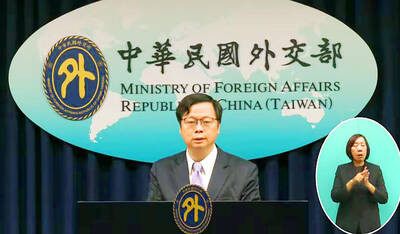
NAMING SPAT: The foreign ministry called on Denmark to propose an acceptable solution to the erroneous nationality used for Taiwanese on residence permits Taiwan has revoked some privileges for Danish diplomatic staff over a Danish permit that lists “Taiwan” as “China,” Eric Huang (黃鈞耀), head of the Ministry of Foreign Affairs’ Department of European Affairs, told a news conference in Taipei yesterday. Reporters asked Huang whether the Danish government had responded to the ministry’s request that it correct the nationality on Danish residence permits of Taiwanese, which has been listed as “China” since 2024. Taiwan’s representative office in Denmark continues to communicate with the Danish government, and the ministry has revoked some privileges previously granted to Danish representatives in Taiwan and would continue to review
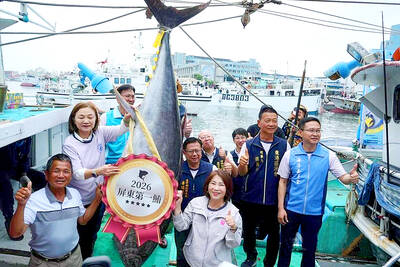
The first bluefin tuna of the season, brought to shore in Pingtung County and weighing 190kg, was yesterday auctioned for NT$10,600 (US$333.5) per kilogram, setting a record high for the local market. The auction was held at the fish market in Donggang Fishing Harbor, where the Siaoliouciou Island-registered fishing vessel Fu Yu Ching No. 2 delivered the “Pingtung First Tuna” it had caught for bidding. Bidding was intense, and the tuna was ultimately jointly purchased by a local restaurant and a local company for NT$10,600 per kilogram — NT$300 ,more than last year — for a total of NT$2.014 million. The 67-year-old skipper
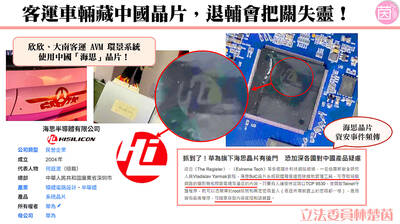
BREACH OF CONTRACT: The bus operators would seek compensation and have demanded that the manufacturer replace the chips with ones that meet regulations Two bus operators found to be using buses with China-made chips are to demand that the original manufacturers replace the systems and provide compensation for breach of contract, the Veterans Affairs Council said yesterday. Democratic Progressive Party Legislator Michelle Lin (林楚茵) yesterday said that Da Nan Bus Co and Shin-Shin Bus Co Ltd have fielded a total of 82 buses that are using Chinese chips. The bus models were made by Tron-E, while the systems provider was CYE Electronics, Lin said. Lin alleged that the buses were using chips manufactured by Huawei subsidiary HiSilicon Co, which presents a national security risk if the


 RSS
RSS