


Following reports that a retired military officer allegedly helped China collect sensitive information about the nation’s missile defense systems when he was in active service 10 years ago, the Ministry of National Defense yesterday reaffirmed its counterintelligence efforts, saying it would communicate with the US about the case.
Retired army major general Hsieh Chia-kang (謝嘉康), the former commander of the Air Defense Missile Command, has been under investigation over allegations he leaked classified information to China.
Hsieh was allegedly approached by retired army colonel Hsin Peng-sheng (辛澎生), who was reportedly recruited by Chinese intelligence operatives as far back as 10 years ago when he was in charge of the missile command.
Hsieh and Hsin were questioned by prosecutors and released on bail earlier this week.
Hsin admitted during questioning to spying for China, but denied allegations that he leaked state secrets, the Liberty Times (the sister newspaper of the Taipei Times) reported.
The ministry is concerned that key information pertaining to the nation’s missile systems might have been compromised when Hsin was in charge of the command, one of the nation’s top missile units, which controls a large array of weaponry, including Tien Kung and US-made MIM-104F Patriot anti-ballistic missile systems, Hawk anti-aircraft missiles and Hsiung Feng-2E cruise missiles.
“This is the most serious and most damaging espionage case in history, as it involves the most critical missile unit and the compromising of its top officials,” Democratic Progressive Party Legislator Wang Ding-yu (王定宇) said at the legislature yesterday.
Ministry spokesman Major General Chen Chung-chi (陳中吉) reaffirmed the military’s counterintelligence operations, but did not confirm if any information had been compromised.
The ministry is to communicate with the US about the case and counterintelligence measures, due to concerns the US might put arms sales to Taiwan on hold, he said.
“We will communicate with the US through appropriate channels and explain our counterespionage and damage control efforts. I believe the US will appreciate our efforts,” Chen said.
About 90 percent of espionage cases have been uncovered due to the ministry’s internal investigations or tip-offs from military personnel, suggesting the ministry’s counterintelligence efforts work, he added.
Counterintelligence measures were in place 10 years ago, Chen said, adding that the ministry collected information on Hsin and Hsieh’s alleged espionage last year.

LOUD AND PROUD Taiwan might have taken a drubbing against Australia and Japan, but you might not know it from the enthusiasm and numbers of the fans Taiwan might not be expected to win the World Baseball Classic (WBC) but their fans are making their presence felt in Tokyo, with tens of thousands decked out in the team’s blue, blowing horns and singing songs. Taiwanese fans have packed out the Tokyo Dome for all three of their games so far and even threatened to drown out home team supporters when their team played Japan on Friday. They blew trumpets, chanted for their favorite players and had their own cheerleading squad who dance on a stage during the game. The team struggled to match that exuberance on the field, with
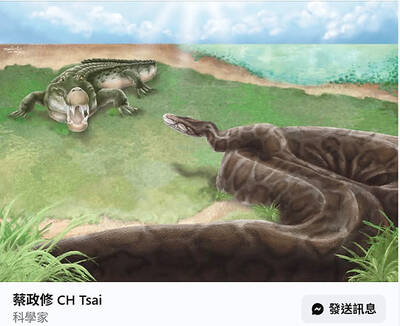
Taiwanese paleontologists have discovered fossil evidence that pythons up to 4m long inhabited Taiwan during the Pleistocene epoch, reporting their findings in the international scientific journal Historical Biology. National Taiwan University (NTU) Institute of Ecology and Evolutionary Biology associate professor Tsai Cheng-hsiu (蔡政修) led the team that discovered the largest snake fossil ever found in Taiwan. The single trunk vertebra was discovered in Tainan at the Chiting Formation, dated to between 400,000 and 800,000 years ago in the Middle Pleistocene, the paper said. The area also produced Taiwan’s first avian fossil, as well as crocodile, mammoth, saber-toothed cat and rhinoceros fossils, it said. Discoveries

Taiwanese paleontologists have discovered fossil evidence that pythons up to 4m long inhabited Taiwan during the Pleistocene epoch, reporting their findings in the international scientific journal Historical Biology. National Taiwan University (NTU) Institute of Ecology and Evolutionary Biology associate professor Tsai Cheng-hsiu (蔡政修) led the team that discovered the largest snake fossil ever found in Taiwan. A single trunk vertebra was discovered in Tainan at the Chiting Formation, dated to between 800,000 to 400,000 years ago in the Middle Pleistocene, the paper said. The area also produced Taiwan’s first avian fossil, as well as crocodile, mammoth, sabre-toothed cat and rhinoceros fossils, it said. Discoveries
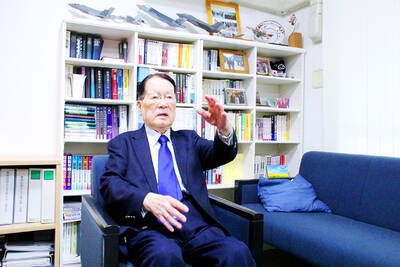
Whether Japan would help defend Taiwan in case of a cross-strait conflict would depend on the US and the extent to which Japan would be allowed to act under the US-Japan Security Treaty, former Japanese minister of defense Satoshi Morimoto said. As China has not given up on the idea of invading Taiwan by force, to what extent Japan could support US military action would hinge on Washington’s intention and its negotiation with Tokyo, Morimoto said in an interview with the Liberty Times (sister paper of the Taipei Times) yesterday. There has to be sufficient mutual recognition of how Japan could provide


 RSS
RSS