


Following another stalled legislative session amid continued opposition by the Chinese Nationalist Party (KMT) to the Forward-looking Infrastructure Development Program bill, President Tsai Ing-wen (蔡英文) yesterday called for an end to political confrontation for the sake of the nation’s development.
“We have no reason to move in circles when many countries have already begun their infrastructure upgrades to lay the foundation for their development,” she said.
Tsai said her administration had begun planning the eight-year NT$882.4 billion (US$29.2 billion) initiative even before she was elected president, adding that it presents a vision for the nation’s development that is the result of the work of think tanks.
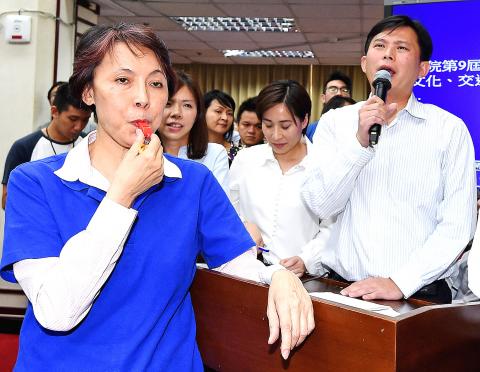
Photo: Chu Pei-hsiung, Taipei Times
While the “five plus two” industries are key to transforming the nation’s economic structure, the Forward-looking program is to create infrastructure that has long been required, she said.
The “five plus two” industries refer to smart machinery, an “Asian Silicon Valley,” “green” energy technology, biomedicine and national defense, in addition to a new agricultural paradigm and a circular economy, which together spearhead the government’s plan for industrial development.
A number of non-DPP mayors and county commissioners have sought funds from the program for local development, suggesting that there is bipartisan support for the initiative, the president said.
“Balancing urban and rural development is visionary, and investing in Taiwan is visionary,” Tsai said, adding that the government would ensure financial stability to avoid leaving future generations in debt as it pushes ahead with infrastructure development.
She urged the KMT to engage in discussion rather than confrontation and allow the legislative review of the bill to begin.
Executive Yuan spokesman Hsu Kuo-yung (徐國勇) urged KMT lawmakers to be specific in their opposition and identify which of the infrastructure projects they believe to be unnecessary.
While the KMT has demanded that the infrastructure initiative be downsized to four years with budgets halved, Hsu defended the plan, citing past infrastructure programs.
Two MRT metropolitan rail lines in New Taipei City that are under construction cannot be completed in four years, while it took more than a decade to complete a flood prevention project along the Keelung River, Hsu said, adding that the Forward-looking program is a long-term project that would require continuous budget support.
The program, which is focused on railway construction in cities other than Taipei and New Taipei City, would help develop central and southern cities, he added.
“Is it fair that Kaohsiung has been left out? Central and southern Taiwan have large populations who also pay taxes. Why is it that MRT lines are always built in northern Taiwan?” Hsu said.

LOUD AND PROUD Taiwan might have taken a drubbing against Australia and Japan, but you might not know it from the enthusiasm and numbers of the fans Taiwan might not be expected to win the World Baseball Classic (WBC) but their fans are making their presence felt in Tokyo, with tens of thousands decked out in the team’s blue, blowing horns and singing songs. Taiwanese fans have packed out the Tokyo Dome for all three of their games so far and even threatened to drown out home team supporters when their team played Japan on Friday. They blew trumpets, chanted for their favorite players and had their own cheerleading squad who dance on a stage during the game. The team struggled to match that exuberance on the field, with
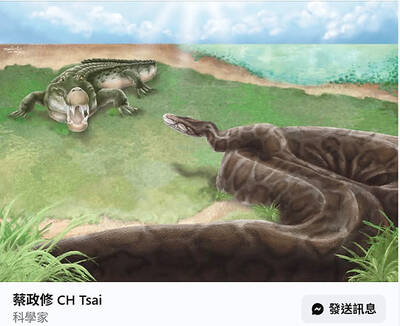
Taiwanese paleontologists have discovered fossil evidence that pythons up to 4m long inhabited Taiwan during the Pleistocene epoch, reporting their findings in the international scientific journal Historical Biology. National Taiwan University (NTU) Institute of Ecology and Evolutionary Biology associate professor Tsai Cheng-hsiu (蔡政修) led the team that discovered the largest snake fossil ever found in Taiwan. The single trunk vertebra was discovered in Tainan at the Chiting Formation, dated to between 400,000 and 800,000 years ago in the Middle Pleistocene, the paper said. The area also produced Taiwan’s first avian fossil, as well as crocodile, mammoth, saber-toothed cat and rhinoceros fossils, it said. Discoveries

Taiwanese paleontologists have discovered fossil evidence that pythons up to 4m long inhabited Taiwan during the Pleistocene epoch, reporting their findings in the international scientific journal Historical Biology. National Taiwan University (NTU) Institute of Ecology and Evolutionary Biology associate professor Tsai Cheng-hsiu (蔡政修) led the team that discovered the largest snake fossil ever found in Taiwan. A single trunk vertebra was discovered in Tainan at the Chiting Formation, dated to between 800,000 to 400,000 years ago in the Middle Pleistocene, the paper said. The area also produced Taiwan’s first avian fossil, as well as crocodile, mammoth, sabre-toothed cat and rhinoceros fossils, it said. Discoveries

Whether Japan would help defend Taiwan in case of a cross-strait conflict would depend on the US and the extent to which Japan would be allowed to act under the US-Japan Security Treaty, former Japanese minister of defense Satoshi Morimoto said. As China has not given up on the idea of invading Taiwan by force, to what extent Japan could support US military action would hinge on Washington’s intention and its negotiation with Tokyo, Morimoto said in an interview with the Liberty Times (sister paper of the Taipei Times) yesterday. There has to be sufficient mutual recognition of how Japan could provide


 RSS
RSS