


Money saved from getting rid of preferential savings rate accounts for retired public employees should be plowed back into the nation’s pension funds, a teachers’ union said yesterday as the Legislative Yuan began review of bills on reforming teachers’ pension.
“There is only one criterion as we look at reform — whether or not any money that is saved is entirely plowed into the pensions funds,” National Federation of Teachers Unions deputy secretary-general Lo Te-shui (羅德水) said.
While the Executive Yuan’s reform proposal includes the critical provision, some versions proposed by Democratic Progressive Party legislators do not.
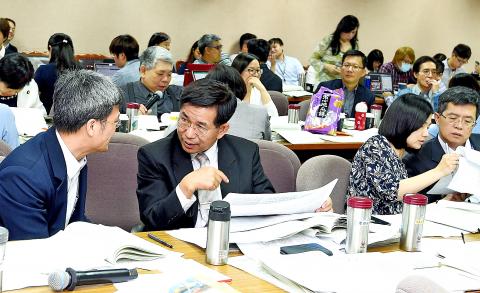
Photo: Chu Pei-hsiung, Taipei Times
A committee review of pension reform for civil servants last week struck out a similar provision from the government-sponsored bill, he added.
Eliminating retirees’ access to preferential savings rate accounts offering above market interest rates is a major source of savings under government sponsored reform.
However, because such interest is now paid out of the annual budgets of the retirees’ former agencies, the savings will not do much to stave off the pending bankruptcy of the pension funds without a specific mandate increasing proportional government contributions to the funds, he said.
“We cannot accept pension reform which devolves into local governments skimming off profits from the cuts,” he said.
Legislation should codify government promises to set up new accounts within the pension funds to ensure that the savings are used to pay the pensions of future retirees, Lo said.
He also criticized proposals that would allow the government to adjust pensions — without legislative approval — when changes to the government’s finances and the national economy require it.
Only revisions tied to the consumer price index should be allowed, he said.
“[Otherwise] this would probably lead to continual changes,” Lo said. “They could tamper with pensions almost at whim.”
Union president Chang Hsu-cheng (張旭政) called for more flexibility in determining teachers’ retirement age, saying that each teacher’s eligibility should be based on a combination of age and years of service rather than fixed at 60 years of age as the Executive Yuan’s bill stipulates.
Absolute ceilings on the pension “replacement ratios” relative to teachers’ original salaries would discourage teachers from working longer, Chang said.
As pension replacement ratios are calculated based on teachers’ years of service, the fixed ceilings would penalize any teachers who work longer than 35 years, he said.
The union also called for Public Employee Insurance to be excluded from the pension ceiling on the grounds that its fund is not expected to go bankrupt anytime soon, unlike the teachers’ general pension fund.

Considering that most countries issue more than five denominations of banknotes, the central bank has decided to redesign all five denominations, the bank said as it prepares for the first major overhaul of the banknotes in more than 24 years. Central bank Governor Yang Chin-lung (楊金龍) is expected to report to the Legislative Yuan today on the bank’s operations and the redesign’s progress. The bank in a report sent to the legislature ahead of today’s meeting said it had commissioned a survey on the public’s preferences. Survey results showed that NT$100 and NT$1,000 banknotes are the most commonly used, while NT$200 and NT$2,000

The Centers for Disease Control (CDC) yesterday reported the first case of a new COVID-19 subvariant — BA.3.2 — in a 10-year-old Singaporean girl who had a fever upon arrival in Taiwan and tested positive for the disease. The girl left Taiwan on March 20 and the case did not have a direct impact on the local community, it said. The WHO added the BA.3.2 strain to its list of Variants Under Monitoring in December last year, but this was the first imported case of the COVID-19 variant in Taiwan, CDC Deputy Director-General Lin Ming-cheng (林明誠) said. The girl arrived in Taiwan on

South Korea is planning to revise its controversial electronic arrival card, a step Taiwanese officials said prompted them to hold off on planned retaliatory measures, a South Korean media report said yesterday. A Yonhap News Agency report said that the South Korean Ministry of Foreign Affairs is planning to remove the “previous departure place” and “next destination” fields from its e-arrival card system. The plan, reached after interagency consultations, is under review and aims to simplify entry procedures and align the electronic form with the paper version, a South Korean ministry official said. The fields — which appeared only on the electronic form

The Ministry of Foreign Affairs (MOFA) is suspending retaliation measures against South Korea that were set to take effect tomorrow, after Seoul said it is updating its e-arrival system, MOFA said today. The measures were to be a new round of retaliation after Taiwan on March 1 changed South Korea's designation on government-issued alien resident certificates held by South Korean nationals to "South Korea” from the "Republic of Korea," the country’s official name. The move came after months of protests to Seoul over its listing of Taiwan as "China (Taiwan)" in dropdown menus on its new online immigration entry system. MOFA last week


 RSS
RSS