

Taipei Rapid Transit Corp (TRTC) yesterday unveiled its design for the belt-shaped park between Nanjing and Minsheng W roads and the Zhongshan and Shuanglian Mass Rapid Transit (MRT) stations, with Taipei Deputy Mayor Chen Chin-jun (陳景峻) saying he hoped the park’s facelift would help it become a city landmark.
The redesign work is to be conducted in seven areas — on the ground level, a subsurface plaza facing the TRTC’s premises and the MRT passenger platform levels — between this month and August, Chen told reporters.
The construction work will not affect the vast majority, 85 percent, of the underground Zhongshan Metro Mall, rebuffing the accusation from Taipei City Councilor Wang Shih-chien (王世堅), a Democratic Progressive Party (DPP) member, last year that the city government wanted to drive bookstores out of the mall in favor of a food court, Chen said.
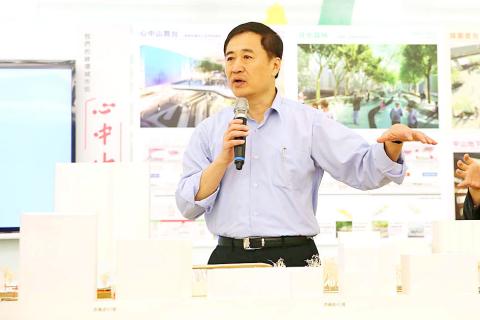
Photo: CNA
If the project is successful, more will be initiated to beautify Taipei’s cityscape, he said.
The project design leader, Angela Soong (宋鎮邁) — the daughter of People First Party Chairman James Soong (宋楚瑜) — said she hopes to make Taipei “cozier.”
Explaining some of the designs she created for the 1.96-hectare park, Angela Soong said an elevated platform would be built above MRT Zhongshan Station Exit 4 to give visitors a better view of the area.
A stage for performances is to be erected at the exit, while playground equipment is to be placed at the end of the park near Minsheng W Road, she said.
Stairs leading to the elevated park are to be replaced by slopes to provide a barrier-free space and pavements that are uneven will be renewed, she said.
Project codesigner Kerby Chou (周書賢), who designed the plaza, said TRTC would take tenders from restaurants that want to operate at the plaza, which would attract more people to the bookstores in mall.
The floor tiles in an open space in the mall where high-school street dance clubs often practice are to be replaced with less slippery ones, he said.
Staircases leading to the indented plaza will also be expanded with platforms to provide space for food vendors, which is expected to be another drawing point, he said.
Angela Soong said she hopes the facelift will led to all the belt-shaped parks between the Taipei Expo Park and Taipei Railway Station undergoing the same kind of renovations to breathe new life into Taipei’s public spaces.
The entire project is scheduled to be completed by August next year, TRTC officials said.
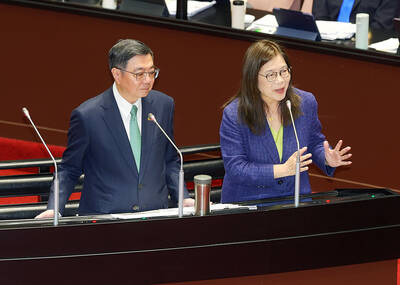
The donation of offshore patrol vessel Kinmen to the Philippines includes provisions that protect Taiwanese fishers and facilitate security cooperation across the First Island Chain, officials said yesterday. The comment was made during the Cabinet’s comprehensive administrative report at the legislature after Chinese Nationalist Party (KMT) Legislator Hsu Yu-chen (許宇甄) expressed concerns about the decision to give a ship to a country whose coast guard had in 2013 fired on a Taiwanese trawler and killed its captain without provocation. The Cabinet should lay out the safeguards that have been established to prevent the Philippine government from using the Kinmen to harass, expel
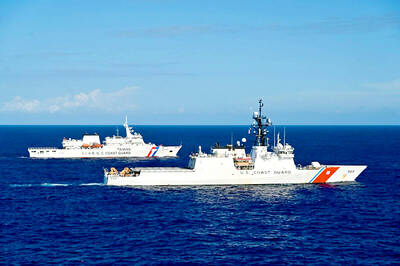
GROWING TIES: The CGA is planning a goodwill mission to the Philippines, in what would be the first time since 1975 a Taiwanese paramilitary vessel has visited the country The Coast Guard Administration (CGA) plans to significantly expand its participation in international security cooperative frameworks and its operational capabilities, a budget proposal for next year showed. The budget indicates a transformation of the CGA from a maritime law enforcement arm into a national defense and intelligence gathering entity capable of tackling larger regional security matters. The proposal showed that personnel from the coast guard’s Intelligence Division and Special Action Support Center are to participate in high-level national security talks with the US. As the CGA has dealt with China’s rising “gray zone” threats around Taiwan, it has become a valuable asset to
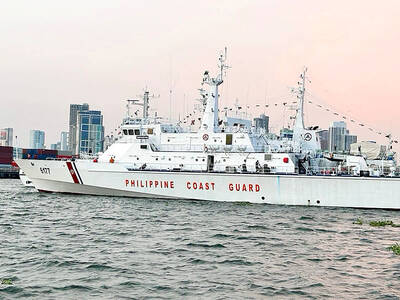
A patrol vessel donated by the Coast Guard Administration (CGA) to the Philippines was commissioned into the Philippine Coast Guard (PCG) on Friday, a Philippine non-governmental organization said. The CGA on Sept. 16 confirmed media reports that Taiwan had donated a retired 500-tonne patrol vessel to the Philippines. The Manila-based We Protect Our Seas (WPS) foundation, which served as an intermediary in the transfer, said that the vessel was formerly the CGA’s 500-tonne petrol vessel Kinmen (CG123). The WPS, in a statement issued on Friday, said the vessel, renamed as the BRP Sarangani, had been commissioned into the PCG the
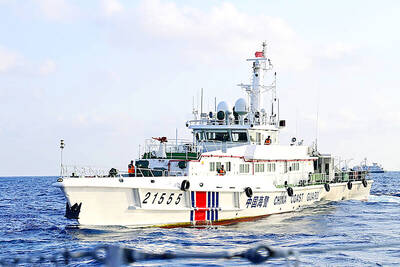
‘GRAY ZONE’ TACTICS: Beijing sent two China Coast Guard vessels to escort a ‘supposedly private research ship,’ a Philippine Coast Guard spokesman said The Coast Guard Administration (CGA) yesterday confirmed that it had recently deployed three patrol vessels to waters in Taiwan’s overlapping exclusive economic zone with the Philippines to monitor three Chinese vessels. CGA Deputy Director-General Hsieh Ching-chin (謝慶欽) said the agency regularly monitors Chinese vessels around Taiwan, and that the deployment south of Oluanpi (鵝鑾鼻), Taiwan proper’s southernmost point, was carried out in accordance with standard procedures. He added that the waters fall within the overlapping exclusive economic zones of Taiwan and the Philippines, which extend 200 nautical miles (370km) from their coastlines. Hsieh made the comments when asked about a


 RSS
RSS