


The launch of China’s first domestically built aircraft carrier on Wednesday has prompted yet another flurry of review of viable Taiwanese counters, with the Ministry of National Defense (MND), legislators and academics all agreeing that missile range development and submarines should be sufficient to counter latent threats posed by the 001A carrier.
The 001A, the official name of which is yet unknown, shows that Beijing’s efforts to build a blue water navy are an unstoppable trend, and that China seeks to protect its national interests in the South China Sea, officials said on Wednesday.
However, MND officials said that, should it prove necessary, the Taiwanese navy is capable of ensuring the safety of the nation through the “layered defense” provided by Hsiung Feng III anti-ship missiles and the submarine fleet.
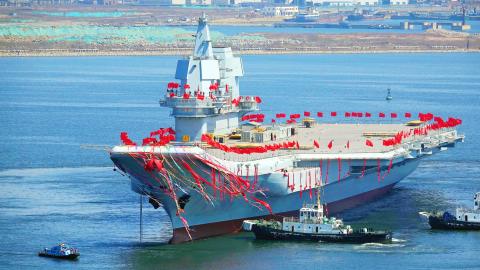
Photo: AFP
The comment on submarines refers to the navy’s plans to manufacture its own submarines, with the first batch scheduled to be in service after 2025.
According to Democratic Progressive Party Legislator Tsai Shih-ying (蔡適應), the reverse-engineering of the 001A from the Liaoning proves that the Chinese are now capable of manufacturing carriers.
With ample funding to sustain and maintain a carrier battle group, even if Chinese carriers were behind those of the US by one to two generations, they would still be able to delay US military aid coming to Taiwan, Tsai said.
However, Chieh Chung (揭仲), a research fellow at the National Policy Foundation, a Chinese Nationalist Party (KMT) think tank, said that while the launch of the 001A carrier shows that China’s shipbuilding technology has improved, the ship’s combat capabilities might not yet be better than those of the Liaoning.
Although the 001A has superior hardware, equipment and deck size compared to the Liaoning, it still employs a ski-jump takeoff ramp, not catapult launchers, to launch jets, which limits the ship to anti-air duty within the battle group, Chieh said.
Airborne early warning and control, and anti-submarine functions would still be performed by helicopters, Chieh said.
Meanwhile, Tsai said that the nation’s missile arsenal was made up mostly of short to mid-range defensive missiles, and the MND should not focus on acquiring more defensive weaponry in future purchases and research.
Taiwan must also acquire weaponry that is capable of offensive actions, Tsai said.
The Chung Shan Institute of Science and Technology could build on the Hsing Feng III missiles and research long-range missiles —with a range that exceeds 1,000km — that are capable of precision strikes, he said.
Only through such weaponry would Taiwan be able to present an effective deterrent to China and prevent it from resorting to armed invasion, he added.
The Chinese aircraft carrier program is still in its infancy, National Chung Hsing University Graduate Institute of International Politics professor Tsai Ming-yen (蔡明彥) said. adding that its capability to conduct strikes are as yet not fully developed, while the ship is still vulnerable to anti-submarines and anti-missile defenses.
The nation should focus on its missile development and on its project to domestically build submarines, as well as develop missile-boat platforms, Tsai Ming-yen said.
The nation should especially invest in enhancing the precision strike capabilities and increasing the destructive force of its missiles, he added.
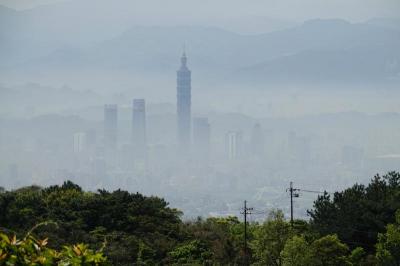
A strong continental cold air mass is to bring pollutants to Taiwan from tomorrow, the Ministry of Environment said today, as it issued an “orange” air quality alert for most of the country. All of Taiwan except for Hualien and Taitung counties is to be under an “orange” air quality alert tomorrow, indicating air quality that is unhealthy for sensitive groups. In China, areas from Shandong to Shanghai have been enveloped in haze since Saturday, the ministry said in a news release. Yesterday, hourly concentrations of PM2.5 in these areas ranged from 65 to 160 micrograms per cubic meter (mg/m³), and pollutants were
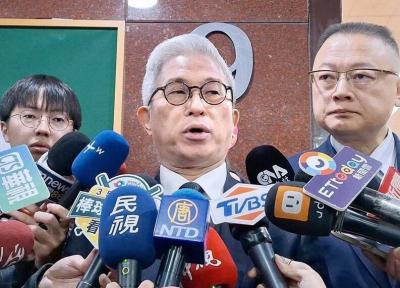
Taiwan’s armed forces have established response protocols for a wide range of sudden contingencies, including the “Wan Chun Plan” to protect the head of state, the Ministry of Defense (MND) said today. After US President Donald Trump on Saturday launched a series of airstrikes in Venezuela and kidnapped Venezuelan President Nicolas Maduro, concerns have been raised as to whether China would launch a similar “decapitation strike” on Taiwan. The armed forces regularly coordinate with relevant agencies and practice drills to ensure preparedness for a wide range of scenarios, Vice Minister of National Defense Hsu Szu-chien (徐斯儉) told reporters before a
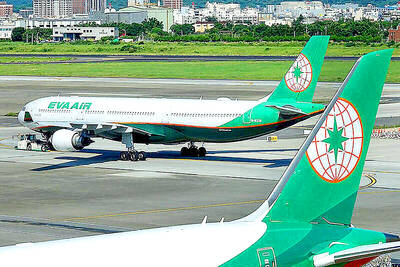
EVA Airways on Saturday said that it had suspended a pilot and opened an investigation after he allegedly lost his temper and punched the first officer several times as their plane was taxiing before takeoff at Los Angeles International Airport. According to a report published on Thursday by The Reporter, the incident occurred after the flight’s Malaysian first officer tried to warn the Taiwanese pilot, surnamed Wen (文), that he was taxiing faster than the speed limit of 30 knots (55.6kph). After alerting the pilot several times without response, the first officer manually applied the brakes in accordance with standard operating

The New Taipei City Social Welfare Department on Thursday celebrated Paralympic competitor Chen Tzu-wei (張孜維), who received last year’s national Golden Eagle award for exemplary achievement by Taiwanese with disabilities. Chen, who suffers from childhood-onset muscular dystrophy, did not attend the first award ceremony held by the Ministry of Health and Welfare in November due to illness. Chen was formally presented with the award at the department, where he gave thanks to government workers for supporting his education and livelihood, the department said in a statement. Chen was raised by the Ai-hsin Home for Persons with Disabilities in the city’s Bali District (八里)


 RSS
RSS