

China’s 18 army corps have been reorganized into 13 army corps, Hong Kong-based military analyst Leung Kwok-leung (梁國樑) said.
The veteran journalist yesterday said that the 13 new army corps of the People’s Liberation Army (PLA) will also use new numeric designations that start from 71.
The PLA has had 70 army corps in its history and the new numbers are simply an extension of that tradition, he said.
According to his information, the new 71st, 72nd and 73rd army corps will be placed under the Eastern Theater Command, the 74th and 75th under the Southern Theater Command, and the 76th and 77th corps under the Western Theater Command, he said.
The remaining are to be equally divided between the Northern Theater Command and the Central Theater Command, he said.
Sources have said that the PLA’s 15th airborne army is likely to be upgraded as the new 84th Airborne Army Corps, an indication that China is trying to improve its airborne forces, Leung said.
He said he expects the new 84th Airborne Army Corps to include an airborne assault group similar to that of the US 101st Airborne Division.
In related news, a military Web site run by Beijing’s Global Times yesterday reported that the new vice head of the 76th Army Corps visited a commemoration event for the Red Army in Gansu Province days ago.
The report is the first time the name of the new 76th Army Corps has been officially mentioned.
In developments in Taiwan, the Ministry of National Defense on Sunday said that the annual Han Kuang exercises will begin on May 25, and President Tsai Ing-wen (蔡英文) has been invited to watch the drills.
Ministry spokesman Major General Chen Chung-chi (陳中吉) said the invitation was delivered to the Presidential Office, but the ministry has not yet received a response.
Several media reports on Sunday said that in preparation for the war games the ministry would conduct drills on May 9 and May 16 in which F-16s will fire AGM-65 Maverick missiles over the Penghu Islands.
However, Chen would not comment on the reports, saying only that “everything is being carefully planned based on our original plans.”
As usual there are to be two stages to the Han Kuang exercises, one focused on computer-simulations and the other centered on live-fire drills.
This year’s exercises will be conducted under the scenario of a PLA deployment in 2025 and include F-35 jets as a parameter in the computerized war games to simulate combat tactics and strategies, ministry officials said.
Live-fire drills will be carried out in Penghu on May 25, with the army, navy and air force participating.
There had been speculation in February that the ministry would forgo live-fire drills in this year’s war games, delaying them until next year, because the ministry has been adjusting the nation’s defense strategies to meet President Tsai Ing-wen’s (蔡英文) goal of overhauling the military and national defenses.
This will be the 33rd year that the ministry has organized the Han Kuang’s exercises, but the first time that they will be held in May. The drills have traditionally been staged in August.

The donation of offshore patrol vessel Kinmen to the Philippines includes provisions that protect Taiwanese fishers and facilitate security cooperation across the First Island Chain, officials said yesterday. The comment was made during the Cabinet’s comprehensive administrative report at the legislature after Chinese Nationalist Party (KMT) Legislator Hsu Yu-chen (許宇甄) expressed concerns about the decision to give a ship to a country whose coast guard had in 2013 fired on a Taiwanese trawler and killed its captain without provocation. The Cabinet should lay out the safeguards that have been established to prevent the Philippine government from using the Kinmen to harass, expel
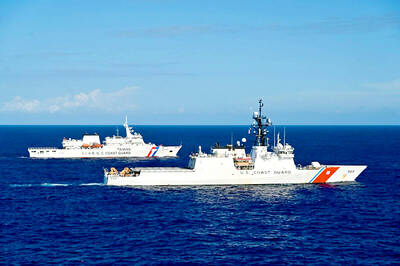
GROWING TIES: The CGA is planning a goodwill mission to the Philippines, in what would be the first time since 1975 a Taiwanese paramilitary vessel has visited the country The Coast Guard Administration (CGA) plans to significantly expand its participation in international security cooperative frameworks and its operational capabilities, a budget proposal for next year showed. The budget indicates a transformation of the CGA from a maritime law enforcement arm into a national defense and intelligence gathering entity capable of tackling larger regional security matters. The proposal showed that personnel from the coast guard’s Intelligence Division and Special Action Support Center are to participate in high-level national security talks with the US. As the CGA has dealt with China’s rising “gray zone” threats around Taiwan, it has become a valuable asset to
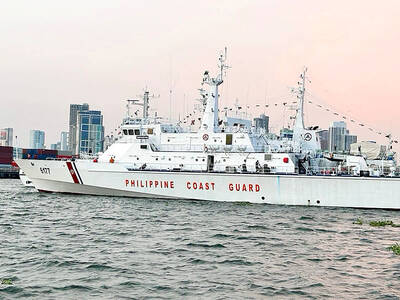
A patrol vessel donated by the Coast Guard Administration (CGA) to the Philippines was commissioned into the Philippine Coast Guard (PCG) on Friday, a Philippine non-governmental organization said. The CGA on Sept. 16 confirmed media reports that Taiwan had donated a retired 500-tonne patrol vessel to the Philippines. The Manila-based We Protect Our Seas (WPS) foundation, which served as an intermediary in the transfer, said that the vessel was formerly the CGA’s 500-tonne petrol vessel Kinmen (CG123). The WPS, in a statement issued on Friday, said the vessel, renamed as the BRP Sarangani, had been commissioned into the PCG the
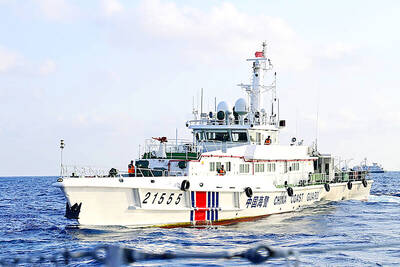
‘GRAY ZONE’ TACTICS: Beijing sent two China Coast Guard vessels to escort a ‘supposedly private research ship,’ a Philippine Coast Guard spokesman said The Coast Guard Administration (CGA) yesterday confirmed that it had recently deployed three patrol vessels to waters in Taiwan’s overlapping exclusive economic zone with the Philippines to monitor three Chinese vessels. CGA Deputy Director-General Hsieh Ching-chin (謝慶欽) said the agency regularly monitors Chinese vessels around Taiwan, and that the deployment south of Oluanpi (鵝鑾鼻), Taiwan proper’s southernmost point, was carried out in accordance with standard procedures. He added that the waters fall within the overlapping exclusive economic zones of Taiwan and the Philippines, which extend 200 nautical miles (370km) from their coastlines. Hsieh made the comments when asked about a


 RSS
RSS