


Most Taiwanese think that the detention of human rights advocate Lee Ming-che (李明哲) has adversely affected cross-strait relations, a survey by the Taiwan Brain Trust showed yesterday.
The poll showed that 64.7 percent of respondents said Lee’s detention has affected cross-strait relations, and 45.4 percent expressed dissatisfaction with the government’s response to Beijing’s actions.
Only 14.1 percent expressed satisfaction with the government’s handling of the case.
Lee went missing after arriving in Guangzhou from Macau on March 19 on what his wife, Lee Ching-yu (李凈瑜), said was a mission to “share Taiwan’s democratization experience.”
Chinese authorities have denied visitation rights to Lee Ching-yu and refused to coordinate with the Taiwanese government, disregarding the Cross-Strait Joint Crime-Fighting and Judicial Mutual Assistance Agreement (海峽兩岸共同打擊犯罪及司法互助協議).
On the question of national identity, the percentage of respondents identifying as Taiwanese fell from 60.4 percent in November to 57.2 percent, while the percentage of those identifying as both Taiwanese and Chinese rose from 33.5 percent to 36.5 percent, the survey showed.
Only 3.2 percent consider themselves Chinese, down from 4.1 percent in November’s survey.
While the shift was within the poll’s margin of error, the percentage of respondents identifying as Taiwanese when given only two options — Taiwanese or Chinese — has significantly declined since it peaked at 90.6 percent in early 2015, National Cheng Kung University associate professor of political science Meng Chih-cheng (蒙志成) said.
Only 83.5 percent of respondents identified as Taiwanese when asked to choose between the two in the latest survey.
Meng attributed the decline to China’s economic “soft power,” including new plans to provide favorable loans to Taiwanese entrepreneurs in China, along with plans to grant Taiwanese the same benefits as Chinese citizens.
“Although China has taken a hard line against President Tsai Ing-wen’s (蔡英文) administration, it has not given up on its ‘soft’ economic line,” Meng said. “If our economy does not improve, some people will see more opportunities on the mainland and when they do not feel there is any other choice, that will eat away at how much people emphasize liberal democratic values.”
“While Taiwanese identification remains high, there seems to be a crisis, even to the point where people feel a bit lost,” foundation chief executive officer Chen Chih-chung (陳致中) said.
“China has been very active, making the ‘hard’ elements of its policy even ‘harder’ and the ‘soft’ parts even ‘softer,’ but the Taiwanese government seems to have been overly passive and conservative,” he said, adding that the government should consider renewing its efforts to apply for WHO and UN memberships.
The survey found that 76.6 percent of respondents support joining the WHO under the name “Taiwan.”
Nearly 37 percent of respondents chose “Chinese suppression” as being responsible for the chill in cross-strait relations since Tsai took office, while 30.9 percent said that the Tsai administration’s refusal to acknowledge the so-called “1992 consensus” was the main reason for the chill.
The “1992 consensus” — a term former Mainland Affairs Council chairman Su Chi (蘇起) admitted making up in 2000 — refers to a tacit understanding between the Chinese Nationalist Party (KMT) and the Chinese government that both sides acknowledge there is “one China,” with each side having its own interpretation of what “China” means.
The percentage of respondents who said the government must acknowledge the “1992 consensus” to develop cross-strait relations fell from 31.3 percent in November to 25.9 percent in the latest survey.
Those who support the acknowledgment of the “consensus” rose from 39.6 percent to 41.8 percent over the same period.
The survey was conducted on Monday and Tuesday and polled 1,068 adults in Taiwan. It has a margin of error of 3 percentage points.

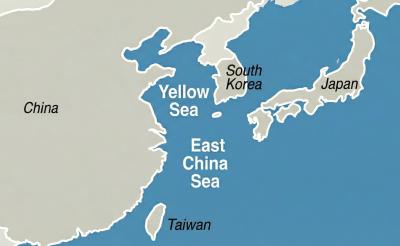
China has reserved offshore airspace in the Yellow Sea and East China Sea from March 27 to May 6, issuing alerts usually used to warn of military exercises, although no such exercises have been announced, the Wall Street Journal (WSJ) reported yesterday. Reserving such a large area for 40 days without explanation is an “unusual step,” as military exercises normally only last a few days, the paper said. These alerts, known as Notice to Air Missions (Notams), “are intended to inform pilots and aviation authorities of temporary airspace hazards or restrictions,” the article said. The airspace reserved in the alert is

South Korea is planning to revise its controversial electronic arrival card, a step Taiwanese officials said prompted them to hold off on planned retaliatory measures, a South Korean media report said yesterday. A Yonhap News Agency report said that the South Korean Ministry of Foreign Affairs is planning to remove the “previous departure place” and “next destination” fields from its e-arrival card system. The plan, reached after interagency consultations, is under review and aims to simplify entry procedures and align the electronic form with the paper version, a South Korean ministry official said. The fields — which appeared only on the electronic form
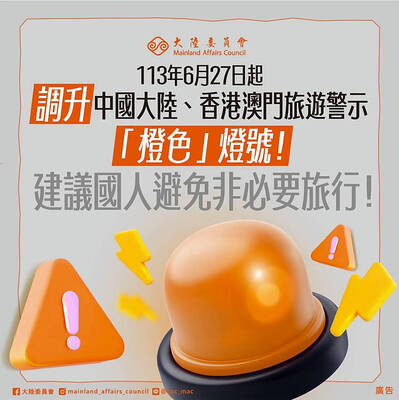
More than 6,000 Taiwanese students have participated in exchange programs in China over the past two years, despite the Mainland Affairs Council’s (MAC) “orange light” travel advisory, government records showed. The MAC’s publicly available registry showed that Taiwanese college and university students who went on exchange programs across the Strait numbered 3,592 and 2,966 people respectively. The National Immigration Agency data revealed that 2,296 and 2,551 Chinese students visited Taiwan for study in the same two years. A review of the Web sites of publicly-run universities and colleges showed that Taiwanese higher education institutions continued to recruit students for Chinese educational programs without

A bipartisan group of US senators has introduced a bill to enhance cooperation with Taiwan on drone development and to reduce reliance on supply chains linked to China. The proposed Blue Skies for Taiwan Act of 2026 was introduced by Republican US senators Ted Cruz and John Curtis, and Democratic US senators Jeff Merkley and Andy Kim. The legislation seeks to ease constraints on Taiwan-US cooperation in uncrewed aerial systems (UAS), including dependence on China-sourced components, limited access to capital and regulatory barriers under US export controls, a news release issued by Cruz on Wednesday said. The bill would establish a "Blue UAS


 RSS
RSS