


A statue of Japanese engineer Yoichi Hatta near Tainan’s Wushantou Reservoir (烏山頭水庫) was found decapitated in an apparent act of vandalism, the Taiwan Chia-Nan Irrigation Association said yesterday.
Hatta is dubbed the “father of the Chianan Irrigation System” for his contributions to the development of irrigation in the Chianan Plain (嘉南平原) in southern Taiwan by building the Wushantou Reservoir during the Japanese colonial era.
An association member exercising in the area at about 6am saw that the statue’s head was missing, association president Yang Ming-feng (楊明風) said, adding that he told workers at the reservoir to call the police.
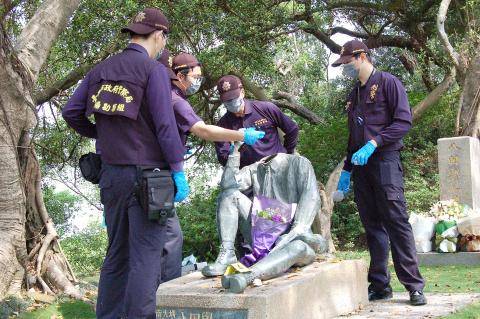
Photo: Wang Han-ping, Taipei Times
Police arriving at the scene surveyed the damage and collected information.
“The culprits of this violent act against Hatta’s memory should be strongly condemned,” Yang said.
The Tainan City Government issued a statement condemning the decapitation, saying that Tainan Mayor William Lai (賴清德) has instructed the city’s police department to form a task force to find the culprits.

Photo: Tsai Wen-chu, Taipei Times
A civil engineering graduate from then-Tokyo Imperial University (now the University of Tokyo), Hatta arrived in Taiwan in 1909 to serve at the civil engineering bureau, controlled by the Taiwan governor-general’s office.
In 1919, Hatta was tasked with designing an irrigation network for the Chianan Plain.
Following about 10 years of construction, Hatta’s team completed the reservoir in May 1930.
The reservoir has a capacity of 150 million cubic meters and can irrigate 100,000 hectares of farmland through a network of canals with a total length of 16,000km running through Chiayi and Tainan.
Hatta was killed in 1942, onboard a Japanese ship that was sunk in a submarine attack during World War II. He was on his way to Manila, where the Japanese government had sent him to develop agriculture in the Philippines.
His body was found, and after cremation, a portion of his ashes was taken to Taiwan for burial in a gravesite at the reservoir.
Following Hatta’s death, his wife, Toyoki Yonemura, remained in Taiwan. Heartbroken over the sudden and tragic loss of her husband, she committed suicide on Sept. 1, 1945, by jumping into the reservoir her husband had built.
The statue of Hatta was commissioned by the engineer’s aides and created by Japanese sculptor Yuma Tsukada of Kanazawa; it was shipped to Taiwan in 1931. However, local residents hid the statue for 40 years from 1941, fearing the Japanese government and later the Chinese Nationalist Party (KMT) government would want to melt down the statue for war materials and for political reasons.
Only when the political climate began to change in 1981 did the residents uncover the statue. It was reinstalled at the reservoir park.
On the anniversary of Hatta’s death on May 8 each year, the Chia-Nan Irrigation Association holds a memorial to honor his contribution in turning the Chianan Plain into Taiwan’s rice bowl.
Lai has asked the irrigation association to enlist professional help to repair the statue ahead of the event, the city government said.
Replacing the statue’s head should not be a problem, as the irrigation association had made a mold of the statue as a precaution, sources said.
News of the statue’s decapitation led to an outcry and speculation among local residents, with some accusing supporters of unification with China or people with anti-Japanese sentiments.
Some residents said Hatta’s legacy is apolitical and should not be used to incite hatred.
Former commissioner of then-Tainan county Su Huan-chih (蘇煥智) in a Facebook post called the decapitation “a deliberate act” adding that he believes the culprits targeted the statute to sabotage next month’s memorial service.
He said that people who vandalized the statues of Chiang Kai-shek (蔣介石) in “vigilante-like actions” have incited populist hatred and partisan acrimony in Taiwan, adding that all such actions should be condemned.
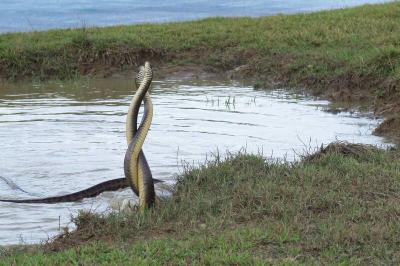
Kenting National Park service technician Yang Jien-fon (楊政峰) won a silver award in World Grand Prix Photography Awards Spring Season for his photograph of two male rat snakes intertwined in combat. Yang’s colleagues at Kenting National Park said he is a master of nature photography who has been held back by his job in civil service. The awards accept entries in all four seasons across six categories: architectural and urban photography, black-and-white and fine art photography, commercial and fashion photography, documentary and people photography, nature and experimental photography, and mobile photography. Awards are ranked according to scores and divided into platinum, gold and
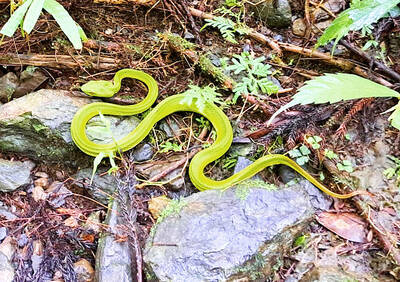
More than half of the bamboo vipers captured in Tainan in the past few years were found in the city’s Sinhua District (新化), while other districts had smaller catches or none at all. Every year, Tainan captures about 6,000 snakes which have made their way into people’s homes. Of the six major venomous snakes in Taiwan, the cobra, the many-banded krait, the brown-spotted pit viper and the bamboo viper are the most frequently captured. The high concentration of bamboo vipers captured in Sinhua District is puzzling. Tainan Agriculture Bureau Forestry and Nature Conservation Division head Chu Chien-ming (朱健明) earlier this week said that the

The Chinese Nationalist Party (KMT) caucus yesterday said it opposes the introduction of migrant workers from India until a mechanism is in place to prevent workers from absconding. Minister of Labor Hung Sun-han (洪申翰) on Thursday told the Legislative Yuan that the first group of migrant workers from India could be introduced as early as this year, as part of a government program. The caucus’ opposition to the policy is based on the assessment that “the risk is too high,” KMT caucus secretary-general Lin Pei-hsiang (林沛祥) said. Taiwan has a serious and long-standing problem of migrant workers absconding from their contracts, indicating that

TRADE-OFF: Beijing seeks to trade a bowl of tempura for a Chinese delicacy, an official said, while another said its promises were attempts to interfere in the polls The government must carefully consider the national security implications of building a bridge connecting Kinmen County and Xiamen, China, the Public Construction Commission (PCC) said yesterday. PCC Commissioner Derek Chen (陳金德), who is also a minister without portfolio, made the remarks in a meeting of the legislature’s Transportation Committee, after Democratic Progressive Party Legislator Hsu Fu-kuei (徐富癸) asked about China’s proposal of new infrastructure projects to further connect Kinmen and Lienchiang (Matsu) counties with Xiamen. China unveiled the bridge plan, along with nine other policies for Taiwan, on Sunday, the last day of Chinese Nationalist Party (KMT) Chairwoman Cheng Li-wun’s (鄭麗文) visit


 RSS
RSS