


If the draft bill proposing stricter regulations on government-funded foundations is passed, the Ministry of Education (MOE) will be able to control a 40 percent stake in the Chiang Ching-kuo Foundation for International Scholarly Exchange, Deputy Minister of Education Yao Leeh-ter (姚立德) said yesterday.
In 1989 and 1990, the ministry donated a total of NT$1.42 billion (US$46.4 million at the current exchange rate) to the foundation, whose assets stand at a value of NT$3.62 billion today, Yao said.
However, he said, out of a total 24 seats, the ministry has only one director on the foundation’s boards of directors and supervisors.
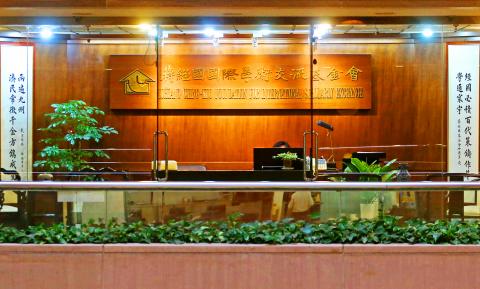
Photo: CNA
According to the draft legislation, a government agency’s stake in a government-funded foundation should be proportional to the funding it provided, he said.
This means the ministry’s representation on the two boards would likely be raised to 40 percent, granting it a controlling stake in the foundation, he said.
Yao, who is set to assume the post of director at the foundation, said the government capped its representation in the foundation at one seat when it was established, so that it would be able to operate largely as a private organization.
To facilitate international research projects and academic exchanges, the ministry would take into consideration the backgrounds of candidates and refrain from nominating a large number of government officials as the foundation’s board members, he said.
In other developments, the Chiang Ching-kuo Foundation issued a response to a report in the Chinese-language United Daily News that implied it might have been used for tax-avoidance due to insufficient regulations.
“The foundation was founded in 1989 with government and private donations, with a mission to provide incentives and funding for international academic facilities and scholars to conduct research in Sinology and Taiwan Studies,” the statement said.
All of the foundation’s board members are unsalaried, it said.
As the ministry’s supervision guidelines for foundations limit the use of the funds provided by the ministry to certificates of deposit, Treasury bonds and short-term transaction instruments, the foundation has struggled to meet its revenue goals in the current low-interest rate environment, the statement said.
Private donations can be used to invest in stocks, equity funds and real estate investment trusts and are essential to making up for the shortfall in its expected revenue, the foundation said
The Cabinet on Thursday approved the draft legislation, which is to be submitted to the legislature for review.
If passed, the bill would require government-funded foundations to regularly divulge financial data and implement new auditing and accounting systems.
Foundations that fail to comply with government inspections or supervisions would be subject to monetary penalties, according to the draft.

SHIPS, TRAINS AND AUTOMOBILES: The ministry has announced changes to varied transportation industries taking effect soon, with a number of effects for passengers Beginning next month, the post office is canceling signature upon delivery and written inquiry services for international registered small packets in accordance with the new policy of the Universal Postal Union, the Ministry of Transportation and Communications said yesterday. The new policy does not apply to packets that are to be delivered to China, the ministry said. Senders of international registered small packets would receive a NT$10 rebate on postage if the packets are sent from Jan. 1 to March 31, it added. The ministry said that three other policies are also scheduled to take effect next month. International cruise ship operators
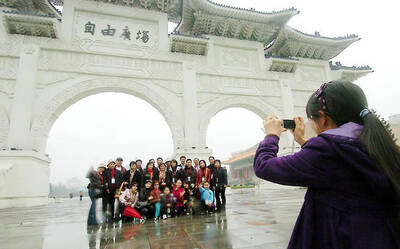
NUMBERS IMBALANCE: More than 4 million Taiwanese have visited China this year, while only about half a million Chinese have visited here Beijing has yet to respond to Taiwan’s requests for negotiation over matters related to the recovery of cross-strait tourism, the Tourism Administration said yesterday. Taiwan’s tourism authority issued the statement after Chinese-language daily the China Times reported yesterday that the government’s policy of banning group tours to China does not stop Taiwanese from visiting the country. As of October, more than 4.2 million had traveled to China this year, exceeding last year. Beijing estimated the number of Taiwanese tourists in China could reach 4.5 million this year. By contrast, only 500,000 Chinese tourists are expected in Taiwan, the report said. The report
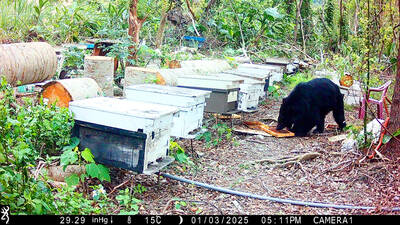
The Forestry and Nature Conservation Agency yesterday launched a gift box to market honey “certified by a Formosan black bear” in appreciation of a beekeeper’s amicable interaction with a honey-thieving bear. Beekeeper Chih Ming-chen (池明鎮) in January inspected his bee farm in Hualien County’s Jhuosi Township (卓溪) and found that more than 20 beehives had been destroyed and many hives were eaten, with bear droppings and paw prints near the destroyed hives, the agency said. Chih returned to the farm to move the remaining beehives away that evening when he encountered a Formosan black bear only 20m away, the agency said. The bear

Chinese embassy staffers attempted to interrupt an award ceremony of an international tea competition in France when the organizer introduced Taiwan and displayed the Republic of China flag, a Taiwanese tea farmer said in an interview published today. Hsieh Chung-lin (謝忠霖), chief executive of Juxin Tea Factory from Taichung's Lishan (梨山) area, on Dec. 2 attended the Teas of the World International Contest held at the Peruvian embassy in Paris. Hsieh was awarded a special prize for his Huagang Snow Source Tea by the nonprofit Agency for the Valorization of Agricultural Products (AVPA). During the ceremony, two Chinese embassy staffers in attendance


 RSS
RSS