


Executive Yuan spokesman Hsu Kuo-yung (徐國勇) yesterday said he would accept the resignation of his office director over her controversial remarks urging public-sector workers protesting pension reform to “die early,” but called on a Chinese Nationalist Party (KMT) councilor who asked for President Tsai Ing-wen’s (蔡英文) head to also take responsibly for his words.
Hsu said he has asked his office director, Connie Lin (林育卉), to temporarily leave her post after her controversial remarks on Facebook were brought to his attention on Thursday.
Hsu said he had no comment on Lin’s personal opinions, but does feel it is inappropriate for someone working for a government agency to post emotional rhetoric online.
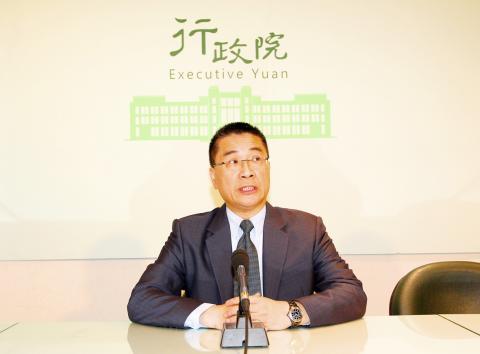
Photo: CNA
“Lin explained to me that her emotional comments were a reaction to KMT New Taipei City Councilor Lin Kuo-chun (林國春) asking other protesters: ‘Shouldn’t she [Tsai] be killed?’” Hsu said.
Hsu said Connie Lin was also upset that KMT Chairwoman Hung Hsiu-chu (洪秀柱) criticized her, but had not held Lin Kuo-chun to the same ethical standards.
Connie Lin posted the apparently sarcastic comment on Facebook on Thursday, a day after retired police officers and firefighters paralyzed the streets of Taipei protesting against the government’s pension reform plans.
Lin Kuo-chun, who is also president of the New Taipei City Retired Police Association, was among the protesters.
“To uphold righteousness, I stopped my friends from criticizing them [retired public-sector workers] for receiving too high a pension, from ridiculing them for taking turns to stage hunger strikes, and from being envious of their ability to use their pension to travel, and buy cars and houses,” Connie Lin wrote.
She said that she has put up with these people for a long time, adding that they should “die early on Tomb Sweeping Day.”
Hung was quick to condemn Connie Lin, saying on Facebook later that day that her comments revealed what the Democratic Progressive Party (DPP) truly thinks about public-sector workers, and how the party is “cold-blooded, ignorant and brutal.”
KMT Culture and Communications Committee deputy director Tang Te-ming (唐德明) accused Hsu at a news conference in Taipei of letting his office become “a base of hatred.”
KMT caucus convener Sufin Siluko (廖國棟) said Connie Lin’s post was “extremely offensive” and had disgraced the Executive Yuan.
“It is like tyranny,” he said.
DPP Legislator Tsai Yi-yu (蔡易餘) said Connie Lin’s remarks were “a bit over the top.”
“Hsu quickly made the decision to suspend her and I hope both sides of the argument on pension reform exercise restraint and keep their discussions free of profanities and insults,” he said.
DPP Legislator Huang Wei-cher (黃偉哲) said Connie Lin is an outspoken person with “a sense of justice,” but there is a clear boundary between the private sphere and the public arena.
DPP spokesperson Ruan Jhao-syong (阮昭雄) urged the KMT and Lin Kuo-chun to apologize for the latter’s speech on Wednesday suggesting that the protesters attack the president.
Additional reporting by Alison Hsiao

Considering that most countries issue more than five denominations of banknotes, the central bank has decided to redesign all five denominations, the bank said as it prepares for the first major overhaul of the banknotes in more than 24 years. Central bank Governor Yang Chin-lung (楊金龍) is expected to report to the Legislative Yuan today on the bank’s operations and the redesign’s progress. The bank in a report sent to the legislature ahead of today’s meeting said it had commissioned a survey on the public’s preferences. Survey results showed that NT$100 and NT$1,000 banknotes are the most commonly used, while NT$200 and NT$2,000

The Centers for Disease Control (CDC) yesterday reported the first case of a new COVID-19 subvariant — BA.3.2 — in a 10-year-old Singaporean girl who had a fever upon arrival in Taiwan and tested positive for the disease. The girl left Taiwan on March 20 and the case did not have a direct impact on the local community, it said. The WHO added the BA.3.2 strain to its list of Variants Under Monitoring in December last year, but this was the first imported case of the COVID-19 variant in Taiwan, CDC Deputy Director-General Lin Ming-cheng (林明誠) said. The girl arrived in Taiwan on

South Korea is planning to revise its controversial electronic arrival card, a step Taiwanese officials said prompted them to hold off on planned retaliatory measures, a South Korean media report said yesterday. A Yonhap News Agency report said that the South Korean Ministry of Foreign Affairs is planning to remove the “previous departure place” and “next destination” fields from its e-arrival card system. The plan, reached after interagency consultations, is under review and aims to simplify entry procedures and align the electronic form with the paper version, a South Korean ministry official said. The fields — which appeared only on the electronic form

The Ministry of Foreign Affairs (MOFA) is suspending retaliation measures against South Korea that were set to take effect tomorrow, after Seoul said it is updating its e-arrival system, MOFA said today. The measures were to be a new round of retaliation after Taiwan on March 1 changed South Korea's designation on government-issued alien resident certificates held by South Korean nationals to "South Korea” from the "Republic of Korea," the country’s official name. The move came after months of protests to Seoul over its listing of Taiwan as "China (Taiwan)" in dropdown menus on its new online immigration entry system. MOFA last week


 RSS
RSS