


The election of Beijing’s favored candidate, former Hong Kong chief secretary for administration Carrie Lam (林鄭月娥) as the territory’s new chief executive shows that China’s “one country, two systems” framework, which guarantees a high degree of autonomy to the territory, is an empty promise, the Democratic Progressive Party (DPP) caucus said yesterday.
Despite her low popularity, Lam won Sunday’s election with 67 percent of the votes cast by the Election Committee.
There are 3.7 million registered voters in Hong Kong, but the chief executive is elected by a 1,194-member committee, making the vote a “bird cage” election, whereby Hong Kongers are represented by a small number of individuals, DPP Legislator Wu Ping-jui (吳秉叡) said.
The election bankrupted the “one country, two systems” framework and weakened the little confidence Taiwanese had in Beijing, Wu said.
The unfairness of Hong Kong’s electoral system in 2014 led to the Occupy Central movement that sought universal suffrage, and Taiwanese, accustomed to universal suffrage, were sympathetic to the movement, Wu said.
Had the Hong Kong election been a direct one, the result would not have been the same, as Lam had an approval rating of 29 percent ahead of the vote, while her main rival, former Hong Kong financial secretary John Tsang (曾俊華), had 56 percent, Wu said.
“Why was there such a ridiculous election? Because the Chinese Communist Party puts its hands into Hong Kong and deprives Hong Kongers of the opportunity to seek freedom. This serves as a clear reminder for Taiwanese that we must ensure that opportunity for future generations,” Wu said.
Hong Kong used to be a leading society in Asia in terms of democratic development, but its democracy has diminished as Beijing has tightened its grip on the territory, DPP Legislator Lee Chun-yi (李俊俋) said, questioning whether Beijing has failed in its promise to protect the territory’s autonomy for 50 years.
“Without the opportunity to have fair elections or freedom of speech, is the so-called ‘one country, two system’ the way of the future?” Lee asked.
Former premier Jiang Yi-huah (江宜樺), who had been sympathetic of Hong Kong’s electoral system, said “one country, two systems” was being emptied out, Lee said.
In addition to its inability to reflect public opinion, Hong Kong’s electoral system screens candidates in Beijing’s favor, as a prospective candidate needs to be endorsed by at least 150 members from a nominating committee, which is dominated by pro-Beijing elites, DPP Legislator Yeh Yi-chin (葉宜津) said.
“Do Taiwanese want a system that limits candidacy and only generates undesirable candidates?” Yeh said. “The Hong Kong system shows that what ‘one country, two systems’ stipulates is fake democracy.”

Nipah virus infection is to be officially listed as a category 5 notifiable infectious disease in Taiwan in March, while clinical treatment guidelines are being formulated, the Centers for Disease Control (CDC) said yesterday. With Nipah infections being reported in other countries and considering its relatively high fatality rate, the centers on Jan. 16 announced that it would be listed as a notifiable infectious disease to bolster the nation’s systematic early warning system and increase public awareness, the CDC said. Bangladesh reported four fatal cases last year in separate districts, with three linked to raw date palm sap consumption, CDC Epidemic Intelligence

Two Taiwanese prosecutors were questioned by Chinese security personnel at their hotel during a trip to China’s Henan Province this month, the Mainland Affairs Council (MAC) said yesterday. The officers had personal information on the prosecutors, including “when they were assigned to their posts, their work locations and job titles,” MAC Deputy Minister and spokesman Liang Wen-chieh (梁文傑) said. On top of asking about their agencies and positions, the officers also questioned the prosecutors about the Cross-Strait Joint Crime-Fighting and Judicial Mutual Assistance Agreement, a pact that serves as the framework for Taiwan-China cooperation on combating crime and providing judicial assistance, Liang

The manufacture of the remaining 28 M1A2T Abrams tanks Taiwan purchased from the US has recently been completed, and they are expected to be delivered within the next one to two months, a source said yesterday. The Ministry of National Defense is arranging cargo ships to transport the tanks to Taiwan as soon as possible, said the source, who is familiar with the matter. The estimated arrival time ranges from late this month to early next month, the source said. The 28 Abrams tanks make up the third and final batch of a total of 108 tanks, valued at about NT$40.5 billion
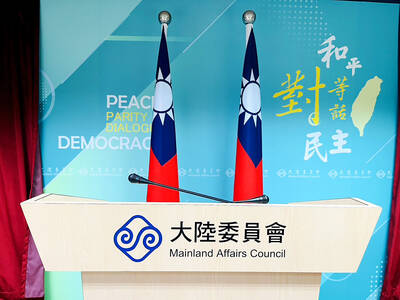
Reports of Taiwanese going missing, being detained or interrogated, or having their personal liberties restricted in China increased about fourfold annually last year, the Mainland Affairs Council (MAC) said yesterday. Last year, 221 Taiwanese who traveled to China were reported missing, were detained and interrogated, or otherwise had their personal freedom restricted, up from 55 the previous year, the council said. Reopening group tours to China would be risky, as it would leave travelers with no way to seek help through official channels after Beijing shut down dialogue between the associations tasked with handling cross-strait tourism, the MAC said. Taipei’s Taiwan Strait Tourism


 RSS
RSS