


The Republic of China’s (ROC) history would be “missing a piece” if the resolutions made from 1945 to 1947 by the now-defunct Supreme National Defense Council transferring the properties left by Japanese in Taiwan to the Chinese Nationalist Party (KMT) as wartime compensation are deemed inequitable, the KMT said yesterday.
KMT Administration and Management Committee director Chiu Da-chan (邱大展) made the remarks ahead of a public hearing by the Executive Yuan’s Ill-gotten Party Assets Settlement Committee on the KMT’s acquisition of assets formerly owned by the Japanese colonial government through a method called “transfer and appropriation.”
The council had been a body that “both represented the political regime and held the governing power” in accordance with the ROC Political Tutelage Period Act (中華民國訓政時期約法), Chiu said.
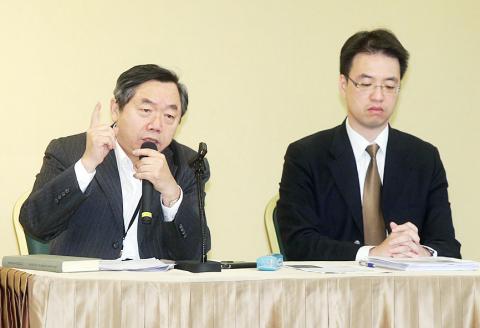
Photo: CNA
If the resolutions regarding property transfers are deemed inequitable, “does that mean that other laws passed from 1945 to 1947 are also inequitable and the history of Taiwan and the ROC would be missing a piece?” Chiu said.
The practice has been recorded as “transfer” rather than “transfer and appropriation” in the KMT’s early documents, Chiu said, adding that even the party headquarters had falsely used the latter term.
According to a Ministry of the Interior representative at the hearing, “appropriation” indicates the transfer of managing rights among government agencies, but does not involve change of ownership, adding that it is also not possible for government agencies to grant the “appropriation” of government-owned properties to non-governmental bodies.
Committee spokeswoman Shih Chin-fang (施錦芳) said that the Executive Yuan in 1947 approved the KMT’s takeover of only Japanese “houses” and not Japanese “land,” adding that the then-provincial property management agency held numerous discussions that all concluded that the land on which the houses were built was not to be transferred.
However, in 1954, the then-Taiwan Provincial Government’s request for the Executive Yuan’s permission for the “transfer and appropriation” of the land to the KMT was approved, Shih said, asking for an explanation on the change in government policy.
Committee member Lee Fu-chung (李福鐘) said that former provincial governor K.C. Wu (吳國楨) was opposed to the transfer, according to his autobiography.
However, Yu Hung-chun (俞鴻鈞), who succeeded Wu in April 1953, sent the request for transfer to the Executive Yuan immediately after assuming the post, Lee said, adding that Yu approved the request after he became premier in June 1954.
Regarding the KMT’s claim that the transfer was compensation for the party’s losses during the war against Japan, Yang Wei-chen (楊維真), a history professor at National Chung Cheng University who was invited by the KMT to the hearing, said the party was not the only entity that had benefited from the post-war compensation doled out by the state.
Yang said that the practice was “universal,” adding that then-private Nankai University in China was also compensated.
Asked whether it was the KMT’s army or the Nationalist army that fought the war, Yang said it was “definitely the Nationalist army.”
Fu Jen Catholic University philosophy professor Shen Ching-kai (沈清楷) said that in democracies political parties should recuse themselves from owning land, properties or accumulative capital, such as investing money through companies, as they might adopt policies and pass laws that benefit themselves rather than the public.
He added that there is “logical contradiction” in the KMT’s argument that the party on the one hand led the regime and, on the other, simply followed the government’s orders.
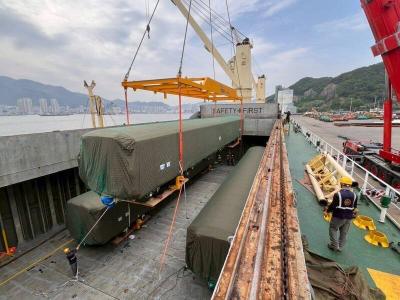
The first of 10 new high-capacity trains purchased from South Korea’s Hyundai Rotem arrived at the Port of Taipei yesterday to meet the demands of an expanding metro network, Taipei Rapid Transit Corp (TRTC) said yesterday. The train completed a three-day, 1,200km voyage from the Port of Masan in South Korea, the company said. Costing NT$590 million (US$18.79 million) each, the new six-carriage trains feature a redesigned interior based on "human-centric" transportation concepts, TRTC said. The design utilizes continuous longitudinal seating to widen the aisles and optimize passenger flow, while also upgrading passenger information displays and driving control systems for a more comfortable
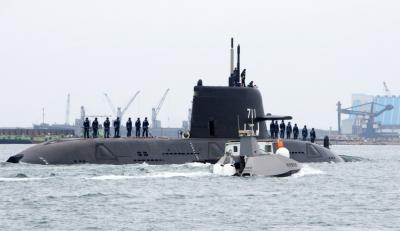
Taiwan's first indigenous defense submarine, the SS-711 Hai Kun (海鯤, or Narwhal), departed for its 13th sea trial at 7am today, marking its seventh submerged test, with delivery to the navy scheduled for July. The outing also marked its first sea deployment since President William Lai (賴清德) boarded the submarine for an inspection on March 19, drawing a crowd of military enthusiasts who gathered to show support. The submarine this morning departed port accompanied by CSBC Corp’s Endeavor Manta (奮進魔鬼魚號) uncrewed surface vessel and a navy M109 assault boat. Amid public interest in key milestones such as torpedo-launching operations and overnight submerged trials,
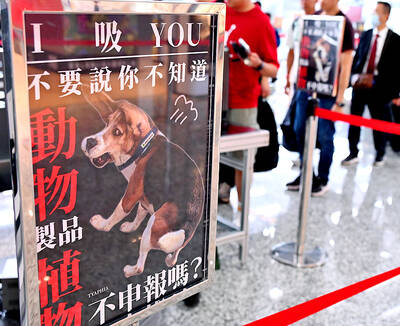
Quarantine awareness posters at Taiwan Taoyuan International Airport have gone viral for their use of wordplay. Issued by the airport branch of the Animal and Plant Health Inspection Agency, the posters feature sniffer dogs making a range of facial expressions, paired with advisory messages built around homophones. “We update the messages for holidays and campaign needs, periodically refreshing materials to attract people’s attention,” quarantine officials said. “The aim is to use the dogs’ appeal to draw focus to quarantine regulations.” A Japanese traveler visiting Taiwan has posted a photo on X of a poster showing a quarantine dog with a
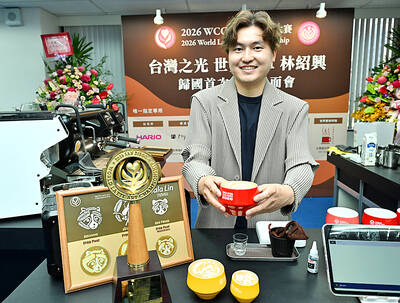
Taiwan’s coffee community has launched a “one-person-one-e-mail” campaign, calling for people to send a protest-e-mail to the World Coffee Championships (WCC) urging it to redesignate Taiwanese competitors as from “Taiwan,” rather than “Chinese Taipei.” The call followed sudden action last week after the WCC changed all references to Taiwanese competitors from “Taiwan” to “Chinese Taipei,” including recent World Latte Art champion Bala (林紹興), who won the World Latte Art Championship in San Diego earlier this month. When Bala received the trophy, he was referred to as representing Taiwan, as well as in the announcement on the WCC’s Web site, until it


 RSS
RSS