


Lawmakers yesterday clashed over supervisory articles governing negotiations with China during a question-and-answer session with Mainland Affairs Council (MAC) Minister Katharine Chang (張小月) at the legislature’s Internal Administration Committee.
“I feel that the Democratic Progressive Party [DPP] is not taking a sincere swing at this issue,” said Chinese Nationalist Party (KMT) Legislator William Tseng (曾銘宗), who, as committee coconvener, has scheduled a review of draft bills to begin tomorrow.
The MAC’s and the DPP caucus’ positions on the urgency of the review are contradictory, he said, questioning whether the council and the caucus were playing “good cop, bad cop” on the issue.
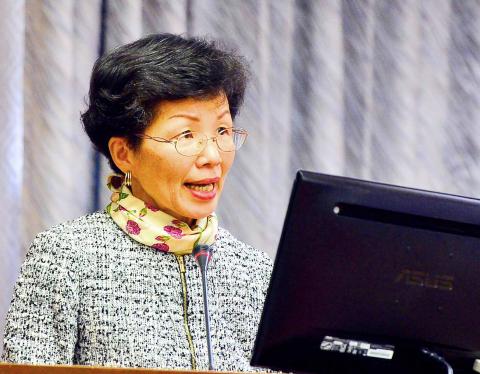
Photo: Wang Yi-sung, Taipei Times
“Even though the council says it attaches great importance to the issue, you have unbelievably refused to put forth your own version of the articles,” he said. “Your own draft version of the articles is supposed to stake out your position, strategy and policy direction, but you have not done any of this. Is that not strange?”
“I do not see the council taking any real action, other than coming here to read from a script,” KMT Legislator Huang Chao-shun (黃昭順) said.
Rebutting the allegations, Chang said: “I take a different view because we have consistently maintained that we hope the legislature can pass supervisory articles guaranteeing openness, transparency and civic participation.”
“We will not present our own version because we support the DPP caucus’ version,” she said, adding it would be inappropriate for the council to present a draft on how the legislature should supervise negotiations conducted by the council.
“As an executive body, all we would end up doing is insisting on our administrative autonomy, while the legislature is concerned with its right to supervise,” she said.
“At this stage, the supervisory articles are not an urgent issue, because of the overall state of cross-strait relations,” said DPP Legislator Pasuya Yao (姚文智), who serves as the committee’s DPP coconvener.
“It is not that the council does not want to hold discussions or that the DPP does not want to hold a review, but the reality is that it is going to be a while before this kind of law would actually be put to use,” he said.
The trade in services agreement has been shelved due to domestic controversy and there is little space for renegotiation because China has refused to contact President Tsai Ing-wen’s (蔡英文) administration, he said.
Passage of supervisory articles was a key demand of the Sunflower movement, which saw student activists occupy the legislature in 2014 to protest the agreement negotiated by the then-KMT government.

LOUD AND PROUD Taiwan might have taken a drubbing against Australia and Japan, but you might not know it from the enthusiasm and numbers of the fans Taiwan might not be expected to win the World Baseball Classic (WBC) but their fans are making their presence felt in Tokyo, with tens of thousands decked out in the team’s blue, blowing horns and singing songs. Taiwanese fans have packed out the Tokyo Dome for all three of their games so far and even threatened to drown out home team supporters when their team played Japan on Friday. They blew trumpets, chanted for their favorite players and had their own cheerleading squad who dance on a stage during the game. The team struggled to match that exuberance on the field, with
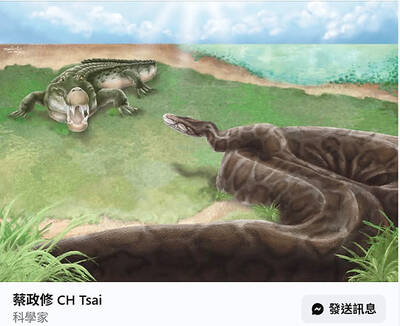
Taiwanese paleontologists have discovered fossil evidence that pythons up to 4m long inhabited Taiwan during the Pleistocene epoch, reporting their findings in the international scientific journal Historical Biology. National Taiwan University (NTU) Institute of Ecology and Evolutionary Biology associate professor Tsai Cheng-hsiu (蔡政修) led the team that discovered the largest snake fossil ever found in Taiwan. The single trunk vertebra was discovered in Tainan at the Chiting Formation, dated to between 400,000 and 800,000 years ago in the Middle Pleistocene, the paper said. The area also produced Taiwan’s first avian fossil, as well as crocodile, mammoth, saber-toothed cat and rhinoceros fossils, it said. Discoveries

Taiwanese paleontologists have discovered fossil evidence that pythons up to 4m long inhabited Taiwan during the Pleistocene epoch, reporting their findings in the international scientific journal Historical Biology. National Taiwan University (NTU) Institute of Ecology and Evolutionary Biology associate professor Tsai Cheng-hsiu (蔡政修) led the team that discovered the largest snake fossil ever found in Taiwan. A single trunk vertebra was discovered in Tainan at the Chiting Formation, dated to between 800,000 to 400,000 years ago in the Middle Pleistocene, the paper said. The area also produced Taiwan’s first avian fossil, as well as crocodile, mammoth, sabre-toothed cat and rhinoceros fossils, it said. Discoveries
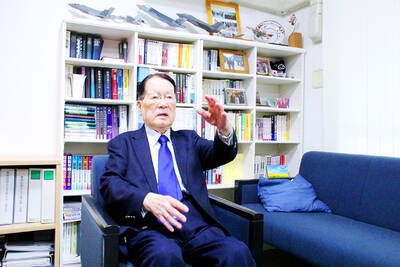
Whether Japan would help defend Taiwan in case of a cross-strait conflict would depend on the US and the extent to which Japan would be allowed to act under the US-Japan Security Treaty, former Japanese minister of defense Satoshi Morimoto said. As China has not given up on the idea of invading Taiwan by force, to what extent Japan could support US military action would hinge on Washington’s intention and its negotiation with Tokyo, Morimoto said in an interview with the Liberty Times (sister paper of the Taipei Times) yesterday. There has to be sufficient mutual recognition of how Japan could provide


 RSS
RSS