


Representatives from human rights organizations yesterday urged the Legislative Yuan to pass a draft bill on refugees as soon as possible.
At a news conference held to urge the swift passage of the bill, the groups played video footage of President Tsai Ing-wen (蔡英文) saying “freedom and human rights are values that Taiwanese cherish the most. Taiwan should not keep itself away from other nations when facing the issue of refugees,” during a charity event held for refugees in Taipei in June last year.
The draft bill — which would allow foreign or stateless victims of political or religious repression, war or natural disaster, who have been forced to leave their homelands to apply for asylum to gain the right to reside in Taiwan if their application is approved by a review committee — passed an initial review by a Legislative Yuan committee in July last year.
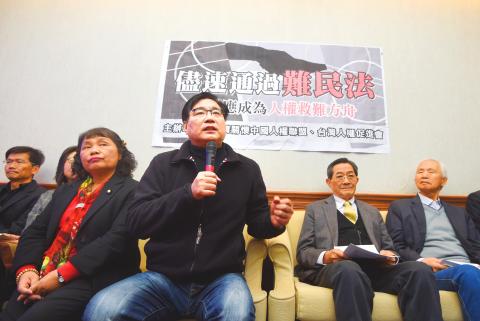
Photo: Fang Pin-chao, Taipei Times
However, representatives from the Taiwan Association for China Human Rights, the Taiwan Association for Human Rights and several other groups said that the human rights issue is not just an opportunity to gain publicity and Tsai should follow through with legislation.
As Taiwan claims to be a nation founded on human rights and has adopted content from international human rights conventions into law, the government should at least try to help people who seek asylum rather than just immediately repatriate them, Taiwan Association for Human Rights secretary-general Chiu E-ling (邱伊翎) said.
Although Taiwan has not passed a refugee law, the nation does not practice non-refoulement either, so the government should pass the draft legislation as soon as possible, Covenants Watch executive member Hsu Wei-chun (徐偉群) said.
“This is not just about passing a law; it also about creating a beacon in Asia,” Taiwan Association for China Human Rights chairman Yang Hsien-hung (楊憲宏) said.
There are hardly any safe national borders around China, and kidnapping is often heard of, so if Taiwan passes the legislation, it would become a relatively safe place for such refugees to stay, he said.

Taiwanese can file complaints with the Tourism Administration to report travel agencies if their activities caused termination of a person’s citizenship, Mainland Affairs Council Minister Chiu Chui-cheng (邱垂正) said yesterday, after a podcaster highlighted a case in which a person’s citizenship was canceled for receiving a single-use Chinese passport to enter Russia. The council is aware of incidents in which people who signed up through Chinese travel agencies for tours of Russia were told they could obtain Russian visas and fast-track border clearance, Chiu told reporters on the sidelines of an event in Taipei. However, the travel agencies actually applied

Japanese footwear brand Onitsuka Tiger today issued a public apology and said it has suspended an employee amid allegations that the staff member discriminated against a Vietnamese customer at its Taipei 101 store. Posting on the social media platform Threads yesterday, a user said that an employee at the store said that “those shoes are very expensive” when her friend, who is a migrant worker from Vietnam, asked for assistance. The employee then ignored her until she asked again, to which she replied: "We don't have a size 37." The post had amassed nearly 26,000 likes and 916 comments as of this

New measures aimed at making Taiwan more attractive to foreign professionals came into effect this month, the National Development Council said yesterday. Among the changes, international students at Taiwanese universities would be able to work in Taiwan without a work permit in the two years after they graduate, explainer materials provided by the council said. In addition, foreign nationals who graduated from one of the world’s top 200 universities within the past five years can also apply for a two-year open work permit. Previously, those graduates would have needed to apply for a work permit using point-based criteria or have a Taiwanese company

The Shilin District Prosecutors’ Office yesterday indicted two Taiwanese and issued a wanted notice for Pete Liu (劉作虎), founder of Shenzhen-based smartphone manufacturer OnePlus Technology Co (萬普拉斯科技), for allegedly contravening the Act Governing Relations Between the People of the Taiwan Area and the Mainland Area (臺灣地區與大陸地區人民關係條例) by poaching 70 engineers in Taiwan. Liu allegedly traveled to Taiwan at the end of 2014 and met with a Taiwanese man surnamed Lin (林) to discuss establishing a mobile software research and development (R&D) team in Taiwan, prosecutors said. Without approval from the government, Lin, following Liu’s instructions, recruited more than 70 software


 RSS
RSS