


The Democratic Progressive Party’s (DPP) representative office in Washington on Tuesday said that former president Ma Ying-jeou (馬英九) mixed up the US’ “one China” policy with Beijing’s “one China” principle in a speech at the Brookings Institution.
Ma misquoted US President Donald Trump’s telephone conversation with Chinese President Xi Jinping (習近平) on Dec. 2 last year, saying Trump had suggested the “one China policy” was up for negotiation by using the term “one China principle,” the office said.
Trump did not mention the “one China principle,” the office said in a statement.
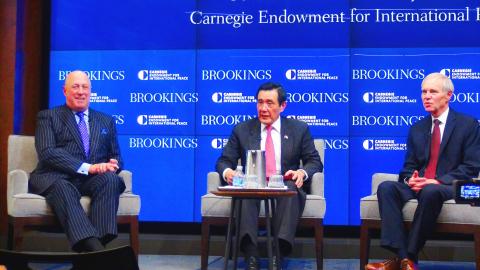
Photo: CNA
The “one China” principle was designed by Beijing as a strategy to deal with Taiwan and is based on the idea that the “government of the People’s Republic of China [PRC] is the sole legitimate government of China and there is only one China and Taiwan is part of China.”
In an interview with Fox News, Trump said he saw no reason for the US to continue abiding by the “one China” policy — under which Washington does not recognize Taiwan as a sovereign state — unless Beijing was prepared to enter into some kind of bargain, the office said in a statement.
Ma also misused the term when commenting on then-US president Barack Obama’s response to Trump’s remarks at a White House news conference on Dec. 16 last year, the statement said.
Obama said it was fine for Trump to review Washington’s “one China” policy toward Taiwan, but added that the Taiwan issue is of the utmost importance to China and how Beijing reacts to potential change could be significant, the DPP office said.
The US’ position regarding sovereignty over Taiwan remains consistent with its “one China policy”: The two sides of the Taiwan Strait should mutually and peacefully agree to a resolution of this as yet unsettled issue, the office said.

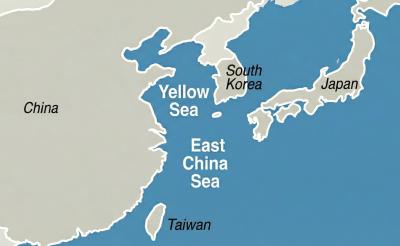
China has reserved offshore airspace in the Yellow Sea and East China Sea from March 27 to May 6, issuing alerts usually used to warn of military exercises, although no such exercises have been announced, the Wall Street Journal (WSJ) reported yesterday. Reserving such a large area for 40 days without explanation is an “unusual step,” as military exercises normally only last a few days, the paper said. These alerts, known as Notice to Air Missions (Notams), “are intended to inform pilots and aviation authorities of temporary airspace hazards or restrictions,” the article said. The airspace reserved in the alert is
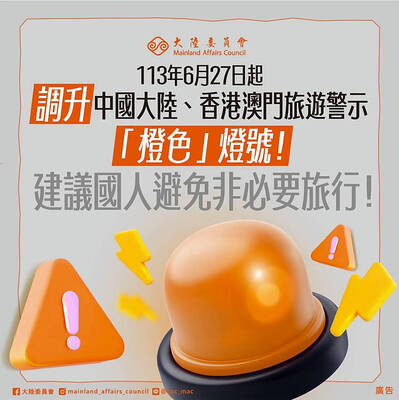
More than 6,000 Taiwanese students have participated in exchange programs in China over the past two years, despite the Mainland Affairs Council’s (MAC) “orange light” travel advisory, government records showed. The MAC’s publicly available registry showed that Taiwanese college and university students who went on exchange programs across the Strait numbered 3,592 and 2,966 people respectively. The National Immigration Agency data revealed that 2,296 and 2,551 Chinese students visited Taiwan for study in the same two years. A review of the Web sites of publicly-run universities and colleges showed that Taiwanese higher education institutions continued to recruit students for Chinese educational programs without
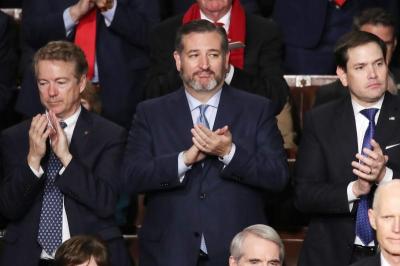
A bipartisan group of US senators has introduced a bill to enhance cooperation with Taiwan on drone development and to reduce reliance on supply chains linked to China. The proposed Blue Skies for Taiwan Act of 2026 was introduced by Republican US senators Ted Cruz and John Curtis, and Democratic US senators Jeff Merkley and Andy Kim. The legislation seeks to ease constraints on Taiwan-US cooperation in uncrewed aerial systems (UAS), including dependence on China-sourced components, limited access to capital and regulatory barriers under US export controls, a news release issued by Cruz on Wednesday said. The bill would establish a "Blue UAS
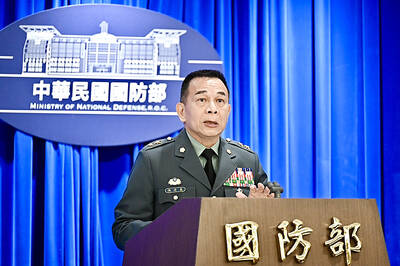
The Republic of China Army Command yesterday relieved Kinmen Defense Battalion commander after authorities indicted the officer on charges connected to using methamphetamine. The Kinmen District Prosecutors’ Office on Wednesday detained Colonel He (何) after the Coast Guard linked him to drug shipments and proceeded to charge him yesterday for using and possessing crystal meth. The man was released on a NT$50,000 bail and banned from leaving Kinmen, the office said. Army Chief of Staff Lieutenant General Chen Chien-yi (陳建義) told a news conference yesterday that He has been removed and another officer is taking over the unit as the acting commander. The military


 RSS
RSS