


Chinese Nationalist Party (KMT) Chairwoman Hung Hsiu-chu (洪秀柱) yesterday called the Democratic Progressive Party’s (DPP) effort to remove symbols of former president Chiang Kai-shek (蔣介石) from public spaces “an effort to ‘de-Republic of China [ROC]-ize’ and ‘desinicize’” Taiwan.
The KMT government had paid compensations, apologized, erected monuments and launched foundations about the 228 Incident when it was in power because “it believed in social harmony through understanding the historical truth, learning the lesson and letting go of the hatred,” she said.
“Sadly, the DPP government has continued to cash in on the Incident like it did [when it first came to power in 2000], and what it did for electoral gains in the name of truth-seeking now has become political persecution in the name of transitional justice,” she said.
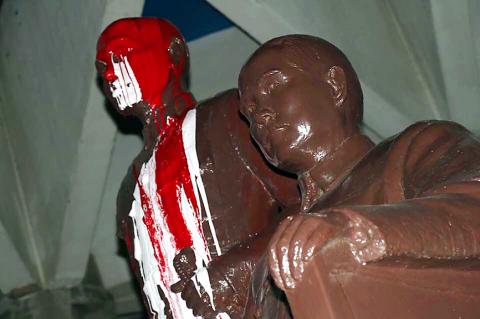
Photo: Courtesy of a Liberty Times reader
The government is planning to “demonize Chiang as Nazi leader Adolf Hitler [has been] and crucify him on the cross of history” and cleanse Taiwan of all the symbols representing the ROC in the name of transitional justice, Hung said.
“The acts of ‘removing Chiang’s symbols’ are the core of the ‘de-ROC-ization’ or we should say ‘desinicization project,’” she said.
By constructing a narrative that the ROC is a foreign regime that massacred people, the DPP government is “laying the political groundwork for Taiwanese independence,” the KMT leader said.
In related news, KMT Legislator Lee Yan-hsiu (李彥秀) said that President Tsai Ing-wen’s (蔡英文) call for the speedy passage of a bill promoting transitional justice was a fig leaf meant to cover the DPP’s poor performance.
“As the DPP is holding office, there is plenty of administrative room for it to deal with historical documents. The call for the passage of the bill within the current legislative session would only stir up more social antagonism,” Lee said.
Tsai’s pledge was only aimed at assuaging the demands of DPP supporters, Lee said.
KMT Legislator Alicia Wang (王育敏) said the committee for promoting transitional justice that is to be set up in accordance under the proposed legislation would be another unconstitutional agency that would work over the heads of current officials.
Tsai needs to stop focusing on politics and working outside the legal framework and turn her focus to the public’s daily needs, Wang said.
However, DPP Legislator Chao Tien-lin (趙天麟) said the transitional justice bill is pending legislative committee review and could clear the Legislative Yuan if the government deems it necessary.
“If Taiwanese society believes that Nazi cosplay is unacceptable, there should be no insistence on worshiping an autocrat,” he said.
Citing Germany as an example, he said that its economic development and national power were not hampered by its pursuit of transitional justice.
DPP Legislator Lo Chih-cheng (羅致政) said people should not be so quick to label the bill political persecution, saying a fair and just examination of the bill could only be done after the concrete articles are established since the bill covers a wide range of matters.
The draft bill is necessary for transitional justice, Lo said.

LOUD AND PROUD Taiwan might have taken a drubbing against Australia and Japan, but you might not know it from the enthusiasm and numbers of the fans Taiwan might not be expected to win the World Baseball Classic (WBC) but their fans are making their presence felt in Tokyo, with tens of thousands decked out in the team’s blue, blowing horns and singing songs. Taiwanese fans have packed out the Tokyo Dome for all three of their games so far and even threatened to drown out home team supporters when their team played Japan on Friday. They blew trumpets, chanted for their favorite players and had their own cheerleading squad who dance on a stage during the game. The team struggled to match that exuberance on the field, with
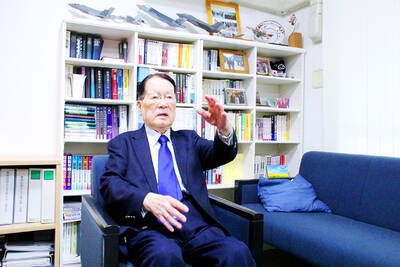
Whether Japan would help defend Taiwan in case of a cross-strait conflict would depend on the US and the extent to which Japan would be allowed to act under the US-Japan Security Treaty, former Japanese minister of defense Satoshi Morimoto said. As China has not given up on the idea of invading Taiwan by force, to what extent Japan could support US military action would hinge on Washington’s intention and its negotiation with Tokyo, Morimoto said in an interview with the Liberty Times (sister paper of the Taipei Times) yesterday. There has to be sufficient mutual recognition of how Japan could provide
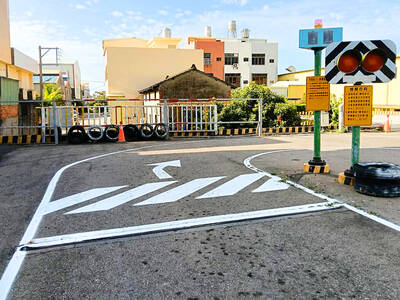
UPDATED TEST: The new rules aim to assess drivers’ awareness of risky behaviors and how they respond under certain circumstances, the Highway Bureau said Driver’s license applicants who fail to yield to pedestrians at intersections or to check blind spots, or omit pointing-and-calling procedures would fail the driving test, the Highway Bureau said yesterday. The change is set to be implemented at the end of the month, and is part of the bureau’s reform of the driving portion of the test, which has been criticized for failing to assess whether drivers can operate vehicles safely. Sedan drivers would be tested regarding yielding to pedestrians and turning their heads to check blind spots, while drivers of large vehicles would be tested on their familiarity with pointing-and-calling

A Taiwanese man apologized on Friday after saying in a social media post that he worked with Australia to provide scouting reports on Taiwan’s team, enabling Australia’s victory in this year’s World Baseball Classic (WBC), saying it was a joke and that he did not hold any position with foreign teams or Taiwan’s sports training center. Chen Po-hao (陳柏豪) drew the rage of many Taiwan baseball fans when he posted online on Thursday night, claiming credit for Australia’s 3-0 win over Taiwan in the opening game for Pool C, saying he worked as a physical therapist with the national team and


 RSS
RSS