


Members of a new Democratic Progressive Party (DPP) committee on immigrants were inaugurated yesterday to advise the party on immigration issues amid rapid growth in the number of immigrants living in Taiwan.
The committee was established to address the needs of new immigrants, which make up the fifth-largest ethnic group in the nation, President Tsai Ing-wen (蔡英文) said at a ceremony held at DPP headquarters in Taipei.
The DPP was the first party to commit itself to issues relating to Aborigines and the party’s new immigrant committee is another step forward, said Tsai, who doubles as DPP chair.
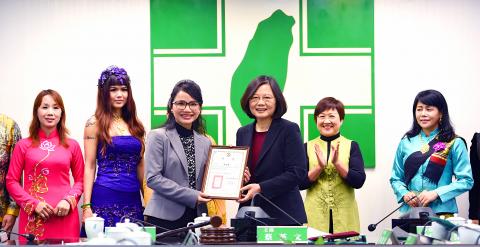
Photo: Liu Hsin-de, Taipei Times
“The number of immigrants has reached nearly 500,000 and the number of their children is more than 350,000. As a party responsive to public opinion and emphasizing ethnic pluralism, the DPP has to address the needs and opinions of new immigrants,” Tsai said.
The committee would help the nation become more multicultural and tolerant, as well as promoting exchanges with other cultures, she said.
Twelve committee members were announced yesterday, including TV star Tran Thi Hoang Phuong; Changhua County New Immigrants Association director Lee Meng-han (李孟涵); Indonesian lecturer Hung Ching-ching (洪晶晶); Thai dancer Hsu Chen-ni (許珍妮); Chang Yi-hui (張義惠), a member of a women’s group who supported Tsai’s presidential campaign; and Hualien County New Immigrant Association director Hung Yu (洪玉).
Chinese immigrant Ning Jiarong (寧家榮), the founder of a cosmetics company; and National Chi Nan University professor Ho Ching-jung (何景榮), an Indonesian-Taiwanese, were also named.
The other committee members are experts on immigration issues — DPP Deputy Secretary-General Hsu Chia-ching (徐佳青); women’s rights campaigner Tsai Shun-jou (蔡順柔); National Cheng Kung University professor Tan Le-kun (陳麗君); and National Kaohsiung University professor Ho Ching-jung (何青蓉).
Tran, who is to be chairwoman, said the establishment of the committee shows that the nation’s leadership has attached great importance to issues concerning immigrants.
A wider participation of immigrants in the nation’s decisionmaking process would harness the creativity of immigrants, Tran said.
Ning, a former member of the Chinese Communist Party, said she had withdrawn from the party and obtained Republic of China citizenship.
Her work on the committee would see her address issues that concern Chinese spouses living in Taiwan, such as the relatively longer process for Chinese spouses to obtain citizenship compared with immigrants from other nations.
There are 330,000 Chinese spouses in Taiwan and their rights have improved over the years, and she would seek further improvements, despite the “historical factors,” Ning said.

The manufacture of the remaining 28 M1A2T Abrams tanks Taiwan purchased from the US has recently been completed, and they are expected to be delivered within the next one to two months, a source said yesterday. The Ministry of National Defense is arranging cargo ships to transport the tanks to Taiwan as soon as possible, said the source, who is familiar with the matter. The estimated arrival time ranges from late this month to early next month, the source said. The 28 Abrams tanks make up the third and final batch of a total of 108 tanks, valued at about NT$40.5 billion

A group from the Taiwanese Designers in Australia association yesterday represented Taiwan at the Midsumma Pride March in Melbourne. The march, held in the St. Kilda suburb, is the city’s largest LGBTQIA+ parade and the flagship event of the annual Midsumma Festival. It attracted more than 45,000 spectators who supported the 400 groups and 10,000 marchers that participated this year, the association said. Taiwanese Designers said they organized a team to march for Taiwan this year, joining politicians, government agencies, professionals and community organizations in showing support for LGBTQIA+ people and diverse communities. As the first country in Asia to legalize same-sex

Travel agencies in Taiwan are working to secure alternative flights for travelers bound for New Zealand for the Lunar New Year holiday, as Air New Zealand workers are set to strike next week. The airline said that it has confirmed that the planned industrial action by its international wide-body cabin crew would go ahead on Thursday and Friday next week. While the Auckland-based carrier pledged to take reasonable measures to mitigate the impact of the workers’ strike, an Air New Zealand flight arriving at Taipei from Auckland on Thursday and another flight departing from Taipei for Auckland on Saturday would have to
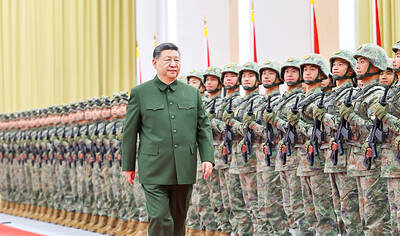
MOTIVES QUESTIONED The PLA considers Xi’s policies toward Taiwan to be driven by personal considerations rather than military assessment, the Epoch Times reports Chinese President Xi Jinping’s (習近平) latest purge of the Chinese People’s Liberation Army (PLA) leadership might have been prompted by the military’s opposition to plans of invading Taiwan, the Epoch Times said. The Chinese military opposes waging war against Taiwan by a large consensus, putting it at odds with Xi’s vision, the Falun Gong-affiliated daily said in a report on Thursday, citing anonymous sources with insight into the PLA’s inner workings. The opposition is not the opinion of a few generals, but a widely shared view among the PLA cadre, the Epoch Times cited them as saying. “Chinese forces know full well that


 RSS
RSS