

The Ministry of Justice yesterday announced a set of measures to reform the prosecutorial system — including allowing public input in the evaluation of prosecutors — to meet public calls for changes and pave the way for the upcoming national affairs conference on judicial reform.
“Many people have expressed their concern over the scrutiny of prosecutors and their conduct in handing criminal cases. They have also expressed their support for more public input in the judicial process,” Minister of Justice Chiu Tai-san (邱太三) told a news conference, where he was joined by Prosecutor-General Yen Ta-ho (顏大和) and Taiwan High Prosecutors’ Office Chief Prosecutor Wang Tien-cheng (王添盛).
“The ministry is willing to lead the change by starting with reforms to the prosecutorial system,” Chiu said.
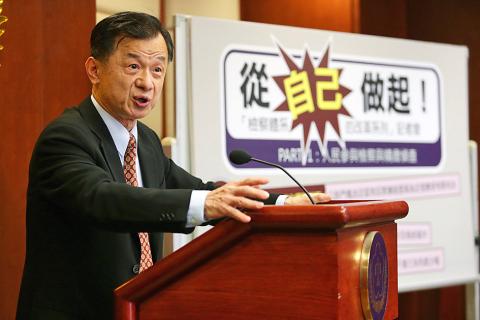
Photo: CNA
The new measures include enhancing teamwork and promoting investigative competence, raising the threshold on indictments, adding public input in the “prosecutors’ review committee” and improving the system for evaluating prosecutors’ performance.
To improve teamwork and competency, Chiu said the name of the head prosecutor and subordinate prosecutors handling major criminal proceedings should be listed for public scrutiny.
“We have seen prosecutors diligently put in efforts to improve their work in recent years, maintaining a conviction rate of more than 96 percent and a non-conviction rate of about 3 percent,” Chiu said. “We cannot compare yet with Japan’s more than 99 percent conviction rate, but our prosecutors are doing good work compared with other advanced, democratic countries.”
He said Taiwan compares quite favorable with the US and Germany, whose non-conviction rates are 8.7 percent and about 3 percent respectively.
“We do have flaws in a few of the prosecution cases, and since these cases have affected individuals’ rights, they have led to an accumulation of public discontent and grievances. The public naturally expects prosecutors to conduct prosecution in a thorough and meticulous manner. The ministry must therefore lead the way to reform, instead of becoming the target for reform in the upcoming national affairs conference,” Chiu said.
To enhance the evaluation system for prosecutors, members of the public will be chosen to join the prosecutors’ review committee and committee members will be empowered to initiate probes into cases deemed in need of redress or rectification, he said.
The committee would be vested with the authority to mete out disciplinary measures upon finding negligence or wrongdoing by prosecutors, he said.
At present, the committee can only make recommendations for prosecutors, which could be overturned by other committees, resulting in accusations of prosecutors covering up for their colleagues.
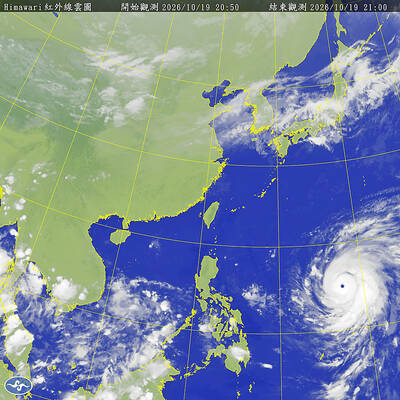
Typhoon Champi is forecast to turn northward earlier than previously expected, sparing Taiwan a direct hit but still bringing heavy rain to the north of the country on Friday and Saturday, the Central Weather Administration (CWA) said yesterday. Typhoon Champi had strengthened and increased in size over the past 12 hours, and as of yesterday afternoon, was packing sustained winds of 198kph near its center, CWA forecaster Cheng Chieh-jen (鄭傑仁) said. However, due to the weakening of a Pacific high-pressure system the storm is now expected to turn northward earlier than initially forecast, likely around Japan’s Ishigaki Island, Cheng said. As Champi brushes

MAYORAL RACE: Su Chiao-hui made gains by persuading undecided voters and winning over voters in KMT-leaning districts, a pollster said Legislator Su Chiao-hui (蘇巧慧), the Democratic Progressive Party’s (DPP) candidate for New Taipei City mayor, has a 13.1 percentage point lead over her Chinese Nationalist Party (KMT) rival Lee Shu-chuan (李四川), a poll released yesterday showed. The poll, commissioned by the Taipei Trust in Democracy Association, showed that 43.1 percent of respondents said they would vote for Su, up 7.9 percentage points from a poll conducted in late August, while support for Lee was at 30 percent, down 4.7 percentage points. It showed that 48.6 percent of respondents thought Su would make a suitable mayor, compared with 35.9 percent for Lee. Independent candidate
A Chinese People's Liberation Army (PLA) Navy aircraft carrier group was being monitored after entering the western Pacific, the Ministry of National Defense said today, after Beijing yesterday criticized Taiwan for using a water cannon against a Chinese fishing boat near the Pratas Islands (Dongsha Islands, 東沙群島). A Chinese naval task group led by the aircraft carrier Liaoning (遼寧) yesterday sailed to the western Pacific for training, Chinese state-run Xinhua news agency quoted the PLA Navy as saying. “The drill is part of the annual routine training plan aimed at testing and improving the troops’ combat readiness and enhancing their ability to
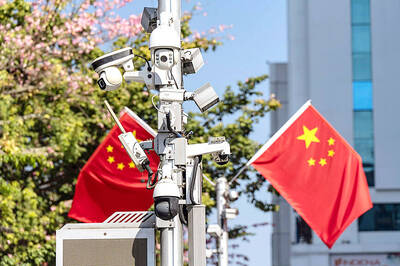
Pulled aside onto the balcony of an empty hotel room by Chinese state security officers, a Taiwanese tourist on a trip to Tibet described facing an unnerving barrage of questions about his military background and political loyalties. The man surnamed Lin (林) reported his experience in a viral post on Threads before accepting an interview with the Central News Agency (CNA) yesterday. Lin, who works as a nurse, told CNA that he knew some Taiwanese had run afoul of Chinese law enforcement, but he thought he would be safe, as he did not post much about his personal political views online. It came


 RSS
RSS