


The Ministry of Foreign Affairs yesterday said that it is working to secure an invitation for Taiwan to attend this year’s World Health Assembly (WHA) as an observer, announcing the nation’s desire to contribute to the promotion of public health worldwide.
The ministry said in a statement that Taiwan will make every effort to solicit the support of allies and nations that share similar ideas in the hope that it will be invited to the assembly when it gathers in May.
Taiwan wants to “continue to attend [the meeting] in a pragmatic and meaningful way, and to make a contribution,” the ministry said.
The statement came in the wake of media reports saying Taiwan might not receive an invitation from the WHO to attend the assembly this year.
The assembly, the WHO’s decisionmaking body, gathers annually in Geneva, Switzerland, and is attended by representatives of the WHO’s 194 member states, including the People’s Republic of China (PRC).
The Chinese-language United Daily News yesterday quoted Lin Shih-chia (林世嘉), executive director of the Taipei-based Foundation of Medical Professionals Alliance, as saying that it was unlikely Taiwan would attend the WHA this year.
“This has been a common understanding in the sector,” Lin reportedly said.
Lin blamed the development on “maneuvering by communist China,” which he said was also evident last year when the WHO cited the “one China” principle in its invitation to Taiwan.
WHA is to take place from May 22 to May 31, the Ministry of Foreign Affairs said, adding that the WHO secretariat is to begin sending out invitations next month.
Taiwan had since 2009 been granted observer status at the gathering under the name “Chinese Taipei.”
However, last year, in an unprecedented move, the WHO cited UN Resolution 2758, Resolution WHA 25.1 and the “one China” principle as “reflected therein” in its invitation to Taiwan.
UN Resolution 2758, passed on Oct. 25, 1971, recognizes the representatives of the PRC government as “the only legitimate representatives of China,” expelling the representatives of the Republic of China from the UN.
Resolution WHA 25.1 expelled the Republic of China (ROC) from the WHO in 1972.
Last year’s invitation came shortly before President Tsai Ing-wen (蔡英文) was sworn in as president on May 20 last year.
Observers have said that Taiwan was allowed to attend last year’s WHA because Beijing was still observing what cross-strait policy the Tsai administration would adopt.

LOUD AND PROUD Taiwan might have taken a drubbing against Australia and Japan, but you might not know it from the enthusiasm and numbers of the fans Taiwan might not be expected to win the World Baseball Classic (WBC) but their fans are making their presence felt in Tokyo, with tens of thousands decked out in the team’s blue, blowing horns and singing songs. Taiwanese fans have packed out the Tokyo Dome for all three of their games so far and even threatened to drown out home team supporters when their team played Japan on Friday. They blew trumpets, chanted for their favorite players and had their own cheerleading squad who dance on a stage during the game. The team struggled to match that exuberance on the field, with
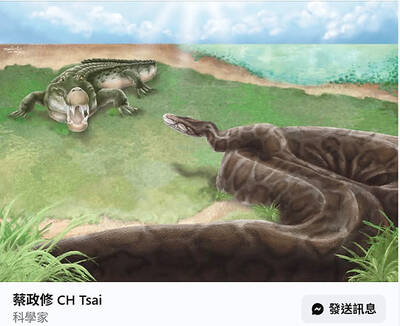
Taiwanese paleontologists have discovered fossil evidence that pythons up to 4m long inhabited Taiwan during the Pleistocene epoch, reporting their findings in the international scientific journal Historical Biology. National Taiwan University (NTU) Institute of Ecology and Evolutionary Biology associate professor Tsai Cheng-hsiu (蔡政修) led the team that discovered the largest snake fossil ever found in Taiwan. The single trunk vertebra was discovered in Tainan at the Chiting Formation, dated to between 400,000 and 800,000 years ago in the Middle Pleistocene, the paper said. The area also produced Taiwan’s first avian fossil, as well as crocodile, mammoth, saber-toothed cat and rhinoceros fossils, it said. Discoveries

Taiwanese paleontologists have discovered fossil evidence that pythons up to 4m long inhabited Taiwan during the Pleistocene epoch, reporting their findings in the international scientific journal Historical Biology. National Taiwan University (NTU) Institute of Ecology and Evolutionary Biology associate professor Tsai Cheng-hsiu (蔡政修) led the team that discovered the largest snake fossil ever found in Taiwan. A single trunk vertebra was discovered in Tainan at the Chiting Formation, dated to between 800,000 to 400,000 years ago in the Middle Pleistocene, the paper said. The area also produced Taiwan’s first avian fossil, as well as crocodile, mammoth, sabre-toothed cat and rhinoceros fossils, it said. Discoveries
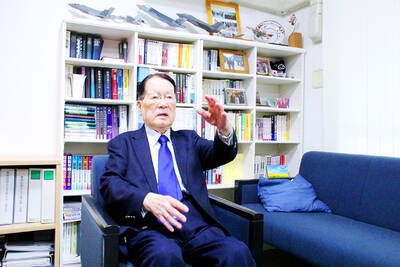
Whether Japan would help defend Taiwan in case of a cross-strait conflict would depend on the US and the extent to which Japan would be allowed to act under the US-Japan Security Treaty, former Japanese minister of defense Satoshi Morimoto said. As China has not given up on the idea of invading Taiwan by force, to what extent Japan could support US military action would hinge on Washington’s intention and its negotiation with Tokyo, Morimoto said in an interview with the Liberty Times (sister paper of the Taipei Times) yesterday. There has to be sufficient mutual recognition of how Japan could provide


 RSS
RSS