


The Ministry of National Defense has proposed a military aviation bill to the Executive Yuan.
Since the promulgation of the Civil Aviation Act (民用航空法) on May 30, 1953, the military has relied on it for legal operations regarding its air bases, the ministry said, adding that no tailor-made law exists to govern military aviation.
It was expected that a military aviation act would be enacted by the legislature for military purposes, but governments have failed for 64 years since the promulgation of the act to enact a military version of the law, it said.
The military needs laws to deal with several situations not covered by the act, such as drones that compromise military flight operations and the organization of investigations into military aviation incidents, it added.
The draft proposes a prison sentence of no more than five years for any civilian found guilty of inflicting damage to military aircraft, air bases or auxiliary equipment, or causing them to become otherwise inoperable, or a sentence of no more than three years in minor cases, the ministry said.
Any active service personnel found guilty of the same charges would be punished in accordance with the Criminal Code of the Armed Forces (陸海空軍刑法), the ministry said.
A fine of between NT$300,000 and NT$1.5 million (US$9,662 and US$48,309) would be given to those who do not remove or improve installations that obstruct signal lights and devices after a first warning, the draft bill states.
According to the draft act, the fine could be levied against persons whose farm animals — including domesticated pigeons — interfere with flight safety at military bases, or cause disruptions to operations at military air bases with remotely-piloted drones, the ministry said.
The draft act would authorize the government to issue multiple fines to repeat offenders, it added.

SHIPS, TRAINS AND AUTOMOBILES: The ministry has announced changes to varied transportation industries taking effect soon, with a number of effects for passengers Beginning next month, the post office is canceling signature upon delivery and written inquiry services for international registered small packets in accordance with the new policy of the Universal Postal Union, the Ministry of Transportation and Communications said yesterday. The new policy does not apply to packets that are to be delivered to China, the ministry said. Senders of international registered small packets would receive a NT$10 rebate on postage if the packets are sent from Jan. 1 to March 31, it added. The ministry said that three other policies are also scheduled to take effect next month. International cruise ship operators

NUMBERS IMBALANCE: More than 4 million Taiwanese have visited China this year, while only about half a million Chinese have visited here Beijing has yet to respond to Taiwan’s requests for negotiation over matters related to the recovery of cross-strait tourism, the Tourism Administration said yesterday. Taiwan’s tourism authority issued the statement after Chinese-language daily the China Times reported yesterday that the government’s policy of banning group tours to China does not stop Taiwanese from visiting the country. As of October, more than 4.2 million had traveled to China this year, exceeding last year. Beijing estimated the number of Taiwanese tourists in China could reach 4.5 million this year. By contrast, only 500,000 Chinese tourists are expected in Taiwan, the report said. The report
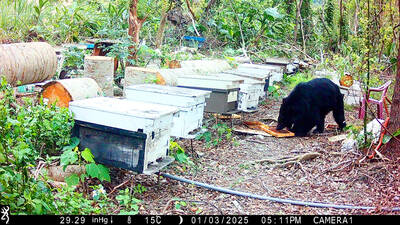
The Forestry and Nature Conservation Agency yesterday launched a gift box to market honey “certified by a Formosan black bear” in appreciation of a beekeeper’s amicable interaction with a honey-thieving bear. Beekeeper Chih Ming-chen (池明鎮) in January inspected his bee farm in Hualien County’s Jhuosi Township (卓溪) and found that more than 20 beehives had been destroyed and many hives were eaten, with bear droppings and paw prints near the destroyed hives, the agency said. Chih returned to the farm to move the remaining beehives away that evening when he encountered a Formosan black bear only 20m away, the agency said. The bear

Chinese embassy staffers attempted to interrupt an award ceremony of an international tea competition in France when the organizer introduced Taiwan and displayed the Republic of China flag, a Taiwanese tea farmer said in an interview published today. Hsieh Chung-lin (謝忠霖), chief executive of Juxin Tea Factory from Taichung's Lishan (梨山) area, on Dec. 2 attended the Teas of the World International Contest held at the Peruvian embassy in Paris. Hsieh was awarded a special prize for his Huagang Snow Source Tea by the nonprofit Agency for the Valorization of Agricultural Products (AVPA). During the ceremony, two Chinese embassy staffers in attendance


 RSS
RSS