


The Executive Yuan on Thursday approved a four-year economic development plan to increase GDP growth to between 2.5 and 3 percent over the next four years.
For this year, the National Development Council (NDC) is to target GDP growth of 2 to 2.5 percent, which is higher than the Directorate General of Budget, Accounting and Statistics forecast in November last year, when it estimated growth of 1.87 percent.
At a news conference to announce the 2017-2020 economic development plan, Executive Yuan spokesman Hsu Kuo-yung (徐國勇) quoted Premier Lin Chuan (林全) as saying that the government considers the GDP growth target to be one of its major challenges.
The Cabinet will instruct all government agencies to focus on boosting the economy and achieving the economic growth target for the four-year period, Hsu said.
The Executive Yuan will monitor the global economy closely to be ready to adjust economic growth plans if necessary, he said.
NDC Deputy Minister Kao Shien-quey (高仙桂) said that the council believes the global economy will pick up over the next four years and that global trade will continue to grow at a moderate pace.
However, Kao said the global economy also faces several risks, including uncertainty caused by US President Donald Trump’s anti-globalization stance, a move by the UK to trigger its exit from the EU, economic reforms in China and the US Federal Reserve’s rate hike cycle.
At home, the economy faces a labor shortage and the local investment environment needs to be improved, Kao said.
Kao said the government will do its best to address challenges at home and abroad and work on the economy through policies to boost innovation, improve employment and increase wealth distribution.
The government’s economic priority is to raise investment in innovative industries and infrastructure, including digital industries, “green” energy, transportation and water resources, Kao said.
In addition, Kao said the government will push for a wide range of reforms, including legal reforms and tax reforms, while eying an upgrade in labor quality, financial technology and improved land utilization.
Kao said that the council expects Taiwan’s GDP per capita for last year to range from US$23,100 to US$23,300, the consumer price index (CPI) to reach a maximum of 2 percent and the jobless rate to be from 3.9 to 3.93 percent.
For the next four years, the council is targeting GDP per capita of US$25,000 to US$26,000, a CPI of up to 2 percent and unemployment of 3.75 to 3.82 percent, Kao said.
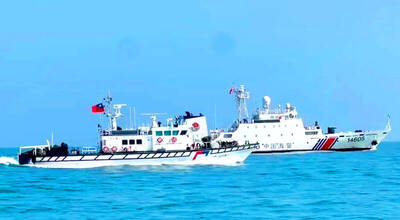
Instead of focusing solely on the threat of a full-scale military invasion, the US and its allies must prepare for a potential Chinese “quarantine” of Taiwan enforced through customs inspections, Stanford University Hoover fellow Eyck Freymann said in a Foreign Affairs article published on Wednesday. China could use various “gray zone” tactics in “reconfiguring the regional and ultimately the global economic order without a war,” said Freymann, who is also a nonresident research fellow at the US Naval War College. China might seize control of Taiwan’s links to the outside world by requiring all flights and ships entering or leaving Taiwan
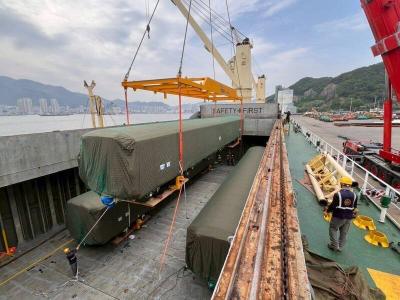
The first of 10 new high-capacity trains purchased from South Korea’s Hyundai Rotem arrived at the Port of Taipei yesterday to meet the demands of an expanding metro network, Taipei Rapid Transit Corp (TRTC) said yesterday. The train completed a three-day, 1,200km voyage from the Port of Masan in South Korea, the company said. Costing NT$590 million (US$18.79 million) each, the new six-carriage trains feature a redesigned interior based on "human-centric" transportation concepts, TRTC said. The design utilizes continuous longitudinal seating to widen the aisles and optimize passenger flow, while also upgrading passenger information displays and driving control systems for a more comfortable
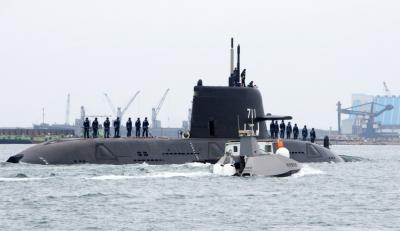
Taiwan's first indigenous defense submarine, the SS-711 Hai Kun (海鯤, or Narwhal), departed for its 13th sea trial at 7am today, marking its seventh submerged test, with delivery to the navy scheduled for July. The outing also marked its first sea deployment since President William Lai (賴清德) boarded the submarine for an inspection on March 19, drawing a crowd of military enthusiasts who gathered to show support. The submarine this morning departed port accompanied by CSBC Corp’s Endeavor Manta (奮進魔鬼魚號) uncrewed surface vessel and a navy M109 assault boat. Amid public interest in key milestones such as torpedo-launching operations and overnight submerged trials,
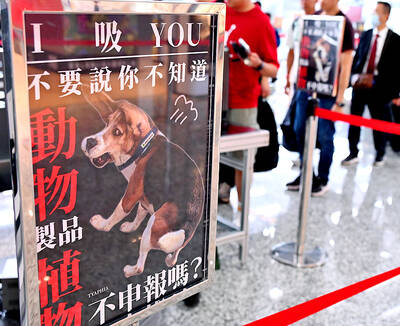
Quarantine awareness posters at Taiwan Taoyuan International Airport have gone viral for their use of wordplay. Issued by the airport branch of the Animal and Plant Health Inspection Agency, the posters feature sniffer dogs making a range of facial expressions, paired with advisory messages built around homophones. “We update the messages for holidays and campaign needs, periodically refreshing materials to attract people’s attention,” quarantine officials said. “The aim is to use the dogs’ appeal to draw focus to quarantine regulations.” A Japanese traveler visiting Taiwan has posted a photo on X of a poster showing a quarantine dog with a


 RSS
RSS