


On World Wetland Day yesterday, environmentalists urged the Changhua County Government to protect its coastal wetlands, saying it should stop opposing the central government’s plans to designate the zone as a national conservation area.
According to Changhua County Environmental Protection Union members at a protest near the county government office in Changhua City, the wetlands at the mouth of the Jhuoshuei River (濁水溪) are the largest collection of mudflats in Taiwan, with a total area of 13,269 hectares.
The area contains more protected species of birds than anywhere else in the nation and provides habitats for other species of environmental or economic value, such as the Taiwanese fiddler crab, the Indo-Pacific humpback dolphin and Austinogebia edulis, a mud shrimp traditionally served as a local delicacy, the union said.
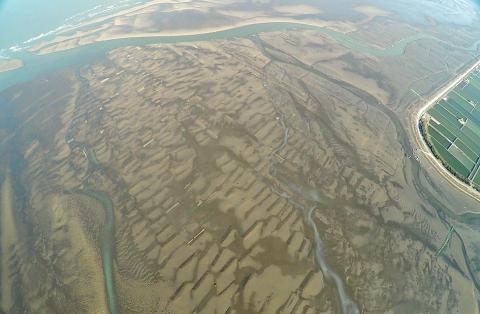
Photo courtesy of the Changhua Environmental Protection Union
In spite of being nominated by the Biodiversity Working Group of the Executive Yuan as a “national wetland of importance” in 2006 and 2009, the wetlands did not receive the designation due to opposition from the county government, which was committed to reclaiming parts of it for oil refineries, the union said.
Known as the Kuokuang Petrochemical Park, the now-defunct project resulted in the loss of 4,000 hectares of the wetland to land-fill operations, but the county government had since put the construction on indefinite hold and no refineries were built, the union said.
As the county government had apparently abandoned plans to develop the coast for industry after the demise of the Kuokuang plan, it should formally reverse its policy and ask the Executive Yuan to grant the wetlands protected status, it said, adding that 83 smaller wetlands have already been incorporated under the national wetlands protection scheme.
Local residents’ opposition to incorporating the area as national wetlands is unwarranted, the union said.
According to the Wetland Conservation Act (濕地保育法), granting national wetland status to an area does not affect its use by local agriculture, fishing, salt production or construction sectors, and will not interfere with land-use by private landowners, the union added.
Taiwan’s endemic subspecies of Indo-Pacific humpback dolphins will certainly become extinct without national efforts to conserve Changhua’s wetlands, environmentalist Wu Hui-chun (吳慧君) said, adding that the population of about 70 dolphins in the area are dependent on Changhua’s coastal wetlands.
Changhua Department of Planning Director Hsieh Chang-ta (謝昌達) said the county is in favor of conserving the wetlands.
Ongoing construction projects on the coast are aimed at community revitalization and are not for industrial construction or urban expansion, Hsieh said.
Many fishermen are opposed to the area being given the status, because they mistakenly believe that authorities would invoke the act to deny them rights to catch or farm fish, Changhua Department of City and Tourism Director Tien Fei-peng (田飛鵬) said.
While local fishermen and fish farmers are required to register fishing operations at sea near a national wetland, the law was written specifically to protect existing local businesses, Tien said.

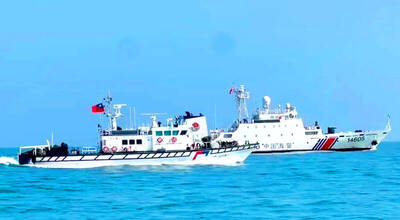
The military has spotted two Chinese warships operating in waters near Penghu County in the Taiwan Strait and sent its own naval and air forces to monitor the vessels, the Ministry of National Defense (MND) said. Beijing sends warships and warplanes into the waters and skies around Taiwan on an almost daily basis, drawing condemnation from Taipei. While the ministry offers daily updates on the locations of Chinese military aircraft, it only rarely gives details of where Chinese warships are operating, generally only when it detects aircraft carriers, as happened last week. A Chinese destroyer and a frigate entered waters to the southwest
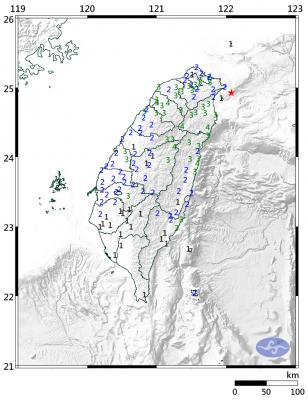
A magnitude 6.1 earthquake struck off the coast of Yilan County at 8:39pm tonight, the Central Weather Administration (CWA) said, with no immediate reports of damage or injuries. The epicenter was 38.7km east-northeast of Yilan County Hall at a focal depth of 98.3km, the CWA’s Seismological Center said. The quake’s maximum intensity, which gauges the actual physical effect of a seismic event, was a level 4 on Taiwan’s 7-tier intensity scale, the center said. That intensity level was recorded in Yilan County’s Nanao Township (南澳), Hsinchu County’s Guansi Township (關西), Nantou County’s Hehuanshan (合歡山) and Hualien County’s Yanliao (鹽寮). An intensity of 3 was
Instead of focusing solely on the threat of a full-scale military invasion, the US and its allies must prepare for a potential Chinese “quarantine” of Taiwan enforced through customs inspections, Stanford University Hoover fellow Eyck Freymann said in a Foreign Affairs article published on Wednesday. China could use various “gray zone” tactics in “reconfiguring the regional and ultimately the global economic order without a war,” said Freymann, who is also a nonresident research fellow at the US Naval War College. China might seize control of Taiwan’s links to the outside world by requiring all flights and ships entering or leaving Taiwan

The next minimum wage hike is expected to exceed NT$30,000, President William Lai (賴清德) said yesterday during an award ceremony honoring “model workers,” including migrant workers, at the Presidential Office ahead of Workers’ Day today. Lai said he wished to thank the awardees on behalf of the nation and extend his most sincere respect for their hard work, on which Taiwan’s prosperity has been built. Lai specifically thanked 10 migrant workers selected for the award, saying that although they left their home countries to further their own goals, their efforts have benefited Taiwan as well. The nation’s industrial sector and small businesses lay


 RSS
RSS