


Former Chinese Nationalist Party (KMT) vice chairman Steve Chan (詹啟賢) yesterday morning announced his decision to run in the KMT’s chairperson election, pledging to build a unified and tolerant party that aims to regain power in 2020.
Chan announced his candidacy at a news conference in Taipei, becoming the fifth KMT official to join the race scheduled for May 20 alongside KMT Chairwoman Hung Hsiu-chu (洪秀柱), KMT Vice Chairman Hau Lung-bin (郝龍斌), former vice president Wu Den-yih (吳敦義) and Taipei Agricultural Products Marketing Co general manager Han Kuo-yu (韓國瑜).
“[Healing] a divided Taiwan and a split KMT are our unavoidable tasks. We must change the current situation. In order to do that, we must begin with the KMT,” Chan said in his candidacy announcement speech.
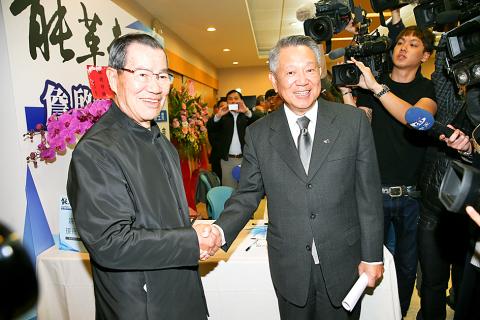
Photo: CNA
Setting his goals for the KMT, Chan said the party must be united, tolerant and diversified and that he intends to reinvigorate its ideals, which he said helped create Asia’s first democratic nation and made Taiwan a beacon of democracy for Chinese communities around the world.
Chan said he also plans to reform the KMT to make it more in-sync with mainstream public opinion, so that the party is able to return Taiwan to its former prosperity, safeguard the Republic of China (ROC) and maintain cross-strait peace.
“The KMT does not need to worry about losing its party assets; our biggest assets are our creation of the ROC; safeguarding of freedom and democracy; our lofty ideals and the sacrifices we have made for the nation,” Chan said.
Prompted by a determination to push for another transfer of power and protect the nation’s peace and prosperity, Chan said the reason behind his candidacy is clear and simple — to put the KMT back in power in the 2020 presidential elections.
Chan said he only began to consider throwing his hat into the ring late last month, but expressed confidence that he would be able to meet all the candidacy requirements, including collecting enough signatures from KMT members.
Asked about his plans for the 2020 election, Chan said it is the ultimate goal of any political party to gain power and that he intends to nominate the best and most competent candidate for the job.
“I do not rule out myself [as the 2020 presidential candidate]. I will work toward that goal, but a lot could happen before the race,” Chan said.
Former vice president Vincent Siew (蕭萬長), who attended yesterday’s news conference in support of Chan, praised the former KMT vice chairman as a “reformer” and a trustworthy person.
Chan tendered his resignation on Jan. 7, reportedly due to divisions between him and Hung over how to handle the KMT’s questionable assets.

FUKUOKA SITUATION: Japanese media reported that the pathogen is expected to be identified by the summer, while the CDC downplayed the idea that it was hMPV A “mysterious cold-like illness” reported in Japan’s Fukuoka Prefecture does not seem to be a new disease, but Japanese authorities have been asked about the situation, the Centers for Disease Control (CDC) said yesterday. The Fukuoka Prefectural Medical Association on Wednesday told a news conference that a “mystery cold” that has become a hot topic on social media is “highly likely to be caused by some kind of viral infection,” Japan’s KBC News reported. “Many people are experiencing symptoms starting with a sore throat, followed by a runny nose, phlegm and a severe cough,” KBC News reported, citing association officials. Health authorities are

Nvidia Corp CEO Jensen Huang (黃仁勳) arrived in Taiwan yesterday ahead of upcoming AI and technology events, saying he plans to meet with clients and Taiwan Semiconductor Manufacturing Co Chairman C.C. Wei (魏哲家) during his visit. After landing at Taipei Songshan Airport, Huang posed for photos with fans and handed out Yakult drinks to reporters and supporters waiting at the scene, saying he has “a lot to do” during the trip. Asked about reports that Nvidia’s planned headquarters site in Taipei’s Beitou Shilin Technology Park could break ground on May 27, Huang said that if the company holds an event, he would

The Ministry of Finance this afternoon announced the winning numbers for the March-April uniform invoice lottery. The winning number for the NT$10 million (US$318,060) special prize is 19531471, and the winning number for the NT$2 million grand prize is 85941329. Three numbers were drawn for the NT$200,000 first prize: 07225810, 20231230 and 83518781. Those with receipts matching the last seven digits of any of the first-prize numbers will win the NT$40,000 second prize, while those matching the last six digits will win the NT$10,000 third prize. Those whose receipts match the last five digits of the first-prize numbers can claim the NT$4,000 fourth prize,
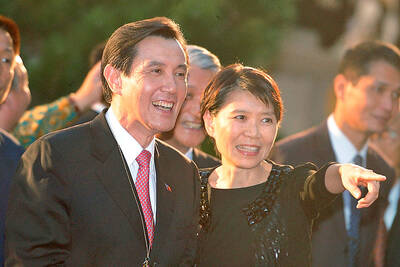
Former president Ma Ying-jeou (馬英九) yesterday expressed “shock and regret” over a statement issued by his wife without his consent, and rejected her assertion that his eldest sister, Ma Yi-nan (馬以南), would manage his medical care or act as his spokesperson amid an ongoing embezzlement probe into his foundation. Ma Ying-jeou in a statement said he was shocked by a statement by his wife, Chou Mei-ching (周美青), regarding his affairs. Ma Yi-nan “must not” be in charge of his healthcare and other personal affairs, nor can she be allowed to represent the Ma family, the former president said. He said he was also


 RSS
RSS