


Chinese Nationalist Party (KMT) Chairwoman Hung Hsiu-chu (洪秀柱) said she is not against reforming regulations requiring 3 percent of party members’ signatures to validate a bid for the party’s chair, following KMT Vice Chairman and party chair hopeful Hau Lung-bin’s (郝龍斌) description of the stipulation as a “technical barrier.”
While on a visit to the US on Friday, Hung told reporters in Los Angeles that the KMT’s internal election signature collection process is plagued with problems.
The process has long been viewed as a formality, and party members’ signatures are often invalidated after being found on more than one candidate’s signature list, Hung said, adding that the issue should be addressed by discussion and any changes to the electoral process should be approved by a party national congress.
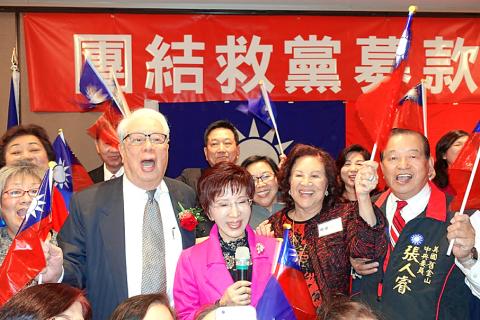
Photo courtesy of the Chinese Nationalist Party (KMT)
She said she is not against reforms that aim to facilitate “authentic signature collection,” lowering the threshold, or even abolishing the process altogether.
Hau earlier in the week called the signature threshold requirement “unnecessary.”
In past chairperson elections, the number of signatures candidates garnered far exceeded the total number of votes the candidates went on to receive in the elections, Hau said.
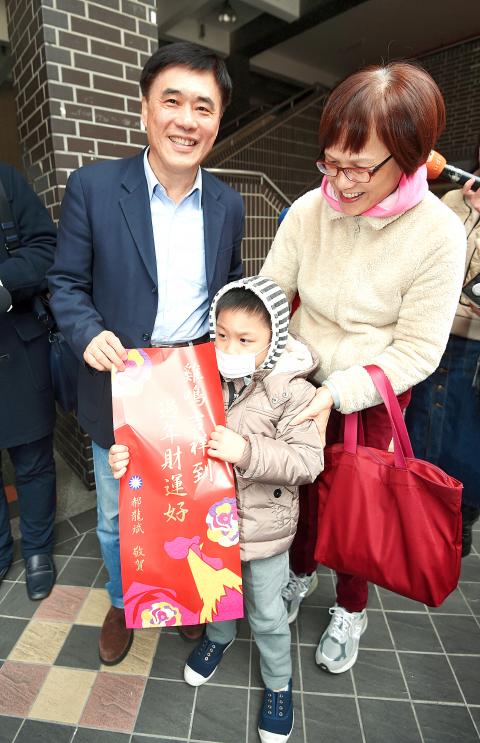
Photo: Fang Pin-chao, Taipei Times
For example in the most recent chairperson race, Hung had more than 80,000 signatures, but she was elected with about 70,000 votes, Hau said, adding that of those, only about 30,000 were considered valid, as they only endorsed Hung.
When party members endorse more than one candidate, candidates who in the end have too many invalid signatures fail to pass the threshold and are forced to drop out, Hau said.
Hung also reiterated her discontent with the freezing of the party’s assets, saying that paying salaries is an organization’s legal obligation.
However, Hung said the KMT is unable to meet its legal responsibilities because the Democratic Progressive Party (DPP) government’s “illegal agency”— a reference to the Ill-gotten Party Assets Settlement Committee — has frozen its savings and nationalized KMT-owned Central Investment Co and Hsinyutai Co.
The committee should not deprive the KMT’s workers of their legal rights, Hung said.
Because the Ministry of Labor had said two days earlier that the dispute should be referred to the Executive Yuan, the party’s younger workers on Wednesday stormed the Executive Yuan and disrupted a committee that was discussing the issue, Hung said.
It was “heart-wrenching” to see young people put in handcuffs and taken to police stations or the prosecutors’ office, Hung said, referring to offenses including insulting a public official or office and damaging historic buildings.
“The protesting students who occupied the Legislative Yuan and stormed the Executive Yuan during the Sunflower movement faced no punishment after the DPP took office,” she said.
Hung also slammed the DPP’s pension reform, saying that it had divided society.
Military personnel, public servants and public-school teachers, who have long been society’s “most stable groups,” were not against reform, but could not stand the unreasonable defamation they had to endure during the process and President Tsai Ing-wen’s (蔡英文) deliberate manufacturing of conflicts between different social groups, Hung said.
The Cabinet dropped charges against Sunflower movement protesters in May last year when the DPP administration took office, but the charges dropped were confined to those against “offenses trialed only upon complaint.”
The trial for the charges against Sunflower movement participants involve alleged insults of public officials or offices or damage to historic buildings is still ongoing.
Additional Reporting by Alison Hsiao
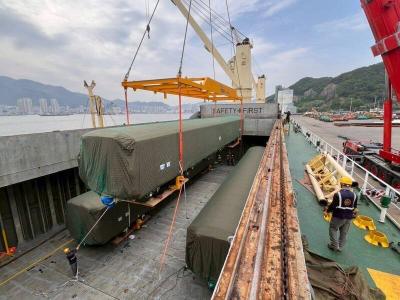
The first of 10 new high-capacity trains purchased from South Korea’s Hyundai Rotem arrived at the Port of Taipei yesterday to meet the demands of an expanding metro network, Taipei Rapid Transit Corp (TRTC) said yesterday. The train completed a three-day, 1,200km voyage from the Port of Masan in South Korea, the company said. Costing NT$590 million (US$18.79 million) each, the new six-carriage trains feature a redesigned interior based on "human-centric" transportation concepts, TRTC said. The design utilizes continuous longitudinal seating to widen the aisles and optimize passenger flow, while also upgrading passenger information displays and driving control systems for a more comfortable
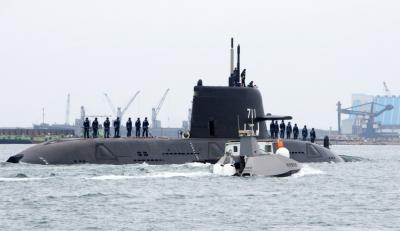
Taiwan's first indigenous defense submarine, the SS-711 Hai Kun (海鯤, or Narwhal), departed for its 13th sea trial at 7am today, marking its seventh submerged test, with delivery to the navy scheduled for July. The outing also marked its first sea deployment since President William Lai (賴清德) boarded the submarine for an inspection on March 19, drawing a crowd of military enthusiasts who gathered to show support. The submarine this morning departed port accompanied by CSBC Corp’s Endeavor Manta (奮進魔鬼魚號) uncrewed surface vessel and a navy M109 assault boat. Amid public interest in key milestones such as torpedo-launching operations and overnight submerged trials,
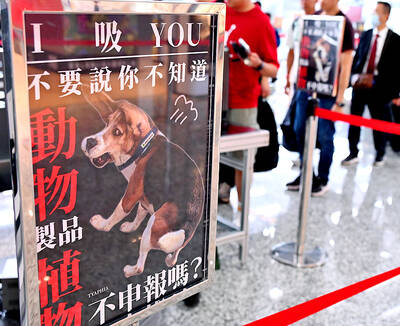
Quarantine awareness posters at Taiwan Taoyuan International Airport have gone viral for their use of wordplay. Issued by the airport branch of the Animal and Plant Health Inspection Agency, the posters feature sniffer dogs making a range of facial expressions, paired with advisory messages built around homophones. “We update the messages for holidays and campaign needs, periodically refreshing materials to attract people’s attention,” quarantine officials said. “The aim is to use the dogs’ appeal to draw focus to quarantine regulations.” A Japanese traveler visiting Taiwan has posted a photo on X of a poster showing a quarantine dog with a
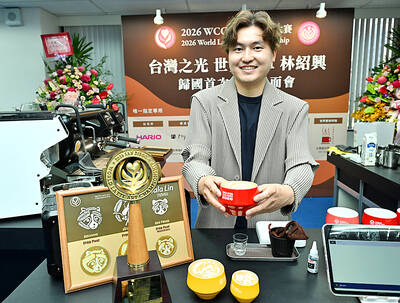
Taiwan’s coffee community has launched a “one-person-one-e-mail” campaign, calling for people to send a protest-e-mail to the World Coffee Championships (WCC) urging it to redesignate Taiwanese competitors as from “Taiwan,” rather than “Chinese Taipei.” The call followed sudden action last week after the WCC changed all references to Taiwanese competitors from “Taiwan” to “Chinese Taipei,” including recent World Latte Art champion Bala (林紹興), who won the World Latte Art Championship in San Diego earlier this month. When Bala received the trophy, he was referred to as representing Taiwan, as well as in the announcement on the WCC’s Web site, until it


 RSS
RSS