


Lawmakers yesterday voiced concern over a media report that the Executive Yuan was considering a monetary fine instead of suspension of pensions as a disciplinary measure for retired military and government officials engaging in political activities in China.
In the wake of the controversial participation of 32 retired high-ranking military officials in a Chinese commemoration event in November in which Chinese President Xi Jinping (習近平) gave a speech, the Executive Yuan has been drafting measures — including suspension of pensions and revocation of awards and medals — to prevent former officials who had access to government secrets from engaging in sensitive activities in China.
However, according to a report by the Chinese-language Apple Daily, the Executive Yuan plans to propose a lighter punishment for officials violating travel restrictions to a monetary fine of between NT$10,000 and NT$50,000, with retired military officials ranked lieutenant general or above subject to a permanent travel approval process.
High-ranking non-military officers are currently banned from travel for one to three years after retirement. The Cabinet is mulling a fixed three-year travel ban on those officials, with their former agencies deciding whether to extend the ban after three years, the report said.
Democratic Progressive Party Legislator Liu Shih-fang (劉世芳), one of the lawmakers who proposed an amendment that would cancel pensions for retired civil servants and military personnel participating in political activities in China, said the fine would be too lenient to deter such participation.
“The [minimum] fine of NT$10,000, which costs less than the price of a flight [to China], is disproportionate to the size of retired generals’ monthly pensions of between NT$100,000 and NT$200,000. Only a 10-year pension suspension will suffice to effectively deter them,” Liu said.
She urged the Chinese Nationalist Party (KMT) to clarify its stance on the issue in order to reach a bipartisan agreement on the amendment, but the KMT is unwilling to offend party members with a military background ahead of the coming party chairperson election.
KMT Legislator Lee Yan-hsiu (李彥秀) said the government should commit itself to strengthening retired officials’ identification with Taiwan, and they should be allowed to attend cultural events in China without being suspected of leaking national secrets.
New Power Party Legislator Hsu Yung-ming (徐永明) said that pension revocation is necessary to deter retired officials.
“Both carrots and sticks have to be used to constrain their behavior. The government has to take the issue seriously with the Liaoning [Chinese aircraft carrier] posing an external threat and retired military officials posing an internal threat to national security,” Hsu said, referring to the controversial passage of the Chinese aircraft carrier through the Taiwan Strait last week.
Executive Yuan spokesman Hsu Kuo-yung (徐國勇) said the monetary fine is an alternative proposal under discussion, but the Cabinet has yet to reach a final decision on the disciplinary measure.

SHIPS, TRAINS AND AUTOMOBILES: The ministry has announced changes to varied transportation industries taking effect soon, with a number of effects for passengers Beginning next month, the post office is canceling signature upon delivery and written inquiry services for international registered small packets in accordance with the new policy of the Universal Postal Union, the Ministry of Transportation and Communications said yesterday. The new policy does not apply to packets that are to be delivered to China, the ministry said. Senders of international registered small packets would receive a NT$10 rebate on postage if the packets are sent from Jan. 1 to March 31, it added. The ministry said that three other policies are also scheduled to take effect next month. International cruise ship operators
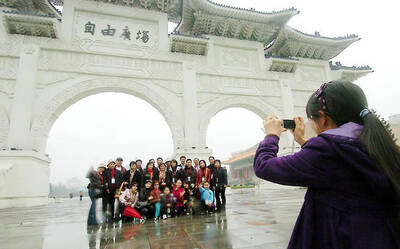
NUMBERS IMBALANCE: More than 4 million Taiwanese have visited China this year, while only about half a million Chinese have visited here Beijing has yet to respond to Taiwan’s requests for negotiation over matters related to the recovery of cross-strait tourism, the Tourism Administration said yesterday. Taiwan’s tourism authority issued the statement after Chinese-language daily the China Times reported yesterday that the government’s policy of banning group tours to China does not stop Taiwanese from visiting the country. As of October, more than 4.2 million had traveled to China this year, exceeding last year. Beijing estimated the number of Taiwanese tourists in China could reach 4.5 million this year. By contrast, only 500,000 Chinese tourists are expected in Taiwan, the report said. The report
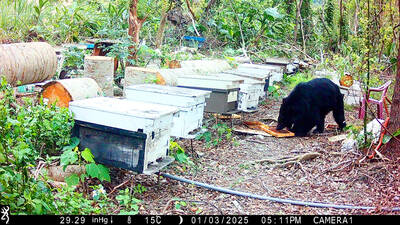
The Forestry and Nature Conservation Agency yesterday launched a gift box to market honey “certified by a Formosan black bear” in appreciation of a beekeeper’s amicable interaction with a honey-thieving bear. Beekeeper Chih Ming-chen (池明鎮) in January inspected his bee farm in Hualien County’s Jhuosi Township (卓溪) and found that more than 20 beehives had been destroyed and many hives were eaten, with bear droppings and paw prints near the destroyed hives, the agency said. Chih returned to the farm to move the remaining beehives away that evening when he encountered a Formosan black bear only 20m away, the agency said. The bear

Chinese embassy staffers attempted to interrupt an award ceremony of an international tea competition in France when the organizer introduced Taiwan and displayed the Republic of China flag, a Taiwanese tea farmer said in an interview published today. Hsieh Chung-lin (謝忠霖), chief executive of Juxin Tea Factory from Taichung's Lishan (梨山) area, on Dec. 2 attended the Teas of the World International Contest held at the Peruvian embassy in Paris. Hsieh was awarded a special prize for his Huagang Snow Source Tea by the nonprofit Agency for the Valorization of Agricultural Products (AVPA). During the ceremony, two Chinese embassy staffers in attendance


 RSS
RSS