


Mika Tanaka, who produced the documentary Wansei Back Home (灣生回家), yesterday admitted to having fabricated her personal history, reversing months of defiance against her critics.
Tanaka, whose legal name is Chen Hsuan-ju (陳宣儒), was a major investor in the popular film released in 2015 that depicted the stories of Japanese born in Taiwan during the Japanese colonial era who returned to Taiwan and recalled their childhood memories.
Tanaka had claimed she was a wansei, the Japanese-language term used to describe people who were born or grew up in Taiwan and are the descendants of Japanese immigrants who came to Taiwan during the Japanese colonial era from 1895 to 1945.
Takeshi Yoshimura, former director of the Taiwan branch of the Japanese-language Sankei Shimbun, last year accused Tanaka of lying about being a wansei in a story published in Japan.
Yoshimura’s accusation was posted by a netizen on Professional Technology Temple, Taiwan’s largest online academic bulletin board system, which was followed by additional accusations that Tanaka had copied and modified paintings by established artists and claimed them as her own.
On Dec. 23 last year, social critic Kuang Jen-chien (管仁健), who in 2015 accused Chen of lying about being a wansei, wrote a story for Chinese-language social media site New Talk that criticized Tanaka for her deception.
“Taiwan is a magical place. Any liar using the slogan ‘love Taiwan’ can hoodwink the members of our vaunted erudite class, because they are, intellectually and critically, retarded and blind... Without speaking a lick of Japanese, [Tanaka] dared to pass herself off as Japanese and got away with selling others’ artworks that she photoshopped,” Kuang said.
At the time, Tanaka told the Chinese-language Liberty Times (sister newspaper of the Taipei Times) that the accusations were untrue, but she declined to issue a public rebuttal, citing her desire to protect her family’s privacy.
However, in a statement posted on Facebook by Wang Jung-wen (王榮文), CEO of Yuan-Liou Publishing Co, Tanaka’s publisher, she admitted that she is not a wansei, but rather a Taiwanese born and bred in Kaohsiung, saying that she wanted to apologize to the Taiwanese public and wansei for her dishonesty.
Tanaka visited the publishing house on Friday to apologize and asked to issue a statement through the company to apologize to the public, Wang said.
Stressing that Yuan-Liou Publishing was merely acting as an intermediary for Tanaka, Wang said he viewed Tanaka’s deception about her personal history and copying of others’ artworks with the utmost regret.
“After you lie once, you need to keep on lying to explain it away,” Wang quoted Tanaka as saying, when he asked her why she continued to lie after the media began to question her story.
In the statement, Tanaka said that when she was a high-school student, she met a wansei woman named Sayo Tanaka at a train station.
The woman told Mika Tanaka that she bore an uncanny resemblance to her daughter, who had died of complications from a difficult childbirth on the day of Mika Tanaka’s birth, the statement said.
The two became fast friends, and Mika Tanaka said she came to regard Sayo Tanaka as a grandmother, adding that the older woman later sponsored her education in Japan, the US and France, which she did not complete due to a “lack of effort.”
She said Sayo Tanaka’s story was the inspiration for her devotion to wansei history, adding that the documentary’s depiction of wansei and their love of Taiwan was genuine, and should not be discounted because of her personal failings.
Mika Tanaka said she was in talks with the original creators of the artworks in an attempt to reach a settlement for her mistakes, but denied that she had sold any photoshopped paintings for commercial gain.

FUKUOKA SITUATION: Japanese media reported that the pathogen is expected to be identified by the summer, while the CDC downplayed the idea that it was hMPV A “mysterious cold-like illness” reported in Japan’s Fukuoka Prefecture does not seem to be a new disease, but Japanese authorities have been asked about the situation, the Centers for Disease Control (CDC) said yesterday. The Fukuoka Prefectural Medical Association on Wednesday told a news conference that a “mystery cold” that has become a hot topic on social media is “highly likely to be caused by some kind of viral infection,” Japan’s KBC News reported. “Many people are experiencing symptoms starting with a sore throat, followed by a runny nose, phlegm and a severe cough,” KBC News reported, citing association officials. Health authorities are

Nvidia Corp CEO Jensen Huang (黃仁勳) arrived in Taiwan yesterday ahead of upcoming AI and technology events, saying he plans to meet with clients and Taiwan Semiconductor Manufacturing Co Chairman C.C. Wei (魏哲家) during his visit. After landing at Taipei Songshan Airport, Huang posed for photos with fans and handed out Yakult drinks to reporters and supporters waiting at the scene, saying he has “a lot to do” during the trip. Asked about reports that Nvidia’s planned headquarters site in Taipei’s Beitou Shilin Technology Park could break ground on May 27, Huang said that if the company holds an event, he would

The Ministry of Finance this afternoon announced the winning numbers for the March-April uniform invoice lottery. The winning number for the NT$10 million (US$318,060) special prize is 19531471, and the winning number for the NT$2 million grand prize is 85941329. Three numbers were drawn for the NT$200,000 first prize: 07225810, 20231230 and 83518781. Those with receipts matching the last seven digits of any of the first-prize numbers will win the NT$40,000 second prize, while those matching the last six digits will win the NT$10,000 third prize. Those whose receipts match the last five digits of the first-prize numbers can claim the NT$4,000 fourth prize,
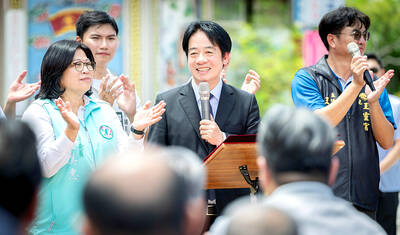
SIX SUBSIDIES: The monthly allowance for older farmers is to increase to NT$10,000, and NT$5,000 is to be given to homemakers under the national pension system, Lai said The government is to implement major welfare policies for disadvantaged groups, including raising the monthly allowance for older farmers to NT$10,000 and providing homemakers with NT$5,000 per month, President William Lai (賴清德) said yesterday. Lai made the remarks during a visit to Wangling Temple in Chiayi County, saying that the planned increases were being introduced amid economic growth and an increase in tax revenue. Touting a policy, in which the government plans to provide a monthly allowance of NT$5,000 for every child under the age of 18 in a bid to address Taiwan’s low birthrate, Lai said that if received for the


 RSS
RSS