


Authorities should not use the land they expropriated under the Mass Rapid Transit Act (大眾捷運法) to build housing projects, the Council of Grand Justices said on Friday in a constitutional interpretation on the scandal-plagued MeHAS City Project (美河市) on the Taipei Mass Rapid Transit (MRT) System’s Songshan-Xindian line.
“The land that authorities expropriated in accordance with Article 6 of the act for construction projects to build mass rapid transportation systems should not be used for joint development housing projects, which are governed by Article 7-1 of the act,” Judicial Yuan Secretary-General Lu Tai-lang (呂太郎) told a news conference in Taipei, quoting the interpretation.
“The Taipei City Government should not have based land expropriation on Article 6 and Article 7-1 simultaneously. If it wanted to initiate joint development projects, it should have proposed another plan, instead of pursuing commercial gains under the guise of serving the public interest,” Lu said.
The Taipei City Government in 1991 expropriated 239 plots of land in Sindian (新店) to build the Xindian Depot close to Xiaobitan MRT Station to house machinery.
In 2001, the Taipei Department of Rapid Transit Systems signed a contract with Radium Life Tech Co for construction of the depot.
Large areas remained unused after the facility was completed in 2007, and the administration of then-Taipei mayor Hau Lung-bin (郝龍斌) allowed the firm to build the housing complex on the remaining land.
The landowners said that the city seized more land than it needed at prices much lower than the market value in the name of developing public transportation systems, but later used their properties to build houses for profit.
Despite claiming NT$3.5 billion (US$108 million) from Radium for the land the company undervalued after results of an arbitration was announced in July last year, the city government risks paying landowners compensation estimated at more than NT$20 billion after the council in 2015 pronounced the land expropriation unconstitutional.
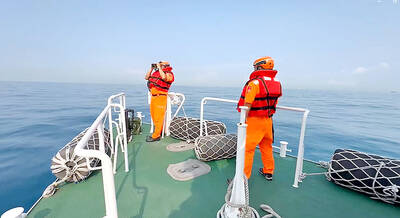
An increase in Taiwanese boats using China-made automatic identification systems (AIS) could confuse coast guards patrolling waters off Taiwan’s southwest coast and become a loophole in the national security system, sources familiar with the matter said yesterday. Taiwan ADIZ, a Facebook page created by enthusiasts who monitor Chinese military activities in airspace and waters off Taiwan’s southwest coast, on Saturday identified what seemed to be a Chinese cargo container ship near Penghu County. The Coast Guard Administration went to the location after receiving the tip and found that it was a Taiwanese yacht, which had a Chinese AIS installed. Similar instances had also

GOOD DIPLOMACY: The KMT has maintained close contact with representative offices in Taiwan and had extended an invitation to Russia as well, the KMT said The Chinese Nationalist Party (KMT) would “appropriately handle” the fallout from an invitation it had extended to Russia’s representative to Taipei to attend its international banquet last month, KMT Chairman Eric Chu (朱立倫) said yesterday. US and EU representatives in Taiwan boycotted the event, and only later agreed to attend after the KMT rescinded its invitation to the Russian representative. The KMT has maintained long-term close contact with all representative offices and embassies in Taiwan, and had extended the invitation as a practice of good diplomacy, Chu said. “Some EU countries have expressed their opinions of Russia, and the KMT respects that,” he

VIGILANCE: The military is paying close attention to actions that might damage peace and stability in the region, the deputy minister of national defense said The People’s Republic of China (PRC) might consider initiating a hack on Taiwanese networks on May 20, the day of the inauguration ceremony of president-elect William Lai (賴清德), sources familiar with cross-strait issues said. While US Secretary of State Anthony Blinken’s statement of the US expectation “that all sides will conduct themselves with restraint and prudence in the period ahead” would prevent military actions by China, Beijing could still try to sabotage Taiwan’s inauguration ceremony, the source said. China might gain access to the video screens outside of the Presidential Office Building and display embarrassing messages from Beijing, such as congratulating Lai
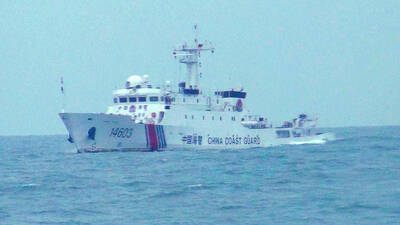
Four China Coast Guard ships briefly sailed through prohibited waters near Kinmen County, Taipei said, urging Beijing to stop actions that endanger navigation safety. The Chinese ships entered waters south of Kinmen, 5km from the Chinese city of Xiamen, at about 3:30pm on Monday, the Coast Guard Administration said in a statement later the same day. The ships “sailed out of our prohibited and restricted waters” about an hour later, the agency said, urging Beijing to immediately stop “behavior that endangers navigation safety.” Ministry of National Defense spokesman Sun Li-fang (孫立方) yesterday told reporters that Taiwan would boost support to the Coast Guard


 RSS
RSS