


The government has measures in place to deal with the sharp drop in the number of Chinese tourists in the wake of increasingly strained cross-strait relations, a Mainland Affairs Council (MAC) official said on Thursday.
MAC Deputy Minister Chiu Chui-cheng (邱垂正) told a news conference that the government “has prepared for the worst” and has countermeasures to deal with the likely continued low number of Chinese tourists next year.
Chiu was responding to questions about the decline in the number of Chinese tourists visiting Taiwan this past year.
He reiterated that the government has not changed its position that Chinese tourists are welcome to visit Taiwan and remains committed to improving the quality of the local tourism sector.
Chiu also expressed regret at the politicization of cross-strait tourism.
In response to the decline in Chinese tourism numbers, he said the government is working to encourage local tourism by urging Taiwanese to take domestic holidays.
According to National Immigration Agency figures, Chinese visitor arrivals from Dec. 1 to Tuesday were 44 percent lower than in the same period last year, with the number of group tourists dropping by 50.4 percent year-on-year.
From January to Tuesday, Chinese tourist arrivals declined 18.5 percent year-on-year, while the number visiting in tour groups fell 29.9 percent, agency figures showed.
Cross-strait relations have cooled since President Tsai Ing-wen (蔡英文) took office on May 20, due mainly to China’s insistence that the so-called “1992 consensus” is the sole political foundation for the development of cross-strait exchanges and the Tsai administration’s refusal to accept that precondition.
The “1992 consensus” — a term former Mainland Affairs Council chairman Su Chi (蘇起) admitted making up in 2000 — refers to a tacit understanding between the Chinese Nationalist Party (KMT) and the Beijing government that both sides acknowledge there is “one China,” with each side having its own interpretation of what “China” means.
Since May 20, the Tsai government has said on several occasions that it respects the 1992 cross-strait meeting as a historical fact and looks forward to promoting cross-strait ties based on the existing foundation, Chiu said.
“We hope mainland China will look squarely at our statements, try to understand and respond accordingly,” the deputy minister said.
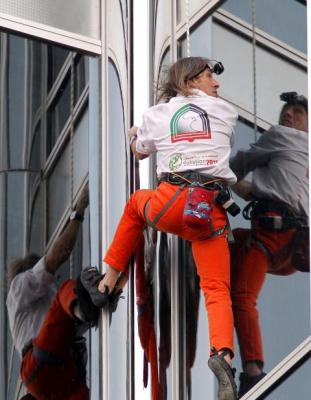
Alain Robert, known as the "French Spider-Man," praised Alex Honnold as exceptionally well-prepared after the US climber completed a free solo ascent of Taipei 101 yesterday. Robert said Honnold's ascent of the 508m-tall skyscraper in just more than one-and-a-half hours without using safety ropes or equipment was a remarkable achievement. "This is my life," he said in an interview conducted in French, adding that he liked the feeling of being "on the edge of danger." The 63-year-old Frenchman climbed Taipei 101 using ropes in December 2004, taking about four hours to reach the top. On a one-to-10 scale of difficulty, Robert said Taipei 101

Nipah virus infection is to be officially listed as a category 5 notifiable infectious disease in Taiwan in March, while clinical treatment guidelines are being formulated, the Centers for Disease Control (CDC) said yesterday. With Nipah infections being reported in other countries and considering its relatively high fatality rate, the centers on Jan. 16 announced that it would be listed as a notifiable infectious disease to bolster the nation’s systematic early warning system and increase public awareness, the CDC said. Bangladesh reported four fatal cases last year in separate districts, with three linked to raw date palm sap consumption, CDC Epidemic Intelligence

Two Taiwanese prosecutors were questioned by Chinese security personnel at their hotel during a trip to China’s Henan Province this month, the Mainland Affairs Council (MAC) said yesterday. The officers had personal information on the prosecutors, including “when they were assigned to their posts, their work locations and job titles,” MAC Deputy Minister and spokesman Liang Wen-chieh (梁文傑) said. On top of asking about their agencies and positions, the officers also questioned the prosecutors about the Cross-Strait Joint Crime-Fighting and Judicial Mutual Assistance Agreement, a pact that serves as the framework for Taiwan-China cooperation on combating crime and providing judicial assistance, Liang
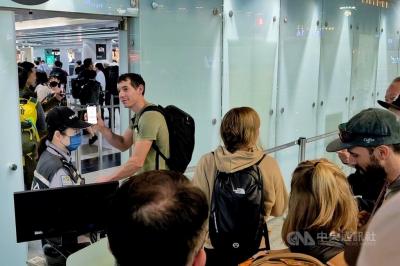
US climber Alex Honnold left Taiwan this morning a day after completing a free-solo ascent of Taipei 101, a feat that drew cheers from onlookers and gained widespread international attention. Honnold yesterday scaled the 101-story skyscraper without a rope or safety harness. The climb — the highest urban free-solo ascent ever attempted — took just more than 90 minutes and was streamed live on Netflix. It was covered by major international news outlets including CNN, the New York Times, the Guardian and the Wall Street Journal. As Honnold prepared to leave Taiwan today, he attracted a crowd when he and his wife, Sanni,


 RSS
RSS