


President Tsai Ing-wen (蔡英文) is set to embark on Jan. 7 on a nine-day overseas state visit to four of the nation’s diplomatic allies in Central America, the Ministry of Foreign Affairs announced yesterday, but added that the locations for Tsai’s transit stops are still being arranged.
Speaking at a morning news conference at the Presidential Office, Deputy Minister of Foreign Affairs Javier Hou (侯清山) said Tsai is due to visit Honduras, Nicaragua, Guatemala, and El Salvador from Jan. 7 to Jan. 15.
Tsai is to stay one night in Honduras before departing on Jan. 9 for Nicaragua, where the president is to stay for two nights, during which she is scheduled to attend the inauguration ceremony of Nicaraguan President Daniel Ortega on Jan. 10.
She is to head to Guatemala on Jan. 11 before moving on to El Salvador the next day. She is set to return to Taiwan on the evening of Jan. 15.
“Our Central American diplomatic ally Nicaragua’s presidential election on Nov. 6 went smoothly, with incumbent president Daniel Ortega and his running mate and wife, Rosario Murillo, wining re-election… They have sent an official invitation to Tsai to attend their inauguration ceremony,” Hou said.
The visit, termed the Ying Chieh Project (英捷專案), is aimed at strengthening the friendship with allies in Central America through “head of state diplomacy” and promoting cooperation based on mutual assistance, reciprocity and “win-win,” Hou said.
Hou said Tsai will be leading a delegation of more than 90 people, including National Security Council Secretary-General Joseph Wu (吳釗燮), Minister of Foreign Affairs David Lee (李大維), Overseas Community Affairs Council Minister Wu Hsin-hsing (吳新興), deputy heads of government agencies, lawmakers and businesspeople.
Tsai will also visit Taiwanese-invested garment factories in Nicaragua; inspect the achievements of a cooperation program between Taiwan and Honduras, titled “one town, one product” project; tour the ancient city of Antigua in Guatemala; and visit coffee factories in El Salvador, Hou said.
Hou added that the president will also meet with Taiwanese expatriots and members of the nation’s embassies during her trip.
As for Tsai’s transit stops, Hou said the locations are still being negotiated and should be made public next week.
Asked whether the government is facing any pressure, Presidential Office spokesman Alex Huang (黃重諺) said there is no such problem and that the delayed announcement is simply due to administrative work.
Following Tsai’s telephone call to US president-elect Donald Trump on Dec. 2, there have been rumors that Tsai will transit in New York City, where she could meet with the US tycoon and his transition team.
However, the rumors were dismissed by Lee earlier this month, saying that New York has never been one of the options considered by the foreign ministry.

LOUD AND PROUD Taiwan might have taken a drubbing against Australia and Japan, but you might not know it from the enthusiasm and numbers of the fans Taiwan might not be expected to win the World Baseball Classic (WBC) but their fans are making their presence felt in Tokyo, with tens of thousands decked out in the team’s blue, blowing horns and singing songs. Taiwanese fans have packed out the Tokyo Dome for all three of their games so far and even threatened to drown out home team supporters when their team played Japan on Friday. They blew trumpets, chanted for their favorite players and had their own cheerleading squad who dance on a stage during the game. The team struggled to match that exuberance on the field, with
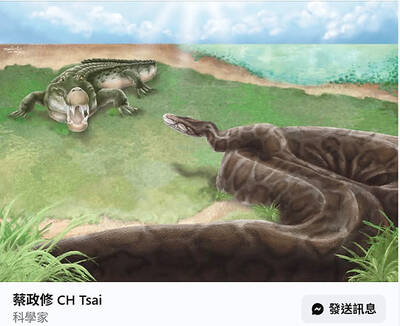
Taiwanese paleontologists have discovered fossil evidence that pythons up to 4m long inhabited Taiwan during the Pleistocene epoch, reporting their findings in the international scientific journal Historical Biology. National Taiwan University (NTU) Institute of Ecology and Evolutionary Biology associate professor Tsai Cheng-hsiu (蔡政修) led the team that discovered the largest snake fossil ever found in Taiwan. The single trunk vertebra was discovered in Tainan at the Chiting Formation, dated to between 400,000 and 800,000 years ago in the Middle Pleistocene, the paper said. The area also produced Taiwan’s first avian fossil, as well as crocodile, mammoth, saber-toothed cat and rhinoceros fossils, it said. Discoveries

Taiwanese paleontologists have discovered fossil evidence that pythons up to 4m long inhabited Taiwan during the Pleistocene epoch, reporting their findings in the international scientific journal Historical Biology. National Taiwan University (NTU) Institute of Ecology and Evolutionary Biology associate professor Tsai Cheng-hsiu (蔡政修) led the team that discovered the largest snake fossil ever found in Taiwan. A single trunk vertebra was discovered in Tainan at the Chiting Formation, dated to between 800,000 to 400,000 years ago in the Middle Pleistocene, the paper said. The area also produced Taiwan’s first avian fossil, as well as crocodile, mammoth, sabre-toothed cat and rhinoceros fossils, it said. Discoveries

Whether Japan would help defend Taiwan in case of a cross-strait conflict would depend on the US and the extent to which Japan would be allowed to act under the US-Japan Security Treaty, former Japanese minister of defense Satoshi Morimoto said. As China has not given up on the idea of invading Taiwan by force, to what extent Japan could support US military action would hinge on Washington’s intention and its negotiation with Tokyo, Morimoto said in an interview with the Liberty Times (sister paper of the Taipei Times) yesterday. There has to be sufficient mutual recognition of how Japan could provide


 RSS
RSS