


Q: Your successor spoke by phone with the president of Taiwan the other day and declared subsequently that he wasn’t sure why the United States needed to be bound by the ‘one China’ policy. He suggested it could be used as a bargaining chip perhaps to get better terms on a trade deal or more cooperation on North Korea.
There’s already evidence that tensions between the two sides have increased a bit, and just today, [Friday] the Chinese have evidently seized an underwater drone in the South China Sea.
Do you agree, as some do, that our China policy could use a fresh set of eyes? And what’s the big deal about having a short phone call with the president of Taiwan? Or do you worry that these types of unorthodox approaches are setting us on a collision course with perhaps our biggest geopolitical adversary?

PHOTO: AFP
Obama: That’s a great question. I’m somewhere in between. I think all of our foreign policy should be subject to fresh eyes. I think one of the — I’ve said this before — I am very proud of the work I’ve done. I think I’m a better president now than when I started. But if you’re here for eight years, in the bubble, you start seeing things a certain way and you benefit from — the democracy benefits, America benefits from some new perspectives.
And I think it should be not just the prerogative, but the obligation of a new president to examine everything that’s been done and see what makes sense and what doesn’t. That’s what I did when I came in, and I’m assuming any new president is going to undertake those same exercises.
And given the importance of the relationship between the United States and China, given how much is at stake in terms of the world economy, national security, our presence in the Asia-Pacific, China’s increasing role in international affairs — there’s probably no bilateral relationship that carries more significance and where there’s also the potential if that relationship breaks down or goes into a full-conflict mode, that everybody is worse off. So I think it’s fine for him to take a look at it.
What I’ve advised the president-elect is that across the board on foreign policy, you want to make sure that you’re doing it in a systematic, deliberate, intentional way.
And since there’s only one president at a time, my advice to him has been that before he starts having a lot of interactions with foreign governments other than the usual courtesy calls, that he should want to have his full team in place, that he should want his team to be fully briefed on what’s gone on in the past and where the potential pitfalls may be, where the opportunities are, what we’ve learned from eight years of experience, so that as he’s then maybe taking foreign policy in a new direction, he’s got all the information to make good decisions and, by the way, that all of government is moving at the same time and singing from the same hymnal.
And with respect to China — and let’s just take the example of Taiwan — there has been a long-standing agreement, essentially, between China, the United States, and, to some degree, the Taiwanese, which is to not change the “status quo.”
Taiwan operates differently than mainland China does. China views Taiwan as part of China, but recognizes that it has to approach Taiwan as an entity that has its own ways of doing things. The Taiwanese have agreed that as long as they’re able to continue to function with some degree of autonomy, that they won’t charge forward and declare independence.
And that status quo, although not completely satisfactory to any of the parties involved, has kept the peace and allowed the Taiwanese to be a pretty successful economy and a people who have a high degree of self-determination. But understand, for China, the issue of Taiwan is as important as anything on their docket. The idea of one China is at the heart of their conception as a nation.
And so if you are going to upend this understanding, you have to have thought through what the consequences are, because the Chinese will not treat that the way they’ll treat some other issues. They won’t even treat it the way they treat issues around the South China Sea, where we’ve had a lot of tensions. This goes to the core of how they see themselves. And their reaction on this issue could end up being very significant.
That doesn’t mean that you have to adhere to everything that’s been done in the past. It does mean that you’ve got to think it through and have planned for potential reactions that they may engage in.

FUKUOKA SITUATION: Japanese media reported that the pathogen is expected to be identified by the summer, while the CDC downplayed the idea that it was hMPV A “mysterious cold-like illness” reported in Japan’s Fukuoka Prefecture does not seem to be a new disease, but Japanese authorities have been asked about the situation, the Centers for Disease Control (CDC) said yesterday. The Fukuoka Prefectural Medical Association on Wednesday told a news conference that a “mystery cold” that has become a hot topic on social media is “highly likely to be caused by some kind of viral infection,” Japan’s KBC News reported. “Many people are experiencing symptoms starting with a sore throat, followed by a runny nose, phlegm and a severe cough,” KBC News reported, citing association officials. Health authorities are

Nvidia Corp CEO Jensen Huang (黃仁勳) arrived in Taiwan yesterday ahead of upcoming AI and technology events, saying he plans to meet with clients and Taiwan Semiconductor Manufacturing Co Chairman C.C. Wei (魏哲家) during his visit. After landing at Taipei Songshan Airport, Huang posed for photos with fans and handed out Yakult drinks to reporters and supporters waiting at the scene, saying he has “a lot to do” during the trip. Asked about reports that Nvidia’s planned headquarters site in Taipei’s Beitou Shilin Technology Park could break ground on May 27, Huang said that if the company holds an event, he would

Carrefour Taiwan is to begin using a new name from the start of July, but it cannot divulge the name until then, the chairman of the supermarket chain's parent company said today. President Chain Store Co chairman Lo Chih-hsien (羅智先) was asked by reporters after a shareholders' meeting to confirm whether the company has settled on a new name for the supermarket brand. In March, the government-registered name of two Carrefour Taiwan branches was quietly changed to "Le Chia Kang" (樂家康) in Chinese, raising speculation that has been selected as the name. Lo said that because of local regulations and contractual obligations, the
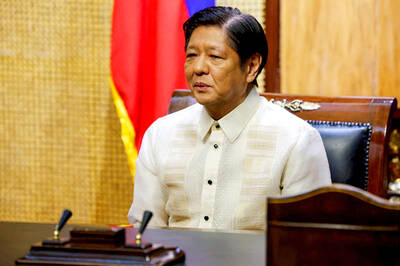
The Philippines would likely be involved in any conflict over Taiwan due to its proximity to the democracy claimed by China, President Ferdinand Marcos Jr said, reiterating a stance that risks angering Beijing. “In the Philippines, we do not have a choice because Taiwan is so close to the Philippines and we have almost 200,000 Filipino nationals living and working in Taiwan,” Marcos said in an interview with Japanese media in Manila on Monday. The Philippine leader’s comments come ahead of a state visit to Japan next week, where he is to meet with Japanese Prime Minister Sanae Takaichi to discuss security


 RSS
RSS