


Members of the Democratic Progressive Party (DPP) said organic farming in Italy and bilateral trade and cultural exchanges with the European nation were discussed when they inaugurated the Taiwan-Italy Inter-Parliamentary Amity Association at the legislature in Taipei yesterday.
“There are many similarities between agricultural production in Taiwan and Italy,” DPP Legislator Tsai Pei-hui (蔡培慧) said in opening remarks. “Both countries have a strong tradition of family farming, with more rural communities taking up organic farming. Now we have many people wanting to introduce Italy’s agricultural diversity, self-sufficiency of food production and the Italian idea of ‘slow food’ to Taiwan.”
“Slow food,” promoted as an alternative to fast food, seeks to preserve traditional and regional cuisine using local ecosystems and farmers.
Tsai said that Taiwan’s society is concerned about healthy lifestyles and food safety, so Taiwanese should learn more about sustainable agriculture, food safety certification and organic food from Italy.
Tsai has done academic research on agricultural economics and public policy for rural-community development and she headed the effort to launch the association with the support of fellow DPP lawmakers.
Tsai was named chairperson of the association, with DPP legislators Yu Mei-nu (尤美女) and Su Chen-ching (蘇震清) made deputies at the inauguration event, which was attended by Italian Economic, Trade and Cultural Promotion Office (IETCPO) Representative Donato Scioscioli and Ministry of Foreign Affairs officials.
Yu said Taiwan can learn from Italy’s advanced fashion, clothing designs, architecture, arts and entertainment, and other creative culture industries.
Scioscioli said Taiwan and Italy signed an agreement on avoidance of mutual taxation in January and he expects to see more Taiwanese in Italy, enhanced trade and business relationships and more exchange programs in the cultural, scientific, arts and entertainment industries.
He said that Italy is Taiwan’s fifth-largest trade partner in the EU, just behind Germany, the Netherlands, the UK and France, with bilateral trade exceeding NT$4 billion (US$126 million) last year.
About 60 Taiwanese firms have business investments in Italy, he said.
Scioscioli said he wanted to promote sports, especially Italian soccer, in Taiwan and would like to have more Serie A matches on television.
“I have been looking for Taiwanese interested in football and have plans to talk to TV networks here hoping they will have weekly screenings of Italian Serie A matches,” he told the Taipei Times.
“In Taiwan, they have the Champions League, Premier League and Bundesliga on TV, but that is not enough. We would like to have Taiwan’s publicly available networks broadcast Serie A fixtures as well,” he said.
The association can enhance bilateral trade and cultural exchanges, while it can also bring Italian sports expertise to the nation, Scioscioli said, adding that it would help Taiwanese soccer develop at the grassroots and club levels.
He said that big soccer names like former players Paolo di Canio and Alessandro del Piero, who played for Italy, could visit Taiwan, while off-season tours by leading Italian clubs like AC Milan, Juventus, SS Lazio and AS Roma would help.
Scioscioli said the office would certainly support such initiatives and work with others to promote Italian soccer in Taiwan.
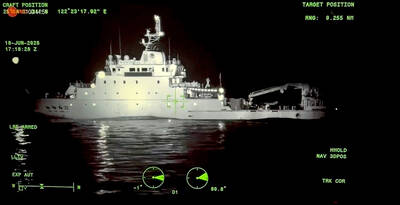
EXCUSES: Beijing is using government and research vessels as a pretext to harass the nation and enter its EEZ, and engage in ‘hegemonic expansion,’ the coast guard said The Coast Guard Administration yesterday said it drove away Chinese oceanographic research vessel Xiang Yang Hong 22 (向陽紅33) from restricted waters after warning it that it was in Taiwan’s exclusive economic zone (EEZ). The Chinese vessel entered restricted waters off the coast of Yilan County’s Suao (蘇澳) at 11:35pm on Thursday, the coast guard said, adding that it dispatched the Lanyu patrol vessel and the boat PP-10077 to shadow the Chinese ship and issue radio warnings ordering it to leave. China has no sovereignty over waters off Taiwan’s east coast, Lanyu’s crew told Xiang Yang Hong 22 over the radio, and demanded
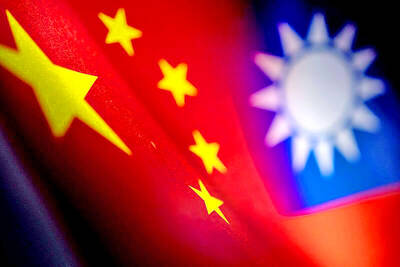
BAIT AND SWITCH: Allowing KMT-run counties to sell to China while the threat of abrupt cancelations hangs overhead is another form of coercion, officials said Beijing is using agricultural purchase offers announced during the Straits Forum to deepen Taiwan’s dependence on the Chinese market, a Taiwanese official said yesterday as they criticized the Taitung County commissioner’s participation in the initiative. During the Straits Forum held in Xiamen on Saturday, Chinese officials announced a sales and purchase agreement for agricultural products from some counties led by the Chinese Nationalist Party (KMT). Taitung County Commissioner Yao Ching-ling (饒慶鈴), who was barred from attending the event in person by the Mainland Affairs Council, participated via video. Under the agreement, China would purchase atemoyas, pomeloes, tea and grouper harvested in Taitung,
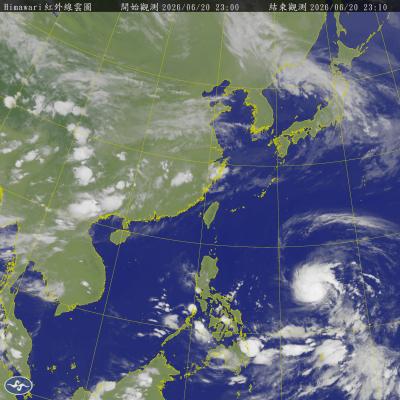
Tropical Storm Mekkhala is forecast to strengthen into a typhoon tomorrow and could come close enough to Taiwan later in the week to prompt a sea warning, the Central Weather Administration (CWA) said yesterday. As of 2 pm, the storm was located 1,870 kilometers southeast of Taiwan's southern tip and moving west- northwest at 23 km per hour. CWA forecaster Cheng Chieh-jen (鄭傑仁) said Mekkhala is expected to continue moving west-northwest through Tuesday under the influence of the Pacific high- pressure system before gradually turning north toward waters east of Taiwan or south of the Ryukyu Islands. The timing and angle of the
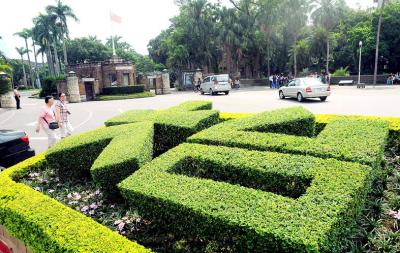
Four Taiwanese universities have been ranked among the world's top 200 institutions in the Quacquarelli Symonds (QS) World University Rankings for next year, the highest Taiwan has ever placed in the category, with National Taiwan University (NTU) achieving its best performance at 54th globally and 17th in Asia. The four Taiwanese institutions in the global top 200 are NTU (54th), National Tsing Hua University (142nd), National Yang Ming Chiao Tung University (177th) and National Cheng Kung University (191st), the rankings showed. All four universities achieved their highest-ever global rankings this year, QS data showed. National Cheng Kung University entered the top 200 for


 RSS
RSS