


Labor campaigners yesterday rallied outside the Legislative Yuan building to protest against proposed amendments to the Labor Standards Act (勞動基準法), demanding that lawmakers scrap the amendments, which they said would institutionalize inferior working conditions prevalent in the nation.
More than 100 protesters from the Workers’ Struggle Alliance, Taoyuan Confederation of Trade Unions and the Trade Union of Electrical, Electronic and Information Workers in Taiwan gathered outside the Legislative Yuan, criticizing what they called the Democratic Progressive Party’s (DPP) attempt to force the amendments through the legislature.
The proposed amendments seek to scrap seven national holidays and implement “one flexible rest day and one fixed day off” to accommodate a 40-hour workweek bill passed last year.
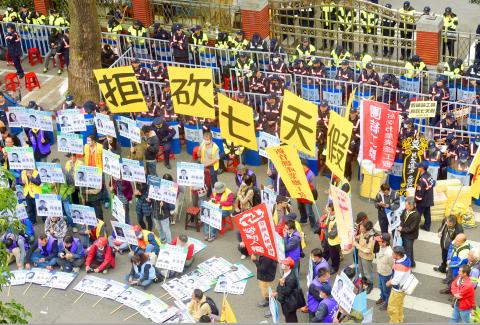
Photo: Huang Yao-cheng, Taipei Times
Following news that the legislature was to vote on the amendments after the DPP caucus resumed a floor meeting brought to a halt by Chinese Nationalist Party (KMT) lawmakers, protesters threw smoke grenades into the premises of the Legislative Yuan and burned joss paper outside its gates.
“The DPP has become a different party after the elections. Before the elections, to garner our support the DPP promised that it would not axe the seven holidays, but after it won the elections, the party rears its ugly head just like the KMT,” Hsinchu Confederation of Trade Unions director Chan Su-chen (詹素貞) said.
Many of the protesters had previously worked with the DPP on social issues, but “the DPP turned into another KMT” once it assumed power, Taoyuan Confederation of Trade Unions director Mao Chen-fei (毛振飛) said.
Protesters held placards bearing the pictures of DPP lawmakers, describing them as “holiday killers.”
“Follow the will of the public. Go against the party’s will. Do not kill the holidays,” protesters chanted, urging DPP lawmakers to act on personal values instead of as a rubber stamp for the party.
DPP Legislator Lin Shu-fen (林淑芬) is the only DPP lawmaker who sided with the protesters and she is to receive disciplinary action for refusing to attend yesterday’s legislative meeting, alliance member Lu Chyi-horng (盧其宏) said.
“President Tsai Ing-wen (蔡英文) said labor rights was where she was the most vulnerable, but what we see is the government’s plan to slash seven holidays,” Lu said.
One of Tsai’s campaign pledges was to reduce working hours and implement a five-day workweek, but the DPP administration’s “rest day” policy could not serve to reduce working hours, as employees could be forced to work on “rest days,” while the number of national holidays would be cut from 19 to 12, alliance member Kuo Kuan-chun (郭冠均) said.
About 53 percent of the public said it did not support the cancelation of seven national holidays and only 35 percent said they accepted the cancelation, Kuo said.
A hunger strike is being held because the amendments are the only labor law revision in 16 years, but the DPP seeks to create a loophole for employers to exploit workers with the “rest day” policy, protesters said.
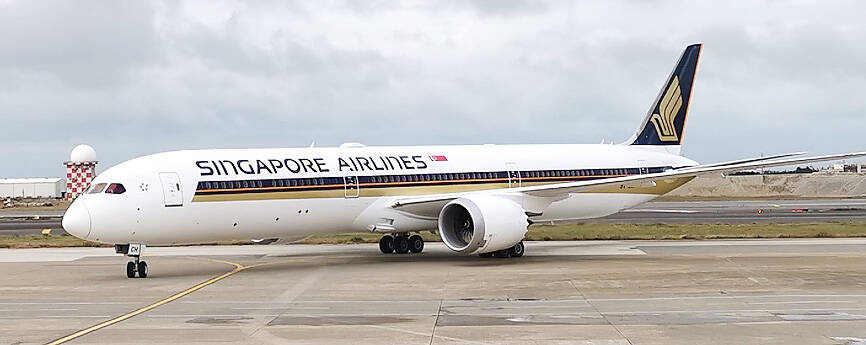
INCREASED CAPACITY: The flights on Mondays, Wednesdays, Fridays and Sundays would leave Singapore in the morning and Taipei in the afternoon Singapore Airlines is adding four supplementary flights to Taipei per week until May to meet increased tourist and business travel demand, the carrier said on Friday. The addition would raise the number of weekly flights it operates to Taipei to 18, Singapore Airlines Taiwan general manager Timothy Ouyang (歐陽漢源) said. The airline has recorded a steady rise in tourist and business travel to and from Taipei, and aims to provide more flexible travel arrangements for passengers, said Ouyang, who assumed the post in July last year. From now until Saturday next week, four additional flights would depart from Singapore on Monday, Wednesday, Friday
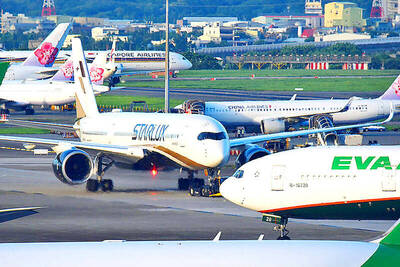
Taiwan’s three major international carriers are increasing booking fees, with EVA Airways having already increased the charge to US$28 per flight segment from US$25, while China Airlines (CAL) and Starlux Airlines are set to follow suit. Booking fees are charged by airlines through a global distribution system (GDS) and passed on to passengers. Carriers that apply the fees include CAL, EVA, Starlux and Tigerair Taiwan. A GDS is a computerized network operated by a company that connects airlines with travel agents and ticketing platforms, allowing reservations to be made and processed in real time. Major players include Amadeus, Sabre and Travelport. EVA Air began
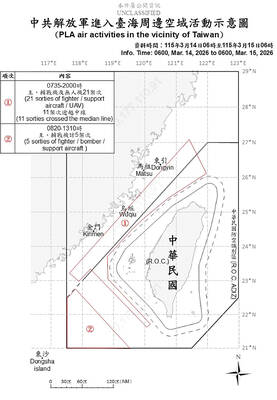
The Ministry of National Defense yesterday reported the return of large-scale Chinese air force activities after their unexplained absence for more than two weeks, which had prompted speculation regarding Beijing’s motives. China usually sends fighter jets, drones and other military aircraft around the nation on a daily basis. Interruptions to such routine are generally caused by bad weather. The Ministry of National Defense said it had detected 26 Chinese military aircraft in the Taiwan Strait over the previous 24 hours. It last reported that many aircraft on Feb. 25, when it spotted 30 aircraft, saying Beijing was carrying out another “joint combat
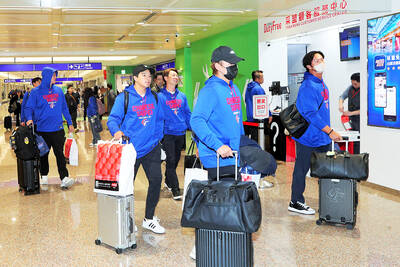
WATCH FOR HITCHHIKERS: The CDC warned those returning home from Japan to be alert for any contagious diseases that might have come back with them People who have returned from Japan following the World Baseball Classic (WBC) games during the weekend are recommended to watch for symptoms of infectious gastroenteritis, flu and measles for two weeks, the Centers for Disease Control (CDC) said. Flu viruses remain the most common respiratory pathogen in Taiwan in the past four weeks and the influenza B virus accounted for 55.7 percent of the tested cases, exceeding the percentage of influenza A (H3N2) infections and becoming the local dominant strain, CDC Epidemic Intelligence Center Deputy Director Lee Chia-lin (李佳琳) said at a news conference on Tuesday. There were 82,187 hospital visits for


 RSS
RSS