


The telephone call between President Tsai Ing-wen (蔡英文) and US president-elect Donald Trump has put Beijing — still preoccupied with adjusting to the prospect of a Trump administration — in a predicament that has so far exceeded Beijing’s ability to react.
The telephone conversation, which took place on Friday and lasted for a little more than 10 minutes, was the first publicly reported call between a Taiwanese leader and a US president or president-elect since 1979, when Washington switched recognition from Taipei to Beijing.
During the US presidential campaign, Chinese media and Internet users gave Trump’s candidacy a more positive response than that of former US secretary of state Hillary Rodham Clinton, who implemented US President Barack Obama’s “rebalance” or “pivot” to Asia.
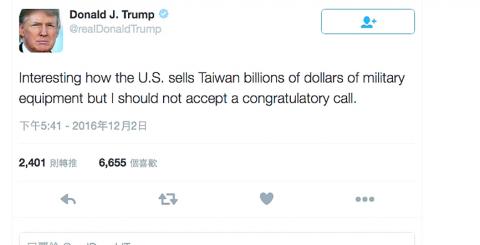
Screen grab from US president-elect Donald Trump’s Twitter account
However, not only did Trump on Friday answer Tsai’s call, he also addressed her as “the president of Taiwan,” sending shock waves through Beijing, where officials appear to have been caught wrong-footed.
Beijing’s surprise is evident in its initial handling of the situation, which amounted to placing the blame on Taipei.
Chinese Minister of Foreign Affairs Wang Yi (王毅) and China’s Taiwan Affairs Office spokesperson Ma Xiaoguang (馬曉光) described the call as “a trick by Taiwan,” and said it would not affect the overall substance of the US’ “one China” policy.
Beijing knows full well that any two-way telephone communication between heads of state requires cooperation on both ends. Tsai’s 10-minute talk with Trump was clearly prearranged by the staff of both sides.
For nations that are trying to decipher the Trump administration’s overall foreign policy direction, the call is ample evidence that a direct channel of communication has been opened by Taipei and the national security advisers of Trump’s presumptive Cabinet.
It is interesting that while the Presidential Office in Taipei has remained relatively low-key about the call, Trump’s team has issued news statements and Trump made repeated comments on Twitter and Facebook to hit back against accusations from the US media that he had challenged Washington’s long-standing “one China” policy.
These moves suggest that Trump answering Tsai’s call was not a spur-of-the-moment decision; instead, it was a premeditated action by the Trump team that hints at his direction of US policy in the Asia-Pacific region.
Trump has expressed his opposition to multilateral trade agreements on multiple occasions and he promised that withdrawing the US from the Trans-Pacific Partnership would be one of his first official acts. The comments have led to fears from US allies and partners in the Asia-Pacific region, such as Japan, that the US might withdraw its influence from the region and China might exploit the power vacuum.
Therefore, Trump’s talk with Tsai served to highlight Taiwan-US relations and reassure the international community of the Trump administration’s commitment to traditional US allies and partners.
It further showed Beijing that the US would continue its crucial role in Asia.
Although the US media has panned Trump for challenging the “one China” policy that has been the long-standing convention in Washington, US pundits are mistaken. The “one China” policy is by no means identical to China’s “one China” principle. While Beijing sees Taiwan as a part of China, the US merely “acknowledges” Beijing’s position, without accepting or recognizing the validity of its claims.
This crucial distinction is the reason Taiwan-US relations havecontinued to grow.
Even as the Chinese government continues its denial that the Tsai-Trump call would affect the international community’s acceptance of its version of “one China,” Trump is emphatically at work redefining what exactly “one China” means.
Translated by Jonathan Chin

NATIONAL SECURITY: Authorities are working to confirm the identities of the military personnel involved and investigating possible illegal conduct and regulatory violations Authorities are probing possible national security implications after Kinmen police and immigration officers on Sunday found a Chinese woman allegedly posing as a tourist while engaging in prostitution involving more than 10 military personnel. The woman, surnamed Chen (陳), has since been deported, authorities said, adding that investigators are still working to confirm the identities of those implicated, as the records only listed code names and aliases. The case stemmed from a report received by the Kinmen District Prosecutors’ Office on Friday last week from the Jinhu Precinct of the Kinmen County Police Bureau. On Sunday, police, along with the National Immigration

GLOBALGIVING: ‘ Caving to external pressure is not acceptable for an organization that has cultivated justice reform and human rights for 30 years,’ one NGO said A slew of non-government organizations (NGOs) have withdrawn from the GlobalGiving fundraising platform after it announced it would use “Chinese Taipei” instead of “Taiwan” from next month. The Taiwan Good Rice Association wrote on Facebook on Friday that it was informed on April 28 via a teleconference call of the change, which was made because the platform wanted to operate in China. Taiwan Good Rice is to terminate all cooperative relationships with GlobalGiving in response to the platform’s “unilateral and non-negotiable” decision to remove references to Taiwan, the NGO said. “Taiwan is in the official name of Taiwan Good Rice Association and the

HEAVY WEATHER: Typhoon Jangmi is due to crash straight into the Ryukyus as airlines look to shift flights to larger aircraft or cancel flights to Okinawa entirely Taiwan’s international air carriers announced flight adjustments over the weekend as Typhoon Jangmi is forecast to hit the Ryukyu Islands today and tomorrow. The Central Weather Administration (CWA) upgraded Jangmi from a tropical storm to a typhoon at 8am yesterday, with the eye located 580km south of Naha city. It was moving north at 19kph. Today, China Airlines’ CI-120, CI-121, CI-122 and CI-123 flights between Taoyuan and Naha, Okinawa, have been canceled as well as CI-132 and CI-133 between Kaohsiung and Naha. EVA Air’s BR-112, BR-113, BR-186 and BR-185 flights between Taoyuan and Naha are also canceled. Low-cost carrier Tigerair Taiwan canceled IT-230,
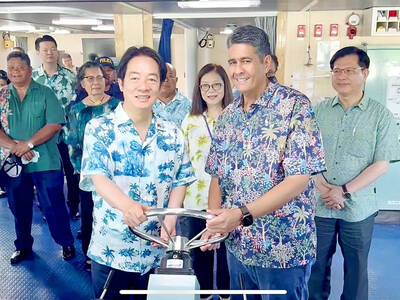
MULTIPRONGED APPROACH: China has sought to pressure Palau across a number of fronts, but the island nation has staunchly resisted overtures to ditch Taiwan Palau has been firm in backing Taiwan despite Chinese pressure that uses tourism economics, cyberattacks and criminal infiltration as tools to threaten the Pacific ally into renouncing its recognition of Taiwan as a sovereign state. The Presidential Office yesterday announced that Vice President Hsiao Bi-khim (蕭美琴) would visit Palau from Saturday to Wednesday next week at the invitation of Palauan President Surangel Whipps Jr. Whipps in April said in an interview that China had outspokenly asked Palau to “denounce Taiwan.” “And we have said: ‘We have no enemies, but nobody tells us who our friends are,’” he said. Whipps has told reporters multiple times


 RSS
RSS