


The New Power Party (NPP) caucus yesterday proposed amendments to the Physicians Act (醫師法), saying that the regulations limit access to medical resources for elderly people, those with chronic illnesses and people needing long-term care.
NPP caucus whip Hsu Yung-ming (徐永明) said advances in technology offer online communications as an alternative to daily meetings and it thinks the government should to look into whether such technology could be used to facilitate long-range medical care.
Article 11 of the act states that doctors must not offer any treatment or prescriptions unless they are in attendance. In an emergency or in cases in remote locations, the local government should appoint a doctor to prescribe medication or offer assistance via telecommunications and authorize medical facilities to carry out any procedure.
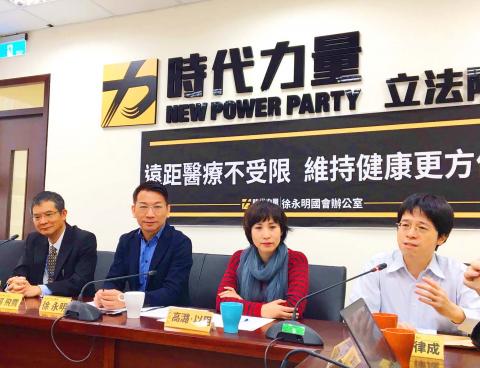
Photo: CNA
The appointment of doctors and the communication method is to be designated by the central government, it says.
The NPP said the regulations needed to be updated, while the meaning of the meaning of “attendance” in the act needed to be examined.
Medical resources for Aborigines or people in rural areas are difficult to arrange, said NPP Legislator Kawlo Iyun Pacidal, an Amis, adding that technology could provide a solution if it was given the legal go-ahead.
The government should consider relaxing restrictions and allow doctors to extend their services via telecommunications and not have to be in attendance in every case, Pacidal said.
National Taiwan University’s Feipei Lai (賴飛羆) said that telecommunications were already used in other countries for such situations and the law needs to get with the times.
The Department of Computer Science and Information Engineering professor said that relaxing the rules would boost sales of products in the industry, while those in need would be able to obtain quality medical services.
National Taiwan University Hospital physician Kuo Lu-cheng (郭律成) said that in practice, doctors are unable to offer many suggestions to people with mobility problems, such as those relegated to bed, stroke patients, or those on respirators.
Instead of long-distance medical services, doctors could instead seek to reduce the number of patients visiting medical centers, especially those whose symptoms are not so serious, Kuo said.
Ministry of Health and Welfare Department of Medical Affairs official Lu Nien-tzu (呂念慈) said the agency was gathering information on long-distance medical services and was giving the matter due consideration.
The act encourages doctors to adhere to the “physically attend” regulation, Lu said, adding however that as long as a doctor is not providing treatment or giving a prescription, there are no limitations on advice they can give.

Taiwan has received more than US$70 million in royalties as of the end of last year from developing the F-16V jet as countries worldwide purchase or upgrade to this popular model, government and military officials said on Saturday. Taiwan funded the development of the F-16V jet and ended up the sole investor as other countries withdrew from the program. Now the F-16V is increasingly popular and countries must pay Taiwan a percentage in royalties when they purchase new F-16V aircraft or upgrade older F-16 models. The next five years are expected to be the peak for these royalties, with Taiwan potentially earning
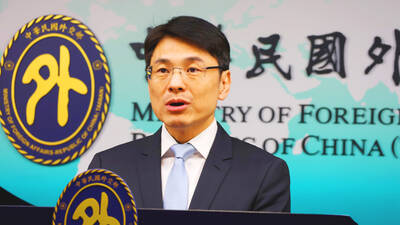
STAY IN YOUR LANE: As the US and Israel attack Iran, the ministry has warned China not to overstep by including Taiwanese citizens in its evacuation orders The Ministry of Foreign Affairs (MOFA) yesterday rebuked a statement by China’s embassy in Israel that it would evacuate Taiwanese holders of Chinese travel documents from Israel amid the latter’s escalating conflict with Iran. Tensions have risen across the Middle East in the wake of US and Israeli airstrikes on Iran beginning Saturday. China subsequently issued an evacuation notice for its citizens. In a news release, the Chinese embassy in Israel said holders of “Taiwan compatriot permits (台胞證)” issued to Taiwanese nationals by Chinese authorities for travel to China — could register for evacuation to Egypt. In Taipei, the ministry yesterday said Taiwan
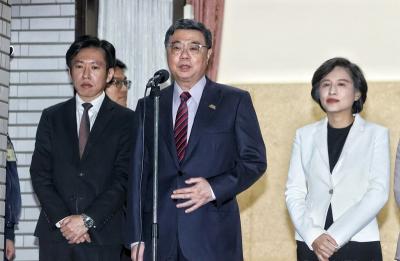
Taiwan is awaiting official notification from the US regarding the status of the Agreement on Reciprocal Trade (ART) after the US Supreme Court ruled US President Donald Trump's global tariffs unconstitutional. Speaking to reporters before a legislative hearing today, Premier Cho Jung-tai (卓榮泰) said that Taiwan's negotiation team remains focused on ensuring that the bilateral trade deal remains intact despite the legal challenge to Trump's tariff policy. "The US has pledged to notify its trade partners once the subsequent administrative and legal processes are finalized, and that certainly includes Taiwan," Cho said when asked about opposition parties’ doubts that the ART was
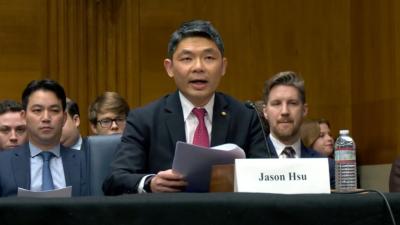
If China chose to invade Taiwan tomorrow, it would only have to sever three undersea fiber-optic cable clusters to cause a data blackout, Jason Hsu (許毓仁), a senior fellow at the Hudson Institute and former Chinese Nationalist Party (KMT) legislator, told a US security panel yesterday. In a Taiwan contingency, cable disruption would be one of the earliest preinvasion actions and the signal that escalation had begun, he said, adding that Taiwan’s current cable repair capabilities are insufficient. The US-China Economic and Security Review Commission (USCC) yesterday held a hearing on US-China Competition Under the Sea, with Hsu speaking on


 RSS
RSS