


Amid the government’s push of its long-term care services program 2.0, President Tsai Ing-wen (蔡英文) yesterday said that laying a foundation is crucial for any reform and cannot be rushed.
Tsai made the remarks at a long-term care workers experience sharing session held by the Ministry of Health and Welfare in Taipei, saying that the program must be established, because Taiwan is gradually becoming an aging society.
“Establishing a findable, visible, usable and affordable long-term care service system is a very important policy of the administration,” she said. “Long-term care workers are the most important human resources in the system.”
Tsai tablked about her experience of being unemployed and caring for her mother at home, saying she deeply feels that long-term care workers need not only a caring heart and patience, but a profession.
The most important aspect in popularizing and providing affordable long-term care services is to create demand and supply, she said, adding that the central government would take the lead by allocating a budget and integrating local resources to create the initial environment.
“The works are like laying the foundation when building a house: You will only see flying dirt and dust in the short run, but we must lay a solid foundation so the house can stand firm,” she said.
“I know everyone is eager for reform, but being hasty will not solve problems. Only by steadily moving forward one step at a time can we solve these issues properly, and pushing the program forward works toward that end,” Tsai said.
A long-term care technology unit has been established to enhance long-term care services, Minister of Health and Welfare Lin Tzou-yien (林奏延) said.
The source of the long-term care workforce should be diversified to include not only graduates of 65 related school departments, but also older people who want to return to work, Lin said, adding that men, immigrants and young people would be welcome.
The ministry is working toward increasing wages for care workers to attract more people to join the workforce, he said.
As most young people tend to prefer stable monthly salaries, while older people prefer hourly wages for part-time jobs, both systems would be adopted, with payment standards to be decided this week, he said.
Cooperation with local long-term care facilities will be changed from bidding to contract terms, so that the facilities can receive funding sooner to pay their employees, he said.
“Aside from an aging society, we also face the serious problem of a low birth rate, and in the long run we will never have sufficient long-term care services personnel, so we need technology’s help,” Lin said, with the new unit working toward enhancing services through technology.
Three long-term care workers shared their experiences at the session, including a 28-year-old woman surnamed Lin (林), who worked at an accountant’s office after graduating from university, but quit that job and became a full-time long-term care worker at a nursing home two years ago.
Providing care to older people has enriched her soul, giving her a sense of achievement by taking care of them and allowing them to live out their lives in a comfortable environment, she said.

The manufacture of the remaining 28 M1A2T Abrams tanks Taiwan purchased from the US has recently been completed, and they are expected to be delivered within the next one to two months, a source said yesterday. The Ministry of National Defense is arranging cargo ships to transport the tanks to Taiwan as soon as possible, said the source, who is familiar with the matter. The estimated arrival time ranges from late this month to early next month, the source said. The 28 Abrams tanks make up the third and final batch of a total of 108 tanks, valued at about NT$40.5 billion

A group from the Taiwanese Designers in Australia association yesterday represented Taiwan at the Midsumma Pride March in Melbourne. The march, held in the St. Kilda suburb, is the city’s largest LGBTQIA+ parade and the flagship event of the annual Midsumma Festival. It attracted more than 45,000 spectators who supported the 400 groups and 10,000 marchers that participated this year, the association said. Taiwanese Designers said they organized a team to march for Taiwan this year, joining politicians, government agencies, professionals and community organizations in showing support for LGBTQIA+ people and diverse communities. As the first country in Asia to legalize same-sex

Travel agencies in Taiwan are working to secure alternative flights for travelers bound for New Zealand for the Lunar New Year holiday, as Air New Zealand workers are set to strike next week. The airline said that it has confirmed that the planned industrial action by its international wide-body cabin crew would go ahead on Thursday and Friday next week. While the Auckland-based carrier pledged to take reasonable measures to mitigate the impact of the workers’ strike, an Air New Zealand flight arriving at Taipei from Auckland on Thursday and another flight departing from Taipei for Auckland on Saturday would have to
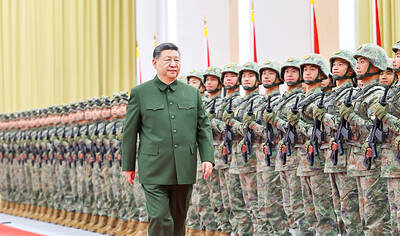
MOTIVES QUESTIONED The PLA considers Xi’s policies toward Taiwan to be driven by personal considerations rather than military assessment, the Epoch Times reports Chinese President Xi Jinping’s (習近平) latest purge of the Chinese People’s Liberation Army (PLA) leadership might have been prompted by the military’s opposition to plans of invading Taiwan, the Epoch Times said. The Chinese military opposes waging war against Taiwan by a large consensus, putting it at odds with Xi’s vision, the Falun Gong-affiliated daily said in a report on Thursday, citing anonymous sources with insight into the PLA’s inner workings. The opposition is not the opinion of a few generals, but a widely shared view among the PLA cadre, the Epoch Times cited them as saying. “Chinese forces know full well that


 RSS
RSS