


President Tsai Ing-wen (蔡英文) has vowed to turn Taiwan into “an Asian tiger” again in an article she wrote for The Economist’s special edition, “The World In 2017,” in which Tsai lays out her reform plans for the coming year.
Taiwan was a bright light in a sea of darkness, but lately, many Taiwanese feel that light has dimmed amid an uncertain global environment, she wrote in the article.
Tsai, who was elected president in January, said she assumed her presidential duties at a time of vast economic and political challenges, including slow economic growth, rising inequality and new security threats that are testing the world.
“Taiwan, no less than other nations, will be defined by how it responds to these difficulties,” Tsai said.
Noting that her Democratic Progressive Party also holds a majority in the legislature, she said “we want to make Taiwan an Asian tiger once again.”
“My plan for 2017 is for Taiwan to renew its role as a pioneer, preserving our basic social safety net while revitalizing the economy with a new development model,” she said.
To that end, her administration will “simultaneously work to reform political institutions, ensuring that economic and social transformations are combined with transparency and a strong democratic culture,” she said.
To bolster the social safety net, Tsai said that her administration is pushing for pension reform aimed at creating a sustainable system and increasing support for the poorest in society.
Noting that the proportion of income spent on housing by Taiwanese has risen sharply amid a real-estate bubble, she said her administration would work to provide 200,000 units of affordable social housing by 2024 via a public-private investment plan.
In response to an aging population, her government would also build new community centers to care for senior citizens, she said.
“Our overall goal is to redistribute public resources for a fairer welfare system,” she said.
Her economic plan for next year focuses on upgrading industries and overcoming stagnation, by laying the groundwork for a more inclusive economic model based on innovation, job creation and the idea that growth should benefit all, not just a few, she said.
“Through ‘smart’ investment, the government is integrating public, private and global resources to nurture industries of the future: the ‘Internet of things,’ biotechnology, ‘smart’ machinery, ‘green’ energy and defense,” she said.
Her government is also working to refine Taiwan’s capital market and make financial policy more inviting to innovation-oriented foreign investment, provide greater support to entrepreneurs and tech start-ups and loosen regulations on foreign professionals, she said.
It is also important to help open new markets for Taiwanese products and services, she said, adding that she hopes to increase engagement with nations in Southeast Asia and South Asia, as well as Australia and New Zealand under the “new southbound policy.”
In terms of regional economic integration, she said Taiwan “will seek accession to the Trans-Pacific Partnership if and when it becomes available. We are also working toward bilateral agreements with important trading partners,” without indicating which ones.
Tsai said these all depend on a stable regional environment and she pledged to seek dialogue with all interested parties, including China, to build a framework for peace and prosperity in the Asia-Pacific region.
“My cross-strait policy is to establish consistent, predictable and sustainable relations under the existing constitutional framework,” she said.
Taiwan, South Korea, Singapore and Hong Kong were called the “Four Asian Tigers” from the 1970s to the 1990s because of their rapid economic growth.

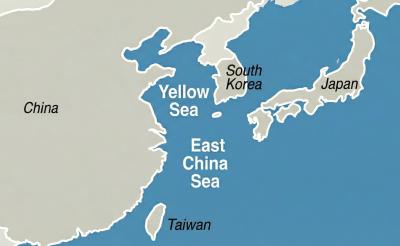
China has reserved offshore airspace in the Yellow Sea and East China Sea from March 27 to May 6, issuing alerts usually used to warn of military exercises, although no such exercises have been announced, the Wall Street Journal (WSJ) reported yesterday. Reserving such a large area for 40 days without explanation is an “unusual step,” as military exercises normally only last a few days, the paper said. These alerts, known as Notice to Air Missions (Notams), “are intended to inform pilots and aviation authorities of temporary airspace hazards or restrictions,” the article said. The airspace reserved in the alert is
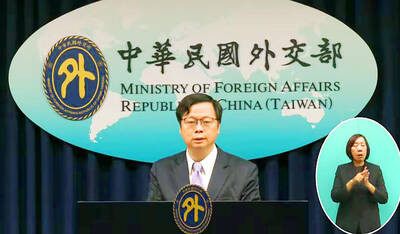
NAMING SPAT: The foreign ministry called on Denmark to propose an acceptable solution to the erroneous nationality used for Taiwanese on residence permits Taiwan has revoked some privileges for Danish diplomatic staff over a Danish permit that lists “Taiwan” as “China,” Eric Huang (黃鈞耀), head of the Ministry of Foreign Affairs’ Department of European Affairs, told a news conference in Taipei yesterday. Reporters asked Huang whether the Danish government had responded to the ministry’s request that it correct the nationality on Danish residence permits of Taiwanese, which has been listed as “China” since 2024. Taiwan’s representative office in Denmark continues to communicate with the Danish government, and the ministry has revoked some privileges previously granted to Danish representatives in Taiwan and would continue to review
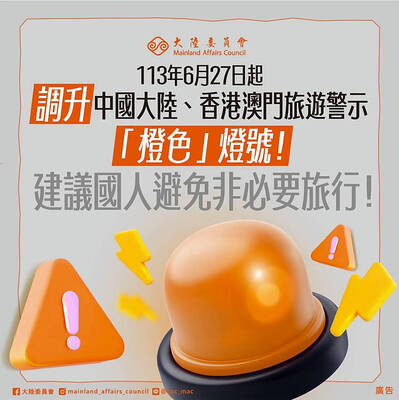
More than 6,000 Taiwanese students have participated in exchange programs in China over the past two years, despite the Mainland Affairs Council’s (MAC) “orange light” travel advisory, government records showed. The MAC’s publicly available registry showed that Taiwanese college and university students who went on exchange programs across the Strait numbered 3,592 and 2,966 people respectively. The National Immigration Agency data revealed that 2,296 and 2,551 Chinese students visited Taiwan for study in the same two years. A review of the Web sites of publicly-run universities and colleges showed that Taiwanese higher education institutions continued to recruit students for Chinese educational programs without
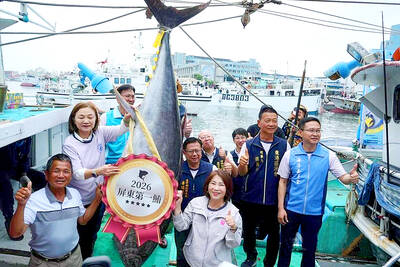
The first bluefin tuna of the season, brought to shore in Pingtung County and weighing 190kg, was yesterday auctioned for NT$10,600 (US$333.5) per kilogram, setting a record high for the local market. The auction was held at the fish market in Donggang Fishing Harbor, where the Siaoliouciou Island-registered fishing vessel Fu Yu Ching No. 2 delivered the “Pingtung First Tuna” it had caught for bidding. Bidding was intense, and the tuna was ultimately jointly purchased by a local restaurant and a local company for NT$10,600 per kilogram — NT$300 ,more than last year — for a total of NT$2.014 million. The 67-year-old skipper


 RSS
RSS