


An opinion poll released yesterday showed wide support for Chinese Nationalist Party (KMT) Chairwoman Hung Hsiu-chu’s (洪秀柱) China visit and meeting with Chinese President Xi Jinping (習近平), with respondents saying the trip would be conducive to addressing the cross-strait impasse.
The survey, which gauged perceptions of the meeting, was conducted by New Taipei City-based polling company Trendgo at the KMT’s behest from Friday to Sunday after Hung returned from the five-day trip to China on Thursday last week.
Of those polled, 44.4 percent said they supported Hung’s decision to counter the Democratic Progressive Party’s (DPP) independence clause with the KMT’s new “peace-centered policy platform,” compared with 24.7 percent who said they did not support it.
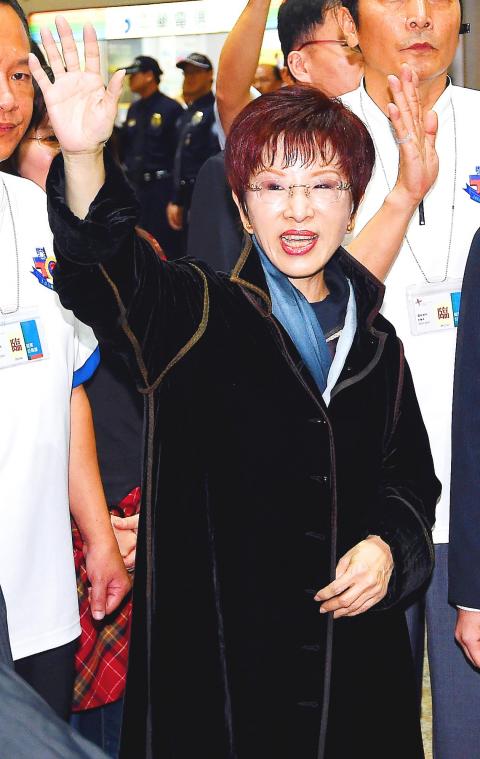
Photo: Chu Pei-hsiung, Taipei Times
Fifty-seven percent expressed a positive view toward Hung’s request that Xi allow Chinese athletes to participate in next year’s Summer Universiade in Taipei, with 19.1 percent disapproving of the move, the poll showed.
Hung’s request that Beijing give Taiwan more opportunities to participate at international events — such as the APEC summit in Peru — received the support of 64 percent of respondents, while 11.5 percent disapproved.
Asked whether Hung’s visit would help break the cross-strait deadlock and promote exchanges, 48.2 percent of respondents answered yes, while 36.3 percent said no.
Among respondents, 57.3 percent said Taiwan should play a more active role in reinvigorating “Zhonghua culture,” while 20.3 percent said it should not.
“Judging from the poll results, Chairwoman Hung’s China visit received wide public support in terms of the subject matters discussed, as well as the nature and connotations of the trip,” KMT Central Policy Committee Director Alex Tsai (蔡正元) told a news conference in Taipei.
“They showed that the Hung-Xi meeting was quite a success,” he said.
KMT Culture and Communications Committee deputy director Hung Meng-kai (洪孟楷) said the survey also found that maintaining the cross-strait “status quo” remained the most popular choice, with 60.4 percent of respondents supporting it.
“Fewer than 20 percent of those polled leaned toward unification or independence, which indicates that the majority of Taiwanese are inclined to seek peaceful and stable cross-strait development under the status quo,” Hung Meng-kai said.
The poll collected 1,070 valid samples.
It had a margin of error of 3 percentage points.

LOUD AND PROUD Taiwan might have taken a drubbing against Australia and Japan, but you might not know it from the enthusiasm and numbers of the fans Taiwan might not be expected to win the World Baseball Classic (WBC) but their fans are making their presence felt in Tokyo, with tens of thousands decked out in the team’s blue, blowing horns and singing songs. Taiwanese fans have packed out the Tokyo Dome for all three of their games so far and even threatened to drown out home team supporters when their team played Japan on Friday. They blew trumpets, chanted for their favorite players and had their own cheerleading squad who dance on a stage during the game. The team struggled to match that exuberance on the field, with
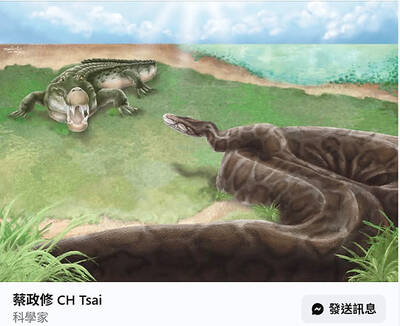
Taiwanese paleontologists have discovered fossil evidence that pythons up to 4m long inhabited Taiwan during the Pleistocene epoch, reporting their findings in the international scientific journal Historical Biology. National Taiwan University (NTU) Institute of Ecology and Evolutionary Biology associate professor Tsai Cheng-hsiu (蔡政修) led the team that discovered the largest snake fossil ever found in Taiwan. The single trunk vertebra was discovered in Tainan at the Chiting Formation, dated to between 400,000 and 800,000 years ago in the Middle Pleistocene, the paper said. The area also produced Taiwan’s first avian fossil, as well as crocodile, mammoth, saber-toothed cat and rhinoceros fossils, it said. Discoveries

Taiwanese paleontologists have discovered fossil evidence that pythons up to 4m long inhabited Taiwan during the Pleistocene epoch, reporting their findings in the international scientific journal Historical Biology. National Taiwan University (NTU) Institute of Ecology and Evolutionary Biology associate professor Tsai Cheng-hsiu (蔡政修) led the team that discovered the largest snake fossil ever found in Taiwan. A single trunk vertebra was discovered in Tainan at the Chiting Formation, dated to between 800,000 to 400,000 years ago in the Middle Pleistocene, the paper said. The area also produced Taiwan’s first avian fossil, as well as crocodile, mammoth, sabre-toothed cat and rhinoceros fossils, it said. Discoveries

Whether Japan would help defend Taiwan in case of a cross-strait conflict would depend on the US and the extent to which Japan would be allowed to act under the US-Japan Security Treaty, former Japanese minister of defense Satoshi Morimoto said. As China has not given up on the idea of invading Taiwan by force, to what extent Japan could support US military action would hinge on Washington’s intention and its negotiation with Tokyo, Morimoto said in an interview with the Liberty Times (sister paper of the Taipei Times) yesterday. There has to be sufficient mutual recognition of how Japan could provide


 RSS
RSS