


The government has listed “long-term care” services as one of its key policies, refocusing attention on how the nation, with its rapidly aging population, will take care of elderly people as their growing numbers stress the healthcare system.
Several challenges stand out in the discussion. Who will pay for the services? How will services be delivered? Is there sufficient and adequately trained workforce to provide care? What should the roles of the public and private sectors be?
However, beyond these broader questions lies a more fundamental issue — how would high-quality care be provided to incapacitated people who need constant attention to the degree that they may need to be “restrained” to prevent harming themselves.
At most assisted-living facilities in Taiwan, it is common to use physical restraints to secure elderly patients to their beds or wheelchairs to prevent them from falling and injuring themselves. Such measures are the result of both safety concerns and a limited number of workers at care facilities.
However, Yunlin County Senior Citizen Welfare and Protection Association chief executive Lin Chin-li (林金立) is hoping the nation can evolve toward a “zero restraint” culture.
“Such restraints are like jailing people,” Lin said, “especially because many elderly people can no longer verbally communicate their discomfort because of illness or aging.”
Yao Chien-an (姚建安), who supervises hospice care wards at National Taiwan University Hospital, said that while restraints are rarely used on patients in hospice care, they are sometimes “a necessary option to prevent patients from hurting themselves or others.”
Some patients accidently pull feeding tubes out of their nose, Yao said.
“Repeatedly inserting the tube can be endless torture for both the patients and their family members,” Yao said.
The use of restraints is a question that care providers battle with and are likely to even more often in the future as Taiwan’s elderly population increases.
The National Development Council has predicted that Taiwan will become an “aged” society by 2018 (when more than 14 percent of the population is 65 years old or over) and a “super-aged” society by 2026 (when more than 20 percent of the population is 65 or over).
In terms of the aging index, which is calculated as the number of people 65 years old or over per 100 people under age 15, Ministry of the Interior statistics show that the index has risen from 51.4 to 91.6 in the 10-year period between November 2005 and November last year.
The number of elderly people in Taiwan is expected to surpass the number of people aged 14 or under for the first time ever next year, and there could be 4.1 times as many seniors as people aged 14 or under by 2061.
By 2061, it is predicted that the percentage of people 65 or over will account for 38.9 percent of Taiwan’s population, compared with 13.2 percent this year, according to the council.
During this dramatic demographic transition, the aged dependency ratio — the size of the non-working population as a percentage of the working-age (15 to 64 years old) population — is expected to rise from 36.2 percent this year to a worrisome 94.6 percent in 2061, the council said.
Also of concern is that while last year, life expectancy in Taiwan averaged 80.2 years, the average number of years people were actually healthy was 71 years — 68.7 years among males and 73.4 years among females — according to Ministry of Health and Welfare data from 2014.
The figures suggest elderly people need to rely on medical support or care given by other people for as long as eight to nine years to stay alive, with many of them requiring full-time care because of incapacitating ailments.
A growing elderly population needing an average of nine years care means more people living in nursing homes or care centers, and it is likely that more people would need physical restraints.
According to the government-approved standard contract for long-term care services, assisted living facilities are entitled to apply “appropriate restraints” to those in their care with the approval of the patients themselves or their families based on a medical diagnosis or medical history.
That partly explains why restraints are so commonly used in Taiwan.
Lin believes that part of the dilemma is a lack of workforce.
Some care facilities believe it is safer to tie people down because if they fall and injure themselves, caregivers would have to spend more time attending to them or be condemned by family members, Lin said.
However, that might be missing the point, Lin said.
Confining people to a bed or wheelchair only worsens their physical condition, leaving even fewer palatable options for their care or helping them improve their quality of life, he said.
Instead, Taiwan should learn from Japan, which is already confronting a serious aging problem, and is moving toward “care without restraints,” he said.
“Long-term care should not be seen as a sanctuary the elderly retreat to or as something that supplements a family’s caregiving function. It should be to help seniors live independently, see themselves in a positive light, and enjoy their later years,” Lin said. “And that means being as free as possible, without physical restraints, especially as experts see care models that use or do not use restraints as both having their risks.”
“Being disabled in some way is not the same as being completely incapacitated,” Lin said. “We don’t want to see people restrained in their old age and die while suffering.”

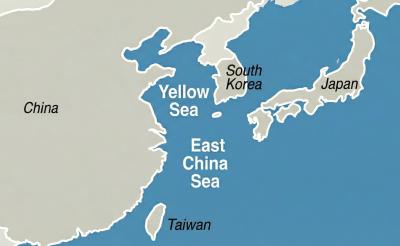
China has reserved offshore airspace in the Yellow Sea and East China Sea from March 27 to May 6, issuing alerts usually used to warn of military exercises, although no such exercises have been announced, the Wall Street Journal (WSJ) reported yesterday. Reserving such a large area for 40 days without explanation is an “unusual step,” as military exercises normally only last a few days, the paper said. These alerts, known as Notice to Air Missions (Notams), “are intended to inform pilots and aviation authorities of temporary airspace hazards or restrictions,” the article said. The airspace reserved in the alert is
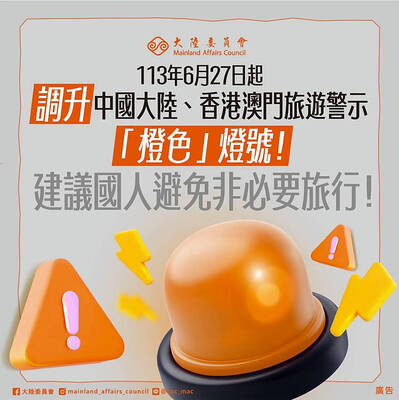
More than 6,000 Taiwanese students have participated in exchange programs in China over the past two years, despite the Mainland Affairs Council’s (MAC) “orange light” travel advisory, government records showed. The MAC’s publicly available registry showed that Taiwanese college and university students who went on exchange programs across the Strait numbered 3,592 and 2,966 people respectively. The National Immigration Agency data revealed that 2,296 and 2,551 Chinese students visited Taiwan for study in the same two years. A review of the Web sites of publicly-run universities and colleges showed that Taiwanese higher education institutions continued to recruit students for Chinese educational programs without

A bipartisan group of US senators has introduced a bill to enhance cooperation with Taiwan on drone development and to reduce reliance on supply chains linked to China. The proposed Blue Skies for Taiwan Act of 2026 was introduced by Republican US senators Ted Cruz and John Curtis, and Democratic US senators Jeff Merkley and Andy Kim. The legislation seeks to ease constraints on Taiwan-US cooperation in uncrewed aerial systems (UAS), including dependence on China-sourced components, limited access to capital and regulatory barriers under US export controls, a news release issued by Cruz on Wednesday said. The bill would establish a "Blue UAS
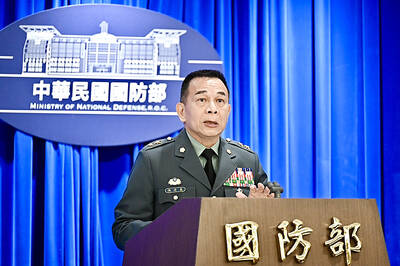
The Republic of China Army Command yesterday relieved Kinmen Defense Battalion commander after authorities indicted the officer on charges connected to using methamphetamine. The Kinmen District Prosecutors’ Office on Wednesday detained Colonel He (何) after the Coast Guard linked him to drug shipments and proceeded to charge him yesterday for using and possessing crystal meth. The man was released on a NT$50,000 bail and banned from leaving Kinmen, the office said. Army Chief of Staff Lieutenant General Chen Chien-yi (陳建義) told a news conference yesterday that He has been removed and another officer is taking over the unit as the acting commander. The military


 RSS
RSS