


A top US diplomat said that “US-Taiwan relations have never been better.”
In an interview with the Taipei Times, US Deputy Assistant Secretary for East Asia Susan Thornton said that from the US’ perspective, “we really have a good foundation to carry through the end of this administration and the transition to the new administration in the US.”
Thornton assumed the post in February. She joined the US Department of State in 1991 and has served in Taipei and China’s Beijing and Chengdu.
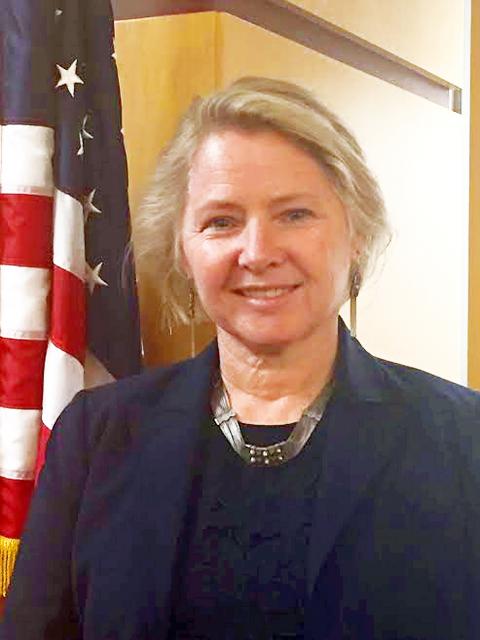
Photo: Nadia Tsao, Taipei Times
Thornton emphasized that Taiwan and the US are continuing all kinds of robust cooperation in many areas and that close Taiwan-US ties are extremely popular in the US.
Although there has been rhetoric urging a review of the relationship during the US election season, she said that everything that the US does with Taiwan enjoys bipartisan support and “Taiwan would never be abandoned.”
Chinese Nationalist Party (KMT) Chairwoman Hung Hsiu-chu (洪秀柱) is scheduled to visit China to meet with Chinese President Xi Jinping (習近平) on Tuesday, and discussions of a peace accord might be on their agenda, according to Taiwanese media reports.
“We really do not have a position on that,” Thornton said, adding that the US had no particular information about a peace accord.
She indicated what the US really wanted to see is the continuity of cross-strait peace and stability and communication taking place that is aimed at sustaining a healthy relationship that can get things done.
Thornton said she understood there might be some continuation of working-level contact between the authorities on both sides of the Taiwan Strait.
The US wants to be sure there is “quality communication” between Taipei and Beijing, as the authorities have to be “responsible [for] resolving issues and problems,” she said.
Thornton said there is a lack of trust on both sides in this regard, and that the US has been encouraging creativity, flexibility and restraint.
She said she hoped both sides of the Taiwan Strait could come up with forward-looking and positive agendas to work toward more established channels of communication.
Thornton said they had not nailed down the timing of a meeting between US Secretary of State John Kerry and People First Party Chairman James Soong (宋楚瑜), whom President Tsai Ing-wen (蔡英文) appointed her special envoy at the APEC summit, but there was no reason not to follow precedent and arrange a meeting.
The APEC leaders’ summit is scheduled to take place from Nov. 17 through Nov. 19.
She indicated that she sat in on the last meeting with the Taiwanese delegation and it was a good chance to review how Taiwan and the US could work together to help Taiwan pursue its goals in a regional and economic context.
Thornton said that Taiwan’s international participation is something the US takes seriously.
She reiterated that the US is still focused on Taiwan’s participation in the World Health Authority, Interpol and the UN Framework Convention on Climate Change and was looking to what Washington could do in those areas.
Apart from these organizations, she said “we always look to Taiwan’s comparative advantages” to showcase Taiwan’s talents to the international community.
She said Taiwan is “a model global citizen” which has a lot to contribute to the world.
Tsai has placed a new focus on prioritizing the indigenous defense industry, targeting the domestic production of diesel submarines and jet trainers.
Thornton said that “in general we support moving toward indigenous capabilities and building up the capacity.”
However, she refused to comment on any specific weapons system.
She reiterated that in general Washington would work with Taipei to ensure that the nation has the weapons it needs to defend itself.
Deputy Minister of Foreign Affairs Leo Lee (李澄然) led a delegation to Washington to conduct political and military dialogue with US counterparts earlier this month.
Thornton said such dialogues are beneficial because Taiwan and the US need robust security dialogues on many different levels.
“I think this kind of dialogue can help to clarify and bridge the gap between Taiwan and the US in military equipment procurement process,” she said.
She said that there are budget constraints on the Taiwanese side, and the US always hopes that Taiwan could invest a little more in its defense.
Although then-US president George W. Bush approved the sale of eight diesel submarines to Taiwan in 2001, little progress has been made on the deal since then.
Thornton confirmed the speculation of some observers in Washington that US President Barack Obama’s administration is unwilling to take any major decisions on the submarine issue and would leave it to the next US administration.
“That is one of those issues that is not really ripe to be finished in this administration,” she said.

LOUD AND PROUD Taiwan might have taken a drubbing against Australia and Japan, but you might not know it from the enthusiasm and numbers of the fans Taiwan might not be expected to win the World Baseball Classic (WBC) but their fans are making their presence felt in Tokyo, with tens of thousands decked out in the team’s blue, blowing horns and singing songs. Taiwanese fans have packed out the Tokyo Dome for all three of their games so far and even threatened to drown out home team supporters when their team played Japan on Friday. They blew trumpets, chanted for their favorite players and had their own cheerleading squad who dance on a stage during the game. The team struggled to match that exuberance on the field, with
Taiwanese paleontologists have discovered fossil evidence that pythons up to 4m long inhabited Taiwan during the Pleistocene epoch, reporting their findings in the international scientific journal Historical Biology. National Taiwan University (NTU) Institute of Ecology and Evolutionary Biology associate professor Tsai Cheng-hsiu (蔡政修) led the team that discovered the largest snake fossil ever found in Taiwan. The single trunk vertebra was discovered in Tainan at the Chiting Formation, dated to between 400,000 and 800,000 years ago in the Middle Pleistocene, the paper said. The area also produced Taiwan’s first avian fossil, as well as crocodile, mammoth, saber-toothed cat and rhinoceros fossils, it said. Discoveries

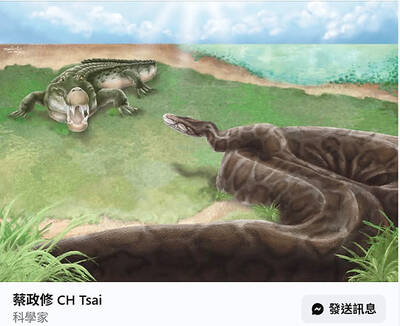
Taiwanese paleontologists have discovered fossil evidence that pythons up to 4m long inhabited Taiwan during the Pleistocene epoch, reporting their findings in the international scientific journal Historical Biology. National Taiwan University (NTU) Institute of Ecology and Evolutionary Biology associate professor Tsai Cheng-hsiu (蔡政修) led the team that discovered the largest snake fossil ever found in Taiwan. A single trunk vertebra was discovered in Tainan at the Chiting Formation, dated to between 800,000 to 400,000 years ago in the Middle Pleistocene, the paper said. The area also produced Taiwan’s first avian fossil, as well as crocodile, mammoth, sabre-toothed cat and rhinoceros fossils, it said. Discoveries
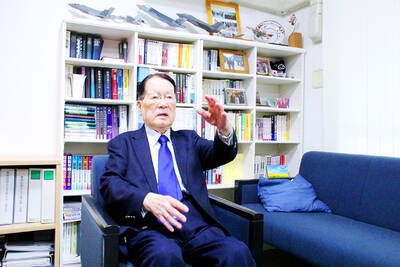
Whether Japan would help defend Taiwan in case of a cross-strait conflict would depend on the US and the extent to which Japan would be allowed to act under the US-Japan Security Treaty, former Japanese minister of defense Satoshi Morimoto said. As China has not given up on the idea of invading Taiwan by force, to what extent Japan could support US military action would hinge on Washington’s intention and its negotiation with Tokyo, Morimoto said in an interview with the Liberty Times (sister paper of the Taipei Times) yesterday. There has to be sufficient mutual recognition of how Japan could provide


 RSS
RSS