


Procedural moves by the Democratic Progressive Party (DPP) to push through controversial amendments to the Labor Standards Act (勞動基準法) have betrayed promises for congressional reform, New Power Party (NPP) Executive Chairman Huang Kuo-chang (黃國昌) said yesterday.
At a meeting of the legislature’s Social Welfare and Environmental Hygiene Committee, the committee’s DPP majority confirmed the minutes of an Oct. 5 meeting, in which amendments to the act were reviewed.
Committee co-convener Wu Yu-chin (吳玉琴) of the DPP refused to consider a NPP motion demanding discussion of purported procedural flaws at the earlier meeting.
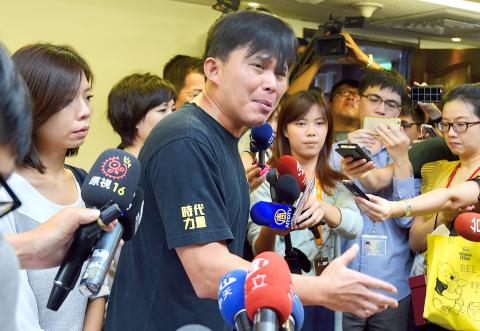
Photo: Chien Jung-fong, Taipei Times
NPP legislators sat quietly on the sidelines during an initial fracas between DPP and Chinese Nationalist Party (KMT) lawmakers at the opening of the meeting, but Huang made a start for the front of the room after Wu announced that his party’s resolution would not be considered and was visibly agitated afterward, shedding tears.
“I was absolutely shocked when [Wu] announced that she would not consider the motion,” Huang said. “It is unacceptable that she was not even willing to address such an important procedural question.”
“What right does [the DPP] have to refuse to deal with this?” he asked. “Does it think that the Legislative Yuan is a company it manages?”
The NPP’s motion called for the committee’s move to send draft amendments directly to cross-caucus negotiations to be invalidated, citing what was reportedly a mistake by co-convener Chen Ying (陳瑩) of the DPP in reading the sending resolution.
Rather than reading the sending resolution itself, Chen repeated the title and text of an earlier resolution, invalidating the vote, Huang said, adding that current meeting minutes falsely imply a unanimous agreement to the earlier resolution to cut off discussions.
“Today’s meeting was a shameless display, because they did not dare accept scrutiny,” he said.
“The issue now is not just about the DPP’s plans for a five-day workweek, the problem is the future direction of the legislature,” NPP caucus convener Hsu Yung-ming (徐永明) said. “Over the past two days, we have felt like we are in hell — not because of all the conflict, but because it appears that all of our efforts to push congressional reforms have been lost in a new vicious cycle.”
Opposition to allowing details of major legislation to be determined in “opaque cross-caucus negotiations” was a key plank of the NPP’s legislative platform, with the party advocating “committee-centric” reviews of bills to increase transparency.
In related news, prominent Sunflower movement leader Wang Yi-kai (王奕凱) attempted to storm the Legislative Yuan last night to protest the confirmation of the meeting minutes, but was swiftly intercepted by police, attracting a crowd of people in response to an online call to action.
Most of the crowd stood aside and watched as he charged down Jinan Road and attempted to use a ladder to scale the Legislative Yuan’s low eastern wall, but a handful of people joined him in a sit-in in the middle of the intersection of Zhongshan S and Jinan roads after he was released by police.
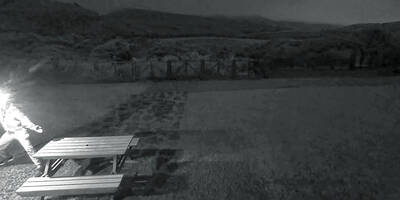
Yangmingshan National Park authorities yesterday urged visitors to respect public spaces and obey the law after a couple was caught on a camera livestream having sex at the park’s Qingtiangang (擎天崗) earlier in the day. The Shilin Police Precinct in Taipei said it has identified a suspect and his vehicle registration number, and would summon him for questioning. The case would be handled in accordance with public indecency charges, it added. The couple entered the park at about 11pm on Thursday and began fooling around by 1am yesterday, the police said, adding that the two were unaware of the park’s all-day live

A former soldier and an active-duty army officer were yesterday indicted for allegedly selling classified military training materials to a Chinese intelligence operative for a total of NT$79,440. The Taipei District Prosecutors’ Office indicted Chen Tai-yin (陳泰尹) and Lee Chun-ta (李俊達) for contravening the National Security Act (國家安全法) and the Anti-Corruption Act (貪污治罪條例). Chen left the military in September 2013 after serving alongside then-staff sergeant Lee, now an army lieutenant, at the 21st Artillery Command of the army’s Sixth Corps from 2011 to 2013, according to the indictment. Chen met a Chinese intelligence operative identified as “Wang” (王) through a friend in November

Minister of Digital Affairs Lin Yi-ching (林宜敬) yesterday cited regulatory issues and national security concerns as an expert said that Taiwan is among the few Asian regions without Starlink. Lin made the remarks on Facebook after funP Innovation Group chief executive officer Nathan Chiu (邱繼弘) on Friday said Taiwan and four other countries in Asia — China, North Korea, Afghanistan and Syria — have no access to Starlink. Starlink has become available in 166 countries worldwide, including Ukraine, Malaysia, the Philippines and Vietnam, in the six years since it became commercial, he said. While China and North Korea block Starlink, Syria is not
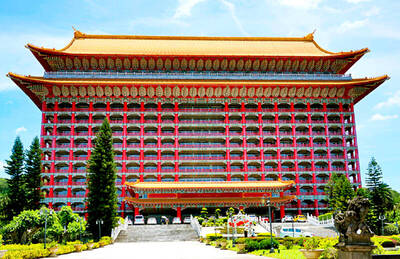
The Grand Hotel Taipei has rejected media reports claiming that the hotel had prevented CBS from broadcasting coverage of the Beijing summit between U.S. President Donald Trump and Chinese President Xi Jinping (習近平) on its premises. Media reports alleging that the hotel owner, dissatisfied with CBS’s coverage, prohibited the network from broadcasting political content on the hotel premises, are not true, the hotel said in a statement issued last night. The reports were “inconsistent with how the hotel actually handled the matter,” it said. The hotel said it received a refund request from a


 RSS
RSS