


President Tsai Ing-wen (蔡英文) yesterday announced plans to boost the nation’s international profile by increasing cooperation with the international community in the areas of disease control and medical aid, while encouraging students from Southeast Asian countries to receive medical training in Taiwan.
Tsai made the remarks in her speech at the two-day Global Health Forum in Taiwan, which has been jointly organized annually by the Ministry of Foreign Affairs and the Ministry of Health and Welfare since 2005 with the stated aim of increasing the nation’s international profile through its advances in medicine and public health.
Referring to the theme of this year’s forum, “Toward 2030,” Tsai laid out several goals for the nation, one of which is to step up its international cooperation.
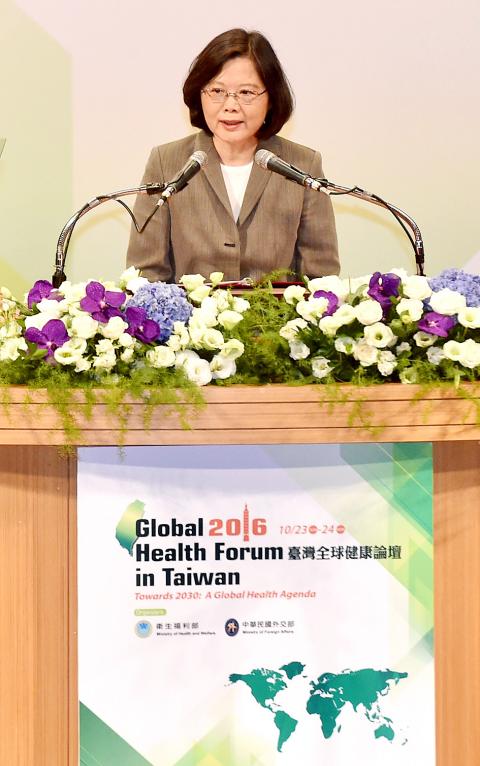
Photo: Chien Jung-fong, Taipei Times
“One can imagine that, in the world of 2030, there will be a lot more cross-border movement of people and goods. This means that communicable diseases will represent a bigger challenge. Accordingly, all nations bear a joint responsibility to share information and work hand-in-hand to fight against new types of communicable diseases,” she said.
Tsai said that as Taiwan has advanced healthcare capabilities and abundant experience in providing medical aid, the exclusion of the nation from the global health system would cause the “jigsaw puzzle” of worldwide disease control to miss a vital piece.
Taiwan is willing and able to make meaningful contributions to global healthcare and hopes to help other nations train health professionals, Tsai said.
“We encourage students from ASEAN and South Asia to come and receive medical training in Taiwan. This is one of the focal points of our ‘new southbound policy,’” Tsai said.
Tsai said her administration also intends to make Taiwan’s healthcare resources available to non-governmental organizations, in order to increase the nation’s presence in international humanitarian aid.
“Taiwan is ready. We strongly hope that all of you will support Taiwan’s participation in various international organizations,” Tsai said.
On the local front, Tsai said that as Taiwan is heading toward becoming a “super-aged” society, the government is working to integrate public and private resources and plans to launch the nation’s second 10-year long-term care plan, which aims at creating a comprehensive long-term care system that is accessible and affordable.
The president also pledged to build a more equitable national health system, achieve more efficient use of healthcare resources and improve care in distant areas and hospitals’ capabilities for patient referrals across administrative boundaries.

The Ministry of Finance this afternoon announced the winning numbers for the March-April uniform invoice lottery. The winning number for the NT$10 million (US$318,060) special prize is 19531471, and the winning number for the NT$2 million grand prize is 85941329. Three numbers were drawn for the NT$200,000 first prize: 07225810, 20231230 and 83518781. Those with receipts matching the last seven digits of any of the first-prize numbers will win the NT$40,000 second prize, while those matching the last six digits will win the NT$10,000 third prize. Those whose receipts match the last five digits of the first-prize numbers can claim the NT$4,000 fourth prize,

SIX SUBSIDIES: The monthly allowance for older farmers is to increase to NT$10,000, and NT$5,000 is to be given to homemakers under the national pension system, Lai said The government is to implement major welfare policies for disadvantaged groups, including raising the monthly allowance for older farmers to NT$10,000 and providing homemakers with NT$5,000 per month, President William Lai (賴清德) said yesterday. Lai made the remarks during a visit to Wangling Temple in Chiayi County, saying that the planned increases were being introduced amid economic growth and an increase in tax revenue. Touting a policy, in which the government plans to provide a monthly allowance of NT$5,000 for every child under the age of 18 in a bid to address Taiwan’s low birthrate, Lai said that if received for the
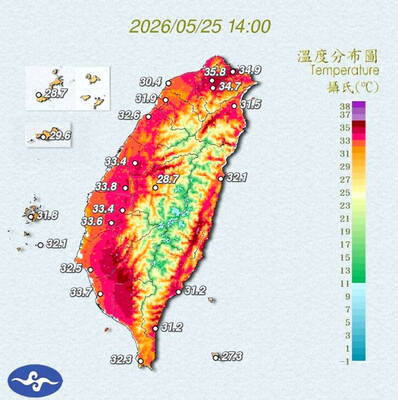
STAY COOL: The HPA recommended that people stay hydrated, use air-conditioning or fans while indoors, wear loose-fitting clothes and walk in the shade while outdoors Employers must implement measures such as installing cooling equipment, and providing drinking water and rest breaks for outdoor workers starting from Monday next week, the Taipei Department of Labor said on Sunday. Employers who fail to comply could face fines of NT$30,000 to NT$300,000 under the Occupational Safety and Health Act (職業安全衛生法), the department said. Businesses in Taipei employing fewer than 100 workers, as well as registered self-employed workers with labor insurance coverage, could receive on-site assessments and guidance from occupational safety consultants to help them apply for central government subsidies to implement or improve heat-protection measures, it said. Under the Ministry of
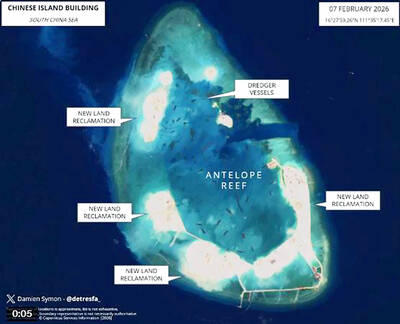
ISOLATION: The outposts would serve as support and backup bases, forcing US forces to either face China head-on or reroute, increasing travel time and operational costs China’s outposts in the South China Sea could be used to delay and constrain foreign forces during a conflict in the Taiwan Strait, giving Beijing a critical window to carry out amphibious landing and blockade operations, a report said. The Chinese Communist Party’s (CCP) forward operating bases on islands and reclaimed features in the South China Sea could delay foreign forces long enough for the Chinese People’s Liberation Army (PLA) to secure a key 48-to-72-hour window in the Taiwan Strait, a report commissioned by the Mainland Affairs Council found. The report, conducted by the Institute for National Defense and Security Research, examined


 RSS
RSS